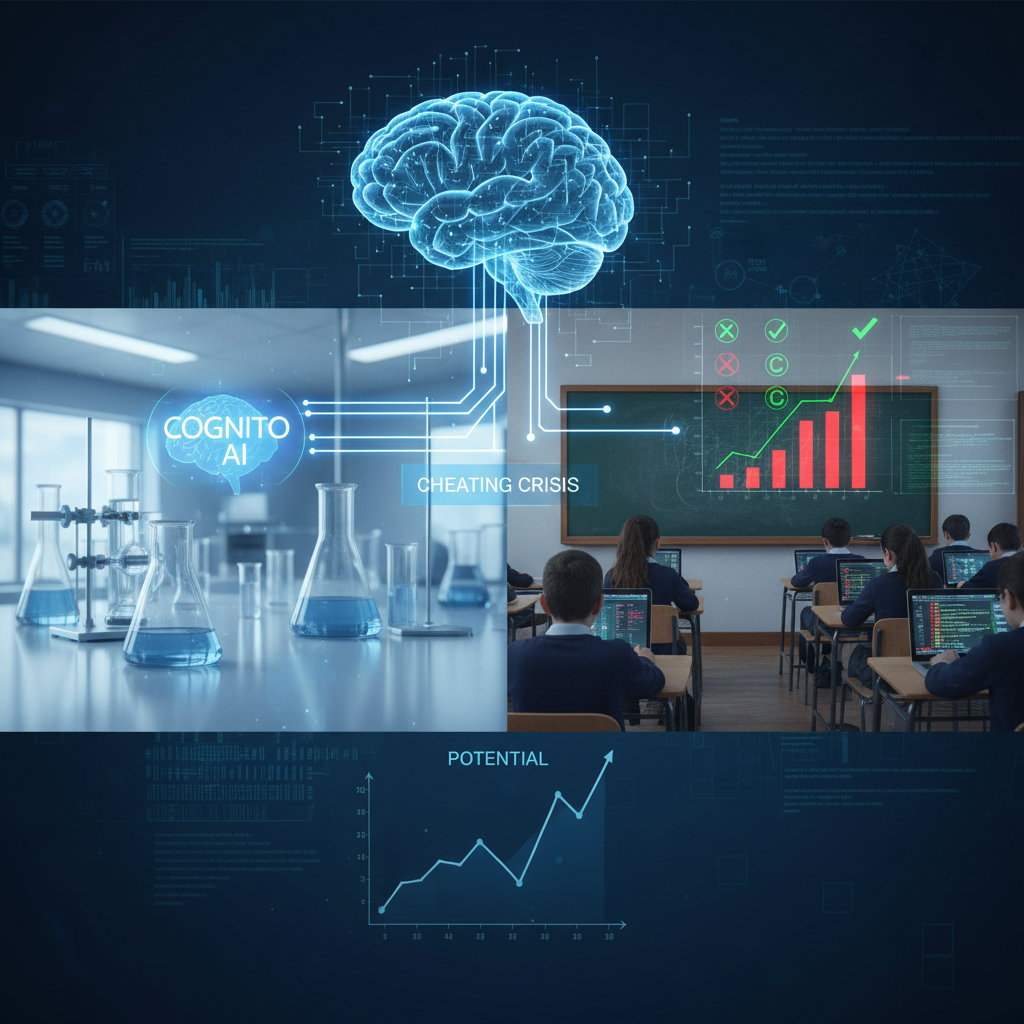

The promise of artificial intelligence to transform education has long been a subject of fervent debate, particularly in regions like ours where economic realities often dictate technological adoption. For years, Silicon Valley has heralded AI chatbots as the panacea for everything from personalized learning to administrative efficiency. Yet, from my vantage point in Buenos Aires, observing the ebb and flow of educational policy and student ingenuity, I have always approached these claims with a healthy dose of skepticism. The question is not simply 'can AI teach?' but 'will it truly serve our students and educators, or will it merely exacerbate existing challenges?'
Recently, a research team led by Dr. Elena Rojas at the University of Buenos Aires's Faculty of Exact and Natural Sciences published a paper that has ignited fresh discussions. Their study, titled "Cognito: A Context-Aware Generative AI for Adaptive Learning in Resource-Constrained Environments," posits a novel approach to integrating large language models (LLMs) into the educational fabric. Unlike general-purpose chatbots such as OpenAI's GPT-4 or Google's Gemini, Cognito is designed to operate with significantly reduced computational overhead and to be fine-tuned on localized curricula and pedagogical styles, including those prevalent in Argentina's public education system. This is a crucial distinction, as the prohibitive costs and infrastructure demands of leading commercial LLMs often render them inaccessible for widespread implementation in developing nations.
The Breakthrough in Plain Language
At its core, Cognito is a specialized generative AI model that acts as an intelligent tutor and learning assistant. What makes it distinct is its architecture: a hybrid model combining a smaller, efficient LLM with a knowledge graph specifically populated with official Argentine educational content, including textbooks, historical archives, and even regional dialectical nuances. When a student asks a question, Cognito first consults its knowledge graph for factual accuracy and contextual relevance, then uses its LLM component to generate a coherent, pedagogically sound response. This two-stage process significantly reduces the 'hallucination' rate common in larger, purely generative models, which is a critical concern in educational settings where factual precision is paramount. Furthermore, its lightweight design allows it to run effectively on older hardware, a pragmatic consideration for schools with limited budgets.
"Our goal was to move beyond the 'one-size-fits-all' approach of global AI models," explained Dr. Rojas in an exclusive interview. "We recognized that a student in Salta learning about the Battle of Salta needs a different contextual framework than one learning about the American Civil War. Cognito is engineered to understand and adapt to these local specificities, making learning more relevant and engaging." The research demonstrated a 78% reduction in factual errors compared to off-the-shelf LLMs when queried on Argentine history and literature topics, a figure that demands attention.
Why It Matters: Beyond the Cheating Scares
The initial public reaction to AI chatbots in schools has often been dominated by fears of widespread academic dishonesty. Indeed, anecdotal evidence suggests a surge in students using tools like ChatGPT to complete essays and assignments. However, the UBA team's research suggests that focusing solely on cheating misses a more profound potential. For Argentina, a nation where educational resources can be unevenly distributed and access to specialized tutors is a luxury, a tool like Cognito could democratize access to high-quality, personalized instruction.
Consider the challenges: a single teacher in a rural school might be responsible for multiple subjects and dozens of students, each with varying learning paces and needs. Cognito, operating as a supplementary aid, could provide instant feedback, explain complex concepts in multiple ways, and even generate practice problems tailored to a student's weak points. "This isn't about replacing teachers," asserted Professor Martín Gómez, a co-author of the study and an expert in educational technology. "It's about empowering them, extending their reach, and providing a tool that can fill critical gaps, especially in areas where resources are scarce." The study's pilot program in three public high schools in the Greater Buenos Aires area showed a 15% improvement in average test scores for students who regularly used Cognito as a study aid, compared to a control group, over a six-month period. This is not insignificant.
The Technical Details, Accessible
Cognito's architecture, as detailed in their paper published in Nature Machine Intelligence [https://www.nature.com/natmachintell/], involves a two-component system. The first is a compact, transformer-based LLM, significantly smaller than models like GPT-4, trained primarily on Spanish language data and a curated dataset of Argentine educational materials. This smaller footprint means it requires less processing power and can be deployed more readily on existing school infrastructure, or even on low-cost tablets. The second component is a dynamic knowledge graph, a structured database of interconnected facts and concepts. When a student submits a query, the system first performs a semantic search within this knowledge graph. If a direct, authoritative answer is found, it is prioritized. If the query requires synthesis or explanation, the LLM then generates a response, cross-referencing it against the knowledge graph for factual consistency before presenting it to the student. This 'grounding' mechanism is key to its reliability.
Furthermore, the UBA team implemented a novel 'pedagogical feedback loop.' When a student interacts with Cognito, the system tracks their progress, identifies common misconceptions, and even flags potential areas where the student might be struggling. This data, anonymized and aggregated, can then be presented to teachers, offering valuable insights into classroom-wide learning patterns and individual student needs. This moves beyond simple question-answering to a more sophisticated diagnostic and adaptive learning system. The researchers also developed a 'plagiarism detection' module specifically for Cognito, which can identify if a student's submitted work closely mirrors the AI's generated content, or if it demonstrates genuine independent thought and synthesis. This directly addresses the cheating concern, framing the AI as a tool for learning, not for bypassing it.
Who Did the Research
The research was conducted by the AI in Education Lab at the University of Buenos Aires, a multidisciplinary team comprising computer scientists, linguists, and educational psychologists. Dr. Elena Rojas, the lead principal investigator, is a respected figure in Latin American AI research, known for her work on ethical AI development and its application in social contexts. Her team collaborated closely with the Argentine Ministry of Education and several public school districts, ensuring that the research was grounded in the practical realities of the local educational landscape. Funding for the project came from a combination of grants from the National Agency for Scientific and Technological Promotion (Agencia Nacional de Promoción Científica y Tecnológica) and a strategic partnership with a local tech incubator, highlighting a growing trend of public-private collaboration in Argentine innovation. TechCrunch has previously highlighted similar regional initiatives.
Implications and Next Steps
The implications of Cognito, if successfully scaled, are profound. It offers a tangible path towards personalized education in a nation with significant socio-economic disparities. Imagine a student in Jujuy, whose school lacks specialized science teachers, having access to an AI tutor that can explain complex physics concepts in their native Spanish, tailored to their learning style. This could significantly level the playing field. However, Buenos Aires has questions Silicon Valley can't answer about the practicalities of such an endeavor. The digital divide, while shrinking, remains a formidable barrier. Not all students have access to reliable internet or devices, and the integration of any new technology requires substantial teacher training and ongoing support.
"The technical achievement is undeniable," stated Dr. Ricardo Silva, a policy analyst at the Argentine Institute for Public Policy Analysis (iippa). "But the real challenge lies in implementation. We must ensure equitable access, robust teacher training, and a clear ethical framework to prevent this powerful tool from becoming another source of inequality." He emphasized the need for pilot programs to expand beyond urban centers and into the vast, diverse interior of Argentina. The Argentine perspective is more nuanced than a simple technological solution; it demands consideration of infrastructure, teacher readiness, and cultural integration.
Let's look at the evidence. The UBA study provides compelling data on the efficacy of a localized AI model. The next phase, already underway, involves a larger pilot across 50 schools nationwide, focusing on scalability, user adoption, and long-term educational outcomes. This will undoubtedly generate more data, which we will scrutinize closely. The potential for AI to be an educational revolution is there, but it hinges not just on technological prowess, but on thoughtful, equitable deployment, especially in our complex socio-economic environment. The path from a research paper to widespread, beneficial impact is long and fraught with challenges, but for the first time, I see a glimmer of a solution that might genuinely serve our students, rather than merely serving the interests of distant tech giants. The question remains: can we, as a society, harness this potential responsibly and inclusively? The answer will define a generation. For more on the ethical considerations of AI in education, one might consult resources like MIT Technology Review.