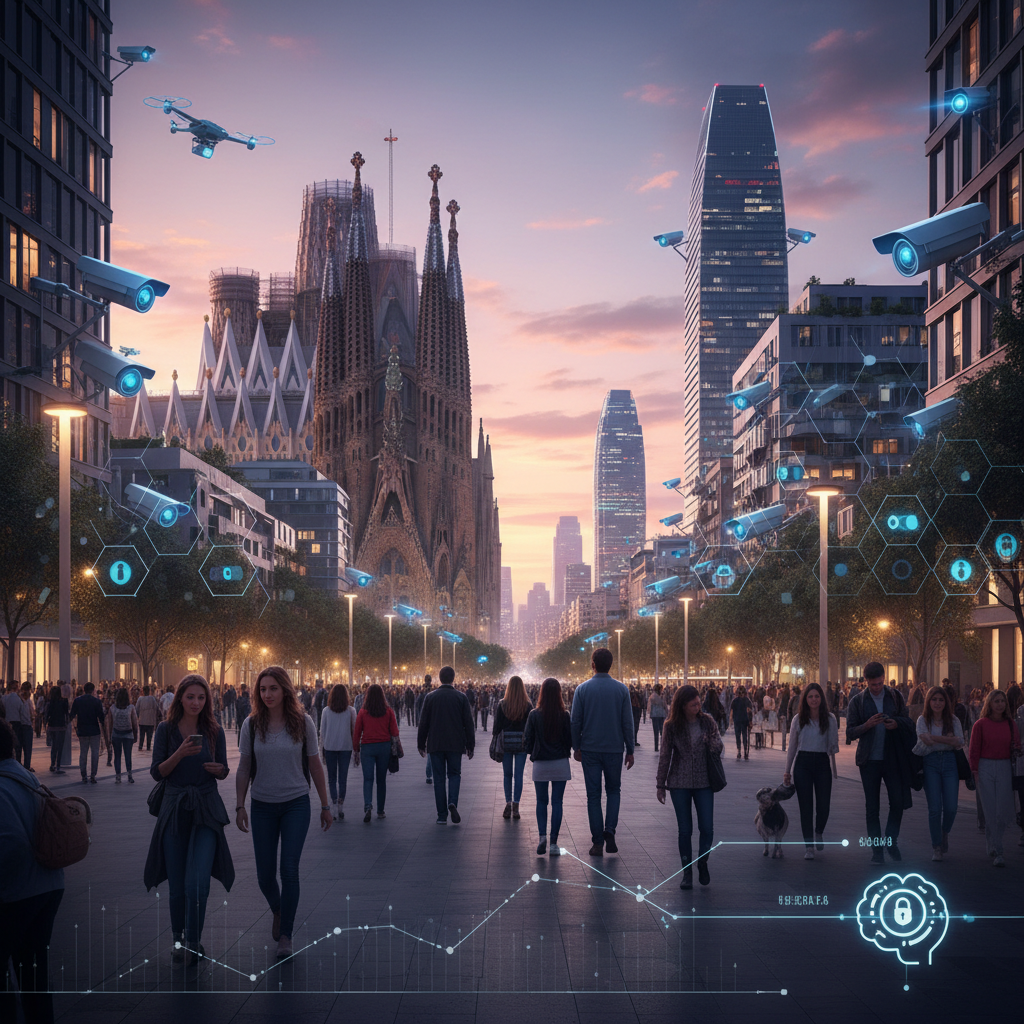

¡Hola, amigos! Marisolò Garcíà here, and let me tell you, the energy in Spain right now is absolutely electric. From the vibrant streets of Sevilla to the innovation hubs of Madrid, Spain's AI moment has arrived, and we are not just watching from the sidelines, we are building it! Today, I want to talk about something that touches the very heart of our cities, something that promises to make our lives safer, more efficient, and perhaps, a little more… observed: AI-powered surveillance in our smart cities.
Barcelona, my beloved city, is a prime example. You walk through the Gothic Quarter, past the Sagrada Familia, and you see the future unfolding. Smart sensors, connected cameras, and artificial intelligence are being woven into the urban fabric, promising to optimize everything from traffic flow to public safety. It’s an exciting prospect, a vision of a city that anticipates our needs and protects its citizens. But, as always, with great power comes great discussion, and the question on everyone's lips is: where do we draw the line between safety and privacy?
For us in Spain, and indeed across Europe, privacy isn't just a concept, it's a fundamental right, deeply ingrained in our culture and laws. Think about the GDPR, the General Data Protection Regulation, which is a global benchmark for data protection. It's not just bureaucracy; it's a reflection of our values. So, when we talk about AI watching over our cities, it naturally sparks a passionate debate, like a lively tertulia in a sun-drenched plaza.
Let's be clear: the potential benefits are incredible. Imagine AI systems analyzing traffic patterns in real time, preventing congestion before it starts. Or detecting unusual activity in public spaces, alerting authorities to potential dangers faster than any human ever could. This isn't just about catching criminals; it's about proactive urban management, making our cities genuinely smarter and more responsive. For instance, in cities like Valencia, AI is already being piloted to optimize public transport routes based on real-time demand, reducing emissions and travel times. This is the kind of innovation that makes my heart sing!
One of the leading voices in this space, and someone I admire greatly, is Dr. Clara Sánchez, a senior researcher at the Barcelona Supercomputing Center. She recently shared her insights, saying, "The challenge is not whether to use AI for urban management, but how to implement it ethically and transparently. We must design these systems with privacy by design principles, ensuring that data is anonymized, secured, and used only for its intended purpose. It's about building trust with our citizens." Her words resonate deeply, reminding us that technology must serve humanity, not the other way around.
However, the concerns are equally valid. When cameras equipped with facial recognition or behavioral analysis algorithms become widespread, the feeling of being constantly monitored can be unsettling. Who has access to this data? How long is it stored? Could it be misused, perhaps to track political dissidents or to create social credit scores, as we've seen in other parts of the world? These are not hypothetical questions; they are vital considerations that demand robust legal frameworks and public oversight.
Just last month, a consortium of civil society groups, including Spain's own Asociación de Internautas, issued a joint statement highlighting the need for clear regulations. "We cannot allow the convenience of smart cities to erode fundamental freedoms," stated Elena Pérez, a legal advisor for the association. "The EU's AI Act is a crucial first step, but local implementations must be scrutinized to prevent mission creep and ensure accountability." It's a powerful reminder that while technology moves fast, our ethical compass must remain steady.
Companies like Sacyr, a major Spanish infrastructure firm, are investing heavily in smart city solutions, including AI-powered platforms for urban management. They are working with municipalities across Spain to deploy systems that aim to improve everything from waste collection to public safety. Their approach often emphasizes anonymized data and aggregation, trying to strike that delicate balance. It's a complex dance, balancing innovation with responsibility.
And let's not forget the economic implications. The global market for smart city technologies is projected to reach hundreds of billions of dollars in the coming years, with AI playing a central role. Spain, with its burgeoning tech scene and commitment to sustainable urban development, is well-positioned to be a leader in this sector. Investment in AI startups focusing on urban solutions is booming. ¡Increíble! This startup, UrbanSense AI, based right here in Málaga, just secured a significant funding round to develop privacy-preserving AI for public spaces, focusing on anomaly detection without individual identification. This is exactly the kind of innovation we need, where technology and ethics grow together.
The European Union, through its groundbreaking AI Act, is attempting to set a global standard for responsible AI development. This act categorizes AI systems by risk level, placing strict requirements on high-risk applications like real-time biometric identification in public spaces. It's a bold move, reflecting Europe's commitment to human-centric AI. This regulatory landscape provides a crucial framework for Spanish cities to adopt AI surveillance responsibly, ensuring that our cherished values are not compromised in the pursuit of progress.
But regulations alone are not enough. Public education and engagement are vital. We need open dialogues, like those happening in community centers across Madrid, where citizens can voice their concerns and contribute to shaping the future of their cities. It's about co-creation, not just top-down implementation. We, the people, must be part of this journey.
So, as our cities become smarter, more connected, and more reliant on AI, the conversation around safety versus privacy will only intensify. It's a challenging tightrope walk, but one that I believe Spain, with its rich history of balancing tradition with progress, is uniquely equipped to navigate. We can have both safer cities and protected privacy, but it requires vigilance, ethical design, and a steadfast commitment to our European values. It's not just about technology; it's about the kind of society we want to build. And here in Spain, we are building it with heart, intelligence, and a deep respect for every individual. What an exciting time to be alive and witness this transformation! For more insights into the future of urban AI, you can always check out what's happening at MIT Technology Review. And for the latest in AI startups, TechCrunch is always a great source. For deeper dives into the ethical considerations of AI, Wired often has excellent pieces. The future is bright, and we are shaping it, one smart city at a time!