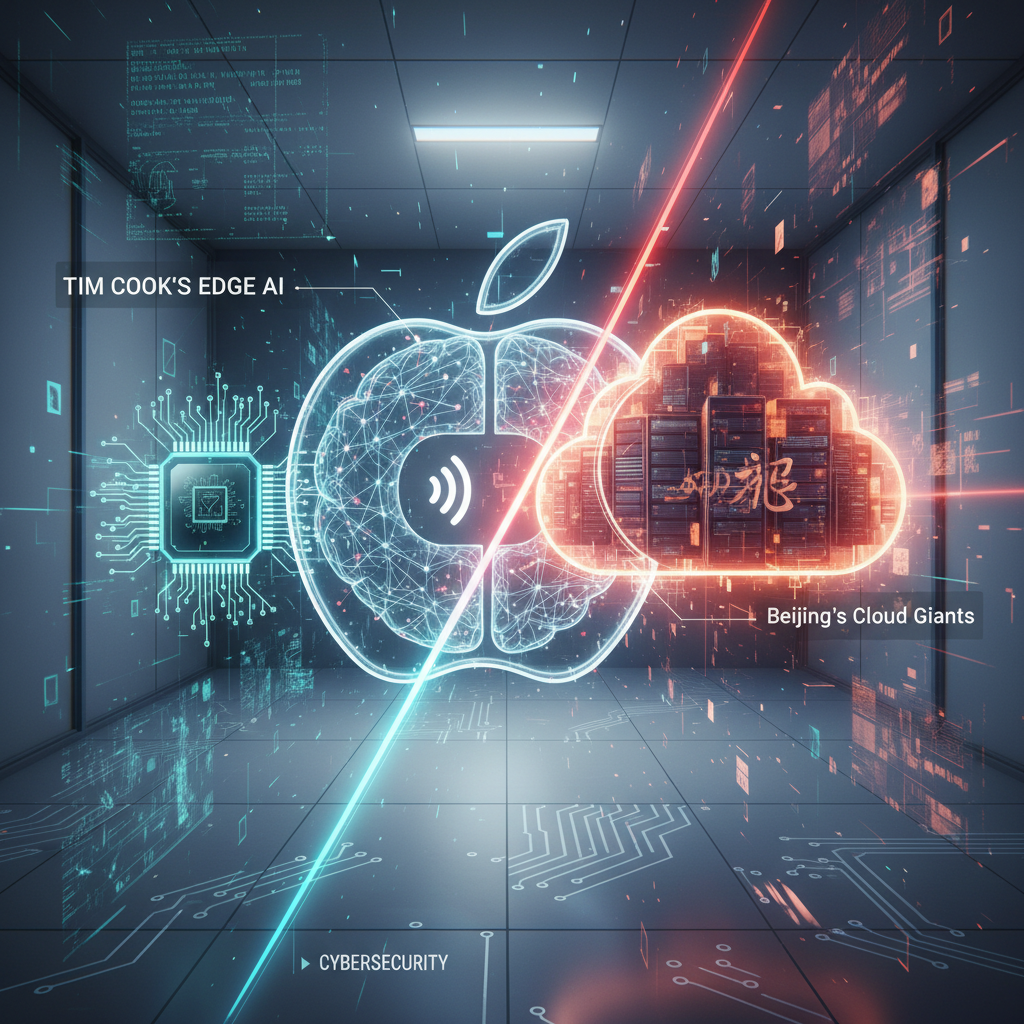

The air in Shenzhen crackles with more than just the hum of manufacturing lines, it vibrates with anticipation. Everyone here, from the factory floor to the high-rise offices of Tencent and Huawei, is watching Apple. Not just for the next iPhone, but for something far more foundational: the future of Siri.
For years, Apple’s digital assistant has been the subject of quiet derision, lagging behind the conversational prowess of Google Assistant and the generative capabilities of OpenAI’s ChatGPT. While competitors moved at breakneck speed, Siri often felt stuck in a time warp, a digital butler with a limited vocabulary. But whispers from Cupertino suggest a monumental overhaul is underway, a strategic pivot that could redefine Apple’s place in the AI race, particularly in markets like China.
The Breakthrough in Plain Language: On-Device Intelligence
The core of Apple's rumored strategy isn't just a bigger, smarter language model, that's almost a given. The real story is in the supply chain, and the shift towards on-device intelligence. Imagine an AI assistant that performs complex tasks, understands nuanced requests, and even generates creative content, all without constantly sending your data to a distant cloud server. This is the promise of on-device AI, and it’s a game-changer.
Traditionally, sophisticated AI models require immense computational power, usually housed in massive data centers. When you ask Siri a question, your voice is often sent to Apple’s servers, processed, and then the answer is sent back. This creates latency, privacy concerns, and a reliance on robust internet connectivity. On-device AI aims to bring much of that processing directly to your iPhone, iPad, or Mac, leveraging specialized neural engines embedded within Apple’’s custom silicon, like the A-series and M-series chips.
This isn't merely about speed; it's about sovereignty and privacy, two concepts that resonate deeply in China. If Siri can operate more autonomously on your device, it means less data leaving your phone, and theoretically, less exposure to surveillance or data breaches. For a market where data security and national control are paramount, this is a compelling proposition.
Why It Matters: A New Battlefield for AI Supremacy
This shift isn't just an engineering feat, it's a strategic gambit. Tim Cook and his team are not simply trying to make Siri 'better', they are attempting to redefine the playing field. While Google and OpenAI have invested billions in cloud infrastructure, Apple is doubling down on its integrated hardware and software ecosystem. It's a classic Apple move, leveraging its control over the entire stack.
“The move towards on-device AI is not just a technical evolution, it’s a philosophical one,” explained Dr. Li Wei, a senior researcher at the Chinese Academy of Sciences’ Institute of Automation. “It challenges the centralized cloud model that has dominated AI development. For countries like China, where data localization and control are critical, an AI that lives predominantly on the device offers a different paradigm, one that could be seen as more secure and less reliant on foreign cloud infrastructure.” Dr. Li’s insights highlight the geopolitical undercurrents of this technological race.
For Apple, it’s about regaining lost ground and differentiating itself. While ChatGPT and Google Gemini have captured headlines with their dazzling conversational abilities, their reliance on the cloud means they are inherently more vulnerable to network issues and regulatory scrutiny over data handling. An on-device Siri could offer a more seamless, private, and reliable experience, especially in regions with varying internet quality or strict data regulations.
The Technical Details: Beyond the Hype
The magic behind this on-device transformation lies in several key areas of research.
First, there's the advancement in model compression and quantization. Large language models (LLMs) are notoriously massive, often requiring hundreds of gigabytes of memory. Researchers, including those at Apple and institutions like Stanford University, have been working on techniques to shrink these models dramatically without significant loss of performance. This involves methods like pruning redundant connections in neural networks and quantizing the precision of the model’s weights from 32-bit floating points to 8-bit integers, or even lower. This makes them small enough to run efficiently on mobile processors.
Second, specialized neural processing units (NPUs) are crucial. Apple’s A-series and M-series chips are not just general-purpose CPUs, they include dedicated neural engines designed for high-speed, low-power AI computations. These engines are optimized for matrix multiplications, the fundamental operation of neural networks. This hardware advantage allows Apple to run complex AI models locally with remarkable efficiency.
Third, federated learning plays a role. While not strictly on-device processing for every task, federated learning allows models to be trained collaboratively across many devices without centralizing raw user data. This means Siri can learn and improve from user interactions while keeping sensitive information private on individual devices. This research, pioneered by Google and adopted by others, is key to developing robust on-device AI without compromising privacy. According to MIT Technology Review, federated learning is becoming an increasingly important tool for privacy-preserving AI development.
Fourth, sparse activation and mixture-of-experts (MoE) models are being explored. Instead of activating the entire large model for every query, MoE models only activate specific ‘expert’ sub-networks relevant to the task. This significantly reduces the computational load and energy consumption, making them ideal for constrained environments like mobile devices. Researchers at Google DeepMind and Meta AI have published extensively on these architectures, demonstrating their potential for efficiency.
Who Did the Research: A Collaborative Effort, With Apple at the Helm
While Apple is famously secretive about its internal research, the groundwork for on-device AI is a testament to years of academic and industry collaboration. Key contributions come from the broader AI research community.
Researchers at institutions like Carnegie Mellon University and the University of California, Berkeley, have been instrumental in developing efficient neural network architectures and compression techniques. Companies like Qualcomm and NVIDIA have also pushed the boundaries of edge AI hardware, though Apple’s integrated approach gives it a unique advantage.
Internally, Apple’s Ai/ml team, led by figures like John Giannandrea, has been quietly recruiting top talent and publishing papers on topics ranging from efficient inference to privacy-preserving machine learning. Their work, often presented at conferences like NeurIPS and Icml, showcases a deep commitment to making advanced AI run on their hardware. The company has also acquired several AI startups over the years, integrating their expertise into its ecosystem.
Implications and Next Steps: A High-Stakes Game for China
For China, Apple’s pivot has significant implications. The Chinese market is fiercely competitive, with local giants like Baidu, Alibaba, and Tencent investing heavily in their own AI ecosystems. Baidu’s Ernie Bot, for instance, has gained significant traction, leveraging its vast cloud infrastructure and deep understanding of Chinese language and culture. Alibaba Cloud and Tencent Cloud are also formidable players, offering robust AI services.
However, Beijing isn't saying this publicly, but the appeal of an AI that keeps data local, within the device, aligns with China's increasingly stringent data sovereignty laws. If Apple can deliver a truly intelligent, private, and locally processed Siri, it could carve out a unique niche, appealing to consumers and potentially even regulators who are wary of data flowing freely across borders.
“The challenge for Apple in China is not just technological parity, but cultural relevance,” noted Wang Jian, a tech analyst based in Shanghai. “Chinese consumers are accustomed to a highly integrated digital life, where services like WeChat and Alipay handle everything. Siri needs to go beyond simple commands and integrate deeply with local services and user habits.” This highlights that while the technology is global, its application must be local.
The next steps for Apple involve not just refining the technology but also a massive marketing and developer push. They need to convince developers to build for this new, more powerful on-device Siri, and they need to convince consumers that it offers a tangible advantage over the cloud-based alternatives. This will likely involve new APIs and development tools, making it easier for Chinese developers to integrate their apps with a smarter, more private Siri.
The race for AI supremacy is far from over. While Google and OpenAI have dominated the cloud, Apple’s strategic shift to on-device intelligence could open a new front, one where its integrated hardware and software ecosystem gives it a powerful advantage. For China, it represents another fascinating chapter in the global tech rivalry, and an opportunity to see how a privacy-first AI might fare in a market that often prioritizes convenience and integration. We must connect the dots between hardware, software, and geopolitics to truly understand the future of AI. For more insights into how companies are navigating this complex landscape, you can follow developments on TechCrunch's AI section.
This isn't just about Siri anymore; it's about the very architecture of artificial intelligence and who controls its future.