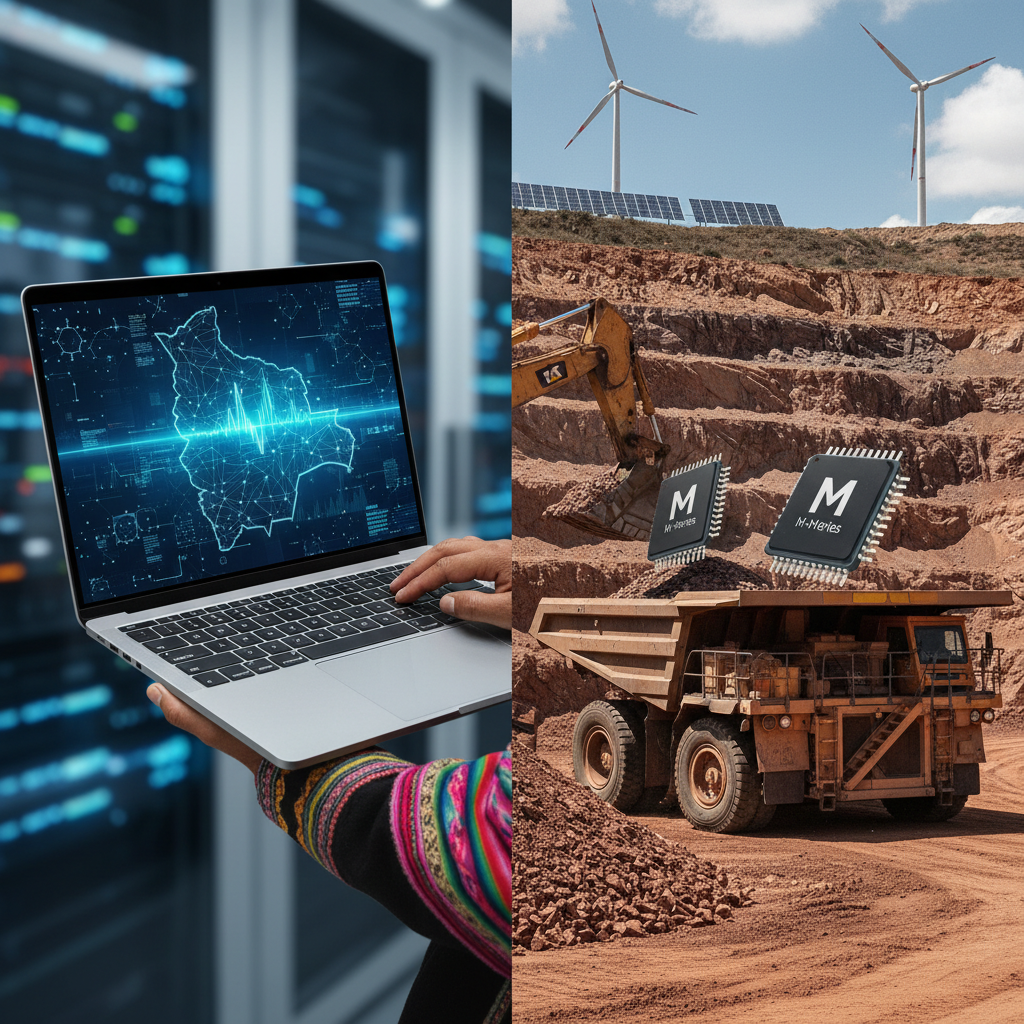
The global conversation around artificial intelligence often fixates on the colossal cloud data centers, the energy hungry GPU farms, and the internet connectivity that underpins it all. Yet, a quieter, equally significant revolution is unfolding: the democratization of AI through powerful, on-device processing. At the forefront of this shift is Apple, with its M-series processors, which are increasingly enabling sophisticated AI models to run directly on personal devices, far from the bustling server rooms of Silicon Valley.
For us in Bolivia, this development is not merely a technical curiosity; it is a point of profound contemplation. Our nation, perched at the altitude of innovation, faces unique infrastructural realities. Reliable, high-speed internet access remains a luxury in many regions, particularly outside the major urban centers like La Paz or Santa Cruz. The promise of local AI, therefore, resonates deeply. If advanced AI capabilities can function without constant reliance on a robust internet connection, the potential for applications in remote communities, in agriculture, or even in our burgeoning lithium industry, becomes tangible.
Apple's M-series chips, first introduced in late 2020, have consistently pushed the boundaries of integrated performance and power efficiency. With each iteration, from the M1 to the latest M4, the neural engine, a dedicated component for accelerating machine learning tasks, has seen substantial gains. The M4, for instance, boasts a 16-core neural engine capable of 38 trillion operations per second (tops), a figure that rivals and often surpasses the capabilities of many dedicated AI accelerators found in larger, more power-intensive systems. This allows for complex tasks such as real-time language translation, advanced image recognition, and even local large language model (LLM) inference to occur directly on a MacBook or iPad, without sending data to the cloud.
This on-device processing capability has several implications. First, it enhances privacy, as sensitive data never leaves the user's device. Second, it reduces latency, making AI applications feel more responsive. Third, and perhaps most critically for regions like ours, it lowers the barrier to entry for advanced AI use cases where internet infrastructure is nascent or unreliable. Imagine a farmer in the Altiplano using an iPad to diagnose crop diseases through local image analysis, or a geologist in the Salar de Uyuni employing an M-series powered device for real-time mineral analysis, all without needing a stable satellite connection.
However, the path from technological promise to practical implementation in Bolivia is rarely straightforward. The cost of Apple's premium devices, while justified by their performance for many, remains a significant hurdle for widespread adoption. The average per capita income in Bolivia, while growing, still places these devices out of reach for a large segment of the population. Furthermore, the ecosystem of developers capable of building and deploying AI solutions specifically tailored for Bolivian contexts on these platforms is still nascent. Bolivia's challenges require Bolivian solutions, and those solutions need to be built by Bolivians.
Dr. Elena Rojas, a leading researcher in computational linguistics at the Universidad Mayor de San Andrés in La Paz, emphasized this point recently. “The hardware is impressive, undoubtedly,” she stated, “but the true impact will come when we can develop culturally relevant AI applications that address our specific needs. This means investing in local talent, in education, and in fostering an environment where our engineers can innovate on these powerful platforms.” Her perspective underscores that technology, no matter how advanced, is merely a tool; its utility is defined by the hands that wield it and the problems it is designed to solve.
The global tech giants are certainly taking notice of the on-device AI trend. Google, for example, has been pushing its Gemini Nano model for on-device applications on Android devices, and Qualcomm is heavily investing in its Snapdragon platforms for similar capabilities. Microsoft is also integrating AI acceleration into its Windows ecosystem with Copilot, leveraging specialized silicon. This competitive landscape suggests that on-device AI is not a fleeting trend but a fundamental shift in how AI will be deployed and consumed globally. According to a recent report from Reuters, the market for edge AI hardware is projected to grow significantly, indicating a broader industry pivot.
Yet, the question remains: how does Bolivia position itself not just as a consumer, but as a contributor to this future? We hold a critical piece of the puzzle: lithium, the essential component for the batteries that power these very devices. As the world transitions to an electrified, AI-driven future, our strategic importance grows. We must leverage this position to demand more than just raw material extraction; we must seek partnerships that foster technology transfer, local manufacturing, and the development of our own AI capabilities. This is not about being given solutions; it is about building them ourselves, using the best tools available.
Tim Cook, Apple's CEO, has repeatedly spoken about the company's commitment to privacy and performance, values that are intrinsically linked to on-device AI. While his statements are often framed through the lens of consumer experience in developed markets, the implications for regions with limited infrastructure are profound. The ability to run sophisticated AI models locally could bypass many of the connectivity limitations that have historically hindered digital transformation in places like Bolivia. This could be a game-changer for educational initiatives, healthcare delivery, and even public safety in remote areas, where a reliable internet connection is often a luxury.
Let's talk about what actually works at 4,000 meters. It is not always the latest cloud-based solution that requires gigabit internet. Often, it is robust, self-contained technology that can withstand harsh conditions and operate independently. Apple's M-series chips, with their impressive performance-per-watt ratio and integrated design, offer a compelling argument for such a paradigm. They represent a potential pathway to bringing advanced computational power to places where it is most needed, but least accessible through traditional means. The challenge for us is to harness this potential, to adapt it to our realities, and to build the human capital necessary to truly benefit from it. The global AI race is not just about who builds the biggest models, but who can make them work effectively, everywhere. This includes the high plains of Bolivia, where ingenuity often thrives out of necessity. For more insights into the broader AI landscape, one might consult MIT Technology Review.
The integration of AI into everyday devices, driven by powerful chips like Apple's M-series, marks a significant inflection point. For a country like Bolivia, it offers a chance to leapfrog some traditional development hurdles, provided we approach it with a clear strategy. We must prioritize education in AI and software development, incentivize local innovation, and strategically position ourselves in the global supply chain beyond raw materials. Only then can we truly leverage these technological advancements to build a more prosperous and digitally empowered future for all Bolivians. The future of AI is not just in the cloud; it is also, increasingly, in the palm of our hands, and that makes it far more accessible for everyone, everywhere.