The air in São Paulo, thick with the hum of innovation and the ever-present scent of coffee, often feels like a world away from the manicured campuses of Silicon Valley. Yet, the decisions made in those distant labs profoundly shape our digital landscape here in Brazil. Today, I want to talk about a philosophical divide that, to me, feels as stark as the difference between our vibrant street markets and a sterile corporate boardroom: the contrasting approaches of Anthropic and OpenAI to AI development.
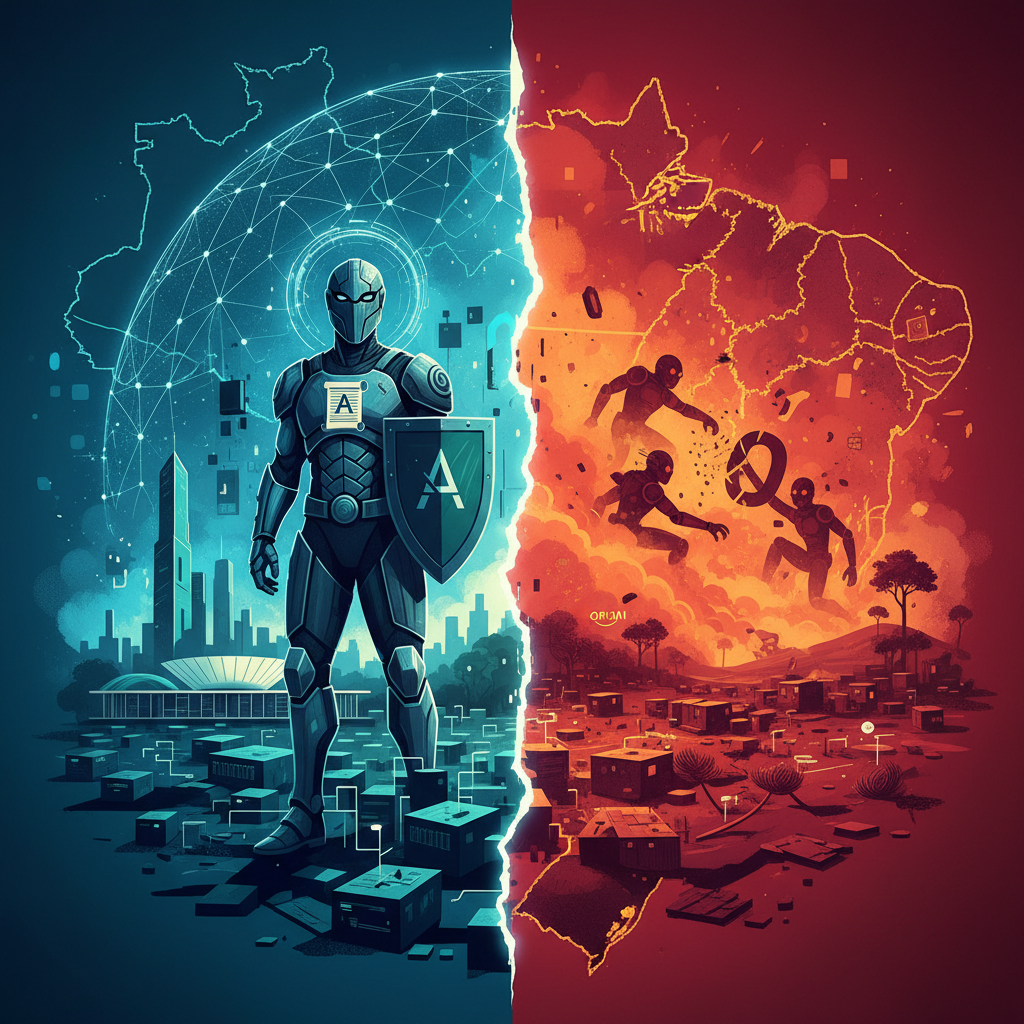
OpenAI, with its rapid releases and 'move fast and break things' ethos, has captured the world's imagination. From ChatGPT to Sora, their innovations are undeniably breathtaking. They push the boundaries of what is possible, often launching models into the public sphere with a certain daring, a belief that widespread exposure will help iron out the kinks. It is like a brilliant samba dancer, improvising with dazzling speed, sometimes stumbling, but always captivating the crowd. Their approach, championed by figures like Sam Altman, seems to prioritize capability and accessibility, letting the market and public interaction guide the evolution of safety features.
On the other side, we have Anthropic, founded by former OpenAI researchers Dario and Daniela Amodei. Their philosophy, centered on 'Constitutional AI' and a deep commitment to safety, feels almost like a counter-cultural movement in the hyper-competitive AI race. They are the meticulous architects, carefully planning every beam and pillar of a skyscraper before the first brick is laid. They are not just building powerful models; they are trying to instill a moral compass, a set of principles, directly into the AI's training process. As Dario Amodei himself stated in an interview, "We are trying to build systems that are helpful, harmless, and honest, and that requires a different approach than just scaling up models." This commitment to foundational safety, while perhaps less flashy, speaks volumes about their long-term vision.
From my vantage point in Brazil, this isn't just an academic debate or a corporate rivalry. It is a fundamental question about how we, as a society, want these powerful tools to be built and deployed. OpenAI's approach, while accelerating progress, also carries inherent risks. The rapid deployment of models that can 'hallucinate' or generate biased content, even if unintentional, can have severe consequences, particularly in contexts where digital literacy is still developing or where misinformation can easily spread. Imagine an AI system advising on public health in a remote Amazonian community, or interpreting legal texts in a complex Brazilian court case. The stakes are incredibly high.
Anthropic's 'Constitutional AI' offers a different paradigm. Instead of just fine-tuning models with human feedback, they use AI itself to supervise and refine the behavior of other AIs based on a set of human-articulated principles. It is an attempt to bake ethical guardrails directly into the system, making the AI align with human values from the ground up, rather than patching problems after they emerge. This method, while more computationally intensive and potentially slower to yield results, promises a more robust and trustworthy foundation. For a country like Brazil, grappling with its own unique socio-economic challenges, having AI systems that are inherently designed for safety and fairness is not a luxury, it is a necessity.
I often hear the counterargument: "But Luciànò, if we wait for perfect safety, we will fall behind!" Or, "The market will self-correct, and open source models will democratize access anyway." I understand this sentiment. Brazil's developer community is massive and talented, and many here are eager to leverage the latest tools. However, the code tells the real story. The architecture of these systems, the very principles embedded during their creation, will dictate their long-term behavior. A system built with a primary directive to maximize utility, with safety as an afterthought, will behave differently from one where safety is a core, architectural component.
Consider the analogy of building a bridge across the Amazon River. OpenAI might be the team that quickly constructs a functional, impressive bridge, perhaps with some innovative shortcuts, and then figures out how to reinforce it against the powerful currents and diverse traffic after it is already in use. Anthropic, on the other hand, would spend years studying the riverbed, the water flow, the local ecosystem, and the long-term impact on communities, designing a bridge that is not only strong but also harmonizes with its environment, built to last for generations. Which bridge would you trust more with the lives and livelihoods of millions?
For me, the choice is clear. While OpenAI's dynamism is compelling, Anthropic's cautious, principled approach resonates more deeply with the kind of future I believe we should be building, especially in diverse and complex societies like ours. The emphasis on transparency, interpretability, and verifiable safety is crucial. We need AI that serves humanity, not just accelerates technological progress for its own sake. The risks of unchecked AI development, from algorithmic bias exacerbating social inequalities to autonomous systems making critical decisions without human oversight, are too great to ignore. We have seen how quickly digital tools can be misused, and the potential for AI to amplify these harms is immense.
Companies like Anthropic are not just building models, they are building a philosophy. They are demonstrating that it is possible to pursue advanced AI while prioritizing ethical considerations from the outset. This is a lesson that should be heeded globally, and especially here in Brazil, as we integrate these powerful technologies into every facet of our lives. We must demand that the AI systems we adopt are not just powerful, but also safe, fair, and aligned with our values. The future of our digital sovereignty, and indeed our societal well-being, may well depend on it. For more on the ethical considerations in AI, you might find articles on MIT Technology Review insightful, or explore the research papers on arXiv for a deeper dive into the technical aspects of these approaches. The conversation about responsible AI development is just beginning, and Brazil must be an active, vocal participant in shaping its trajectory.