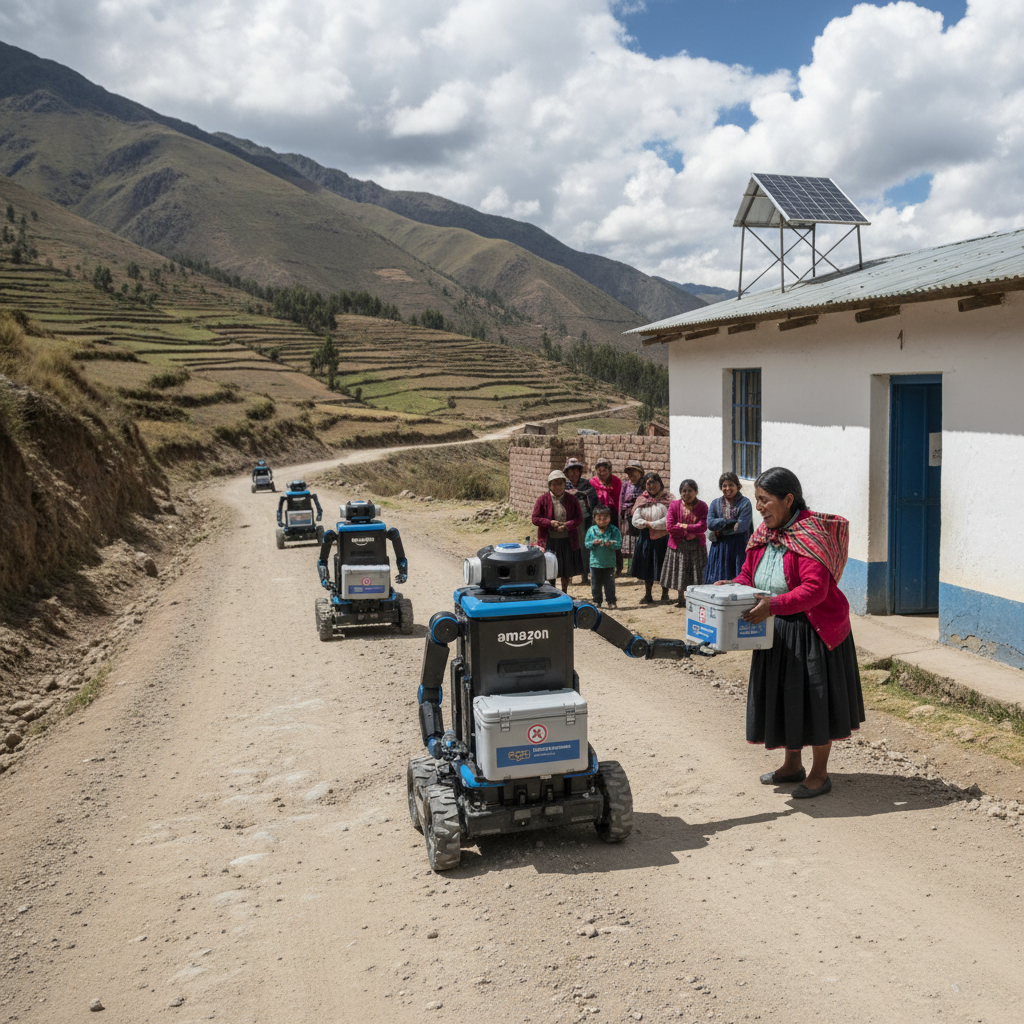

The hum of a thousand tiny motors, the precise dance of robotic arms, and the silent whir of AI algorithms orchestrating it all. This is the new reality inside Amazon's burgeoning logistics network, a revolution that promises unparalleled efficiency and speed. For much of the world, this is a marvel of modern engineering, a testament to what artificial intelligence can achieve. But here in Peru, a land steeped in ancient traditions and complex geographies, the arrival of such a force sparks a different kind of conversation, one that weaves through our history, our communities, and our future.
Amazon, under the leadership of CEO Andy Jassy, has been aggressively expanding its AI and robotics capabilities across its fulfillment centers globally. Reports suggest that by 2026, over 75% of Amazon's package sorting and handling operations in major hubs will be fully automated, driven by advanced machine learning models that predict demand, optimize routes, and manage inventory with astonishing accuracy. This isn't just about speed; it is about a fundamental reimagining of how goods move from producer to consumer. The company’s investments in robotics, like its Proteus autonomous mobile robots and Sparrow picking arms, are not just futuristic concepts; they are operational realities in many countries, promising to cut costs and delivery times dramatically. Reuters recently highlighted how these systems are pushing the boundaries of what is possible in e-commerce logistics.
But what does this mean for a place like Peru? Our country, with its diverse landscapes ranging from the arid coast to the towering Andes and the dense Amazon rainforest, presents unique logistical challenges. For centuries, our communities, particularly those in the highlands of Peru, have relied on intricate, often human-powered, supply chains. Think of the arrieros, the muleteers who traverse treacherous mountain paths, or the small family businesses that connect remote villages to city markets. These are not just economic links; they are cultural arteries.
“The efficiency Amazon brings is undeniable, but we must ask at what cost to our existing social and economic fabric,” says Dr. Elena Vargas, a sociologist at the Pontificia Universidad Católica del Perú, whom I spoke with in her bustling Miraflores office. “We have a rich history of community-based trade. How do these hyper-efficient, AI-driven systems integrate without displacing people and knowledge that have sustained us for generations?” Her concern is echoed by many who fear that while the promise of faster delivery sounds appealing, the underlying shift could erode local livelihoods.
Consider the mercados of Cusco or Arequipa, vibrant hubs where farmers bring their produce directly to consumers. The idea of a drone delivering a package to a remote Andean village, while technologically impressive, bypasses this vital human interaction. It replaces the local vendor, the small transporter, and the community connection with an algorithm and a machine. This is where the tension lies: between the undeniable allure of global efficiency and the deeply rooted value of local resilience.
I recently visited a small cooperative in the Sacred Valley, where farmers are experimenting with blockchain to trace their quinoa from field to table, ensuring fair prices and authenticity. Their system, while not as flashy as Amazon's robotics, is built on trust and transparency, values that have been central to Andean commerce for millennia. One of the cooperative leaders, Mateo Quispe, a man whose hands bore the marks of a lifetime spent working the land, shared his thoughts with me. “We have always found ways to get our goods to market, even in difficult terrain,” he said, gesturing towards the terraced fields. “Our way is slower, perhaps, but it keeps our community strong. We know the people who buy our quinoa, and they know us. Can a robot know that?” His question lingered in the crisp mountain air.
Amazon's expansion in South America, particularly in Brazil and Colombia, has already provided a glimpse into its potential impact. In these markets, the company has invested heavily in fulfillment centers and last-mile delivery solutions, often leveraging local partnerships. The data shows significant improvements in delivery times and customer satisfaction in urban centers. For instance, in São Paulo, Amazon reported a 30% reduction in average delivery times for Prime members after implementing new AI-driven sorting systems in 2025. This kind of data makes a compelling case for efficiency.
However, the Peruvian context is distinct. Our infrastructure, particularly outside Lima, is less developed. The sheer geographical diversity, from the Amazon basin's waterways to the high-altitude mountain passes, requires solutions that are adaptable and resilient. This is where the conversation shifts from mere logistics to cultural integration. Can Amazon's AI learn from the ingenuity of the qapaq ñan, the ancient Inca road system that connected an empire, or the chasquis, the swift messengers who carried information across vast distances? This is a story about ancient wisdom meeting modern AI.
“The key is not to resist innovation, but to shape it,” offered Dr. Sofia Rojas, an expert in indigenous technologies at the Ministry of Culture. “We need to ensure that these powerful technologies serve our people, not just global corporate interests. We have an opportunity to demand that AI systems are designed with local context in mind, perhaps even incorporating indigenous knowledge of our unique landscapes and communities.” She showed me something that changed my understanding: a digital map developed by an indigenous community in the Amazon, using satellite imagery and local knowledge to track deforestation and illegal mining. It was a powerful example of technology empowering local voices.
Indeed, some local tech entrepreneurs are already exploring hybrid models. A startup in Lima, 'Andean Connect,' is developing an AI-powered platform that optimizes routes for small, independent delivery services, allowing them to compete more effectively with larger players. Their system takes into account local road conditions, community events, and even traditional market days, things a generic global algorithm might overlook. “We are building technology that understands Peru,” explained Ricardo Morales, Andean Connect’s CEO. “Our AI learns from the local context, from the rhythms of our cities and towns, not just from abstract data points.”
The economic implications are vast. While Amazon's robotics might create new jobs in maintenance and data analysis, they also risk displacing traditional labor. A recent report by the Instituto Nacional de Estadística e Informática (inei) projected that a full-scale automation of logistics in Peru could impact up to 150,000 jobs in the transportation and warehousing sectors over the next decade, with a disproportionate effect on informal workers. This necessitates proactive measures, including retraining programs and social safety nets, to ensure a just transition.
Ultimately, Amazon's AI-powered logistics revolution in Peru is not just a technological story; it is a human one. It is about how a global giant navigates a land rich in history and culture, and how Peruvians respond to this powerful wave of automation. Can we harness the efficiency of AI while preserving the invaluable human connections that define our commerce and communities? The answer will depend on our ability to engage, adapt, and insist that technology serves the unique spirit of our nation. The future of delivery here might involve robots, but it must also involve the heart of Peru. Wired often explores these complex societal impacts of AI, reminding us that technology is never neutral.