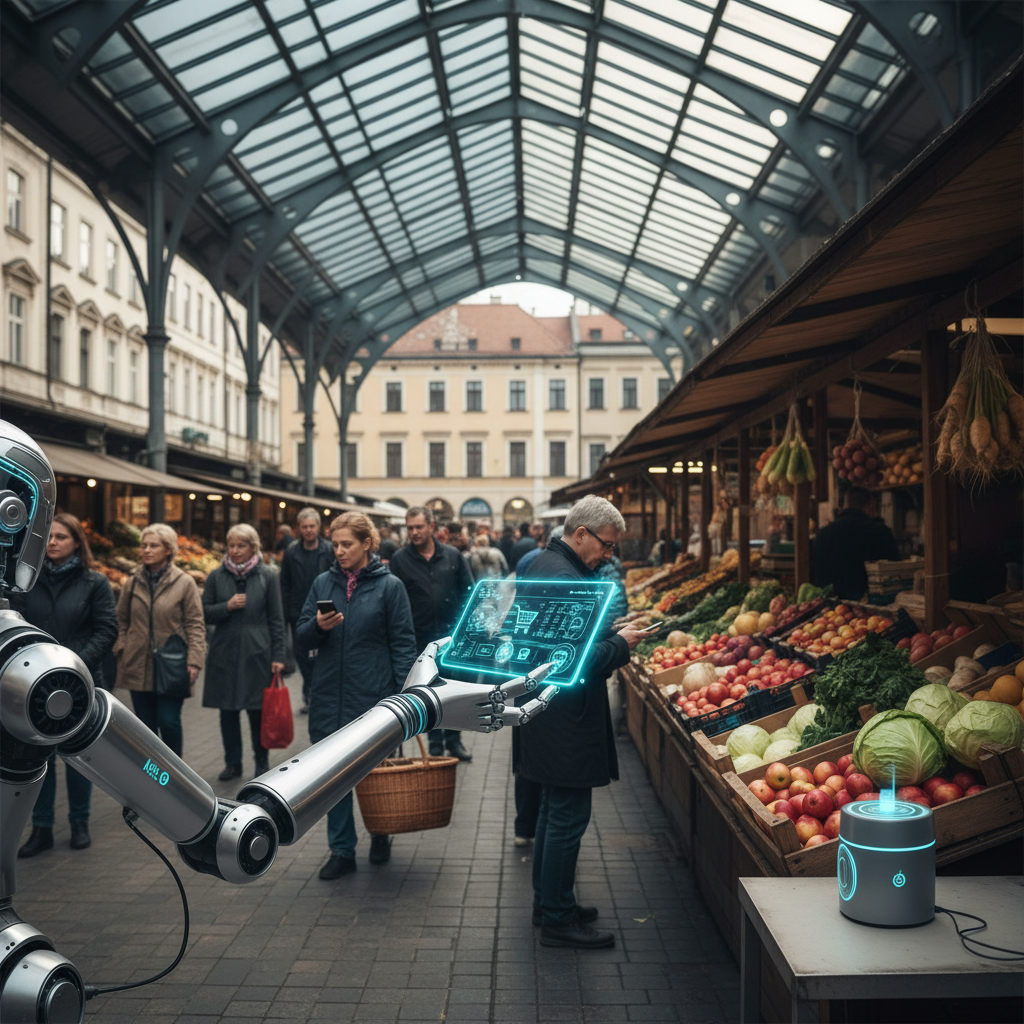

The bustling energy of Kraków's Stary Kleparz market, with its vendors calling out daily specials and the tactile experience of selecting fresh produce, represents a deeply human form of commerce. Yet, in the digital realm, Amazon is striving to replicate this intuitive, personalized interaction on a global scale, not with human vendors, but with sophisticated artificial intelligence. Its AI shopping assistants are no longer merely suggesting items you might like; they are becoming proactive digital concierges, anticipating your needs before you even articulate them. This shift from reactive recommendation to predictive personalization is a monumental leap, fundamentally altering the landscape of e-commerce.
From a systems perspective, this evolution is driven by an intricate orchestration of machine learning models, vast datasets, and real-time processing capabilities. It is a technological symphony designed to understand the consumer with unprecedented depth, mirroring the way a seasoned market stall owner might intuitively know a regular customer's preferences. But how, precisely, does this digital intuition operate? Let us peel back the layers of this algorithmic bazaar.
The Big Picture: Anticipating Desire, Not Just Fulfilling It
At its core, Amazon's AI shopping assistant aims to create a hyper-personalized shopping journey. Imagine you are planning a weekend trip to the Polish mountains. Instead of searching for 'hiking boots' and then 'waterproof jacket', the assistant might proactively suggest a complete gear list, including a specific brand of thermal socks popular in the Tatras, a high-capacity power bank, and even a local guide book. This is not just about convenience; it is about anticipating the entire context of your purchase intent. The system moves beyond simple collaborative filtering, which suggests items based on what similar users bought, to a more holistic understanding of individual lifestyle, past behaviors, and even external factors like weather forecasts or upcoming events.
This proactive approach is a significant departure from the early days of e-commerce, which relied on rudimentary 'customers who bought this also bought that' algorithms. Today, the ambition is to create a seamless, almost prescient shopping experience, reducing friction and increasing conversion rates. It is a digital equivalent of having a personal shopper who knows your wardrobe, your hobbies, and your upcoming calendar, all without ever speaking to you directly.
The Building Blocks: A Symphony of Data and Algorithms
To achieve this level of personalization, Amazon employs a multi-faceted AI architecture. Think of it as constructing a magnificent Polish castle, where each tower, wall, and courtyard serves a distinct, yet interconnected, purpose. The primary components include:
-
Data Ingestion and Feature Engineering: This is the foundation. Every click, search query, purchase, return, product view, and even cursor hover is meticulously recorded. Beyond direct interactions, the system incorporates external data points such as geographical location, time of day, device type, local weather, trending news, and even social media sentiment. Feature engineering transforms this raw data into meaningful signals for machine learning models. For instance, 'time spent on product page' is a more potent feature than just 'product page view'.
-
User Profiling and Segmentation: Advanced clustering algorithms categorize users into dynamic segments based on their behavioral patterns, demographic inferences, and psychographic traits. A user might be simultaneously part of a 'tech enthusiast' segment, a 'young parent' segment, and a 'sustainable shopper' segment. These profiles are not static; they evolve with every interaction.
-
Recommendation Engines: This is where the magic often appears to happen. Modern recommendation systems are far more complex than their predecessors. They leverage a combination of techniques:
- Content-Based Filtering: Recommends items similar to those a user has liked in the past, based on item attributes (e.g., if you bought a book on Polish history, it suggests other books on Polish history).
- Collaborative Filtering: Identifies users with similar tastes and recommends items liked by those 'neighbors' (e.g., if users similar to you bought a specific brand of coffee, it suggests that coffee).
- Deep Learning Models: Neural networks, particularly transformer architectures, are increasingly used to understand complex sequential patterns in user behavior and product relationships. These models can capture subtle nuances, like recommending a specific type of camera lens after you have browsed several camera bodies, even if no one else has made that exact sequence of purchases.
- Reinforcement Learning: This enables the system to learn from its own recommendations. If a recommendation leads to a purchase, the model is 'rewarded', reinforcing that behavior. If it leads to no interaction, it is 'penalized'. This continuous feedback loop refines the assistant's effectiveness over time.
-
Natural Language Processing (NLP) and Understanding (NLU): For voice assistants like Alexa, or text-based chat interfaces, robust NLP is crucial. This allows the AI to understand complex, colloquial queries, disambiguate intent, and extract entities. For example, understanding that 'I need something for a cold evening in Zakopane' implies warm clothing, possibly wool, and suitable for mountain temperatures.
-
Contextual Awareness Engine: This orchestrates all the above. It integrates real-time data streams, user profiles, and recommendation outputs to deliver timely and relevant suggestions. This engine considers the current session, recent searches, items in the cart, and even external factors to provide contextually appropriate recommendations.
Step by Step: How the Assistant Works from Input to Output
Let us trace a typical interaction with this sophisticated system:
-
Initial Interaction: A user logs into Amazon, or perhaps asks Alexa, 'What should I buy for my friend's birthday next week?'
-
Data Collection and Profile Activation: The system immediately accesses the user's historical data: past purchases, browsing history, wish lists, demographic data, and any explicit preferences. It also notes the current context: time of day, device, and the general nature of the query (a gift, for a friend, upcoming event).
-
Intent Recognition and Entity Extraction (nlp/nlu): The NLP component processes the query. It identifies 'friend's birthday' as the occasion, 'next week' as the timeframe, and 'buy' as the intent. It might also infer the friend's gender or age range based on past gift purchases or other profile data.
-
Profile Enrichment and Segmentation: Based on the query and existing profile, the system might temporarily activate or refine specific user segments. For example, if the user frequently buys gardening tools, the system might infer the friend also enjoys gardening.
-
Recommendation Generation: Multiple recommendation engines run in parallel. The content-based engine might suggest popular gifts based on the friend's inferred interests. Collaborative filtering might identify users with similar gift-giving patterns and suggest items they bought. Deep learning models might predict items with high purchase probability given the current context and user profile.
-
Contextual Filtering and Ranking: The contextual awareness engine takes the raw recommendations and filters them. It might exclude items already purchased, items out of stock, or items that are not suitable for 'next week' delivery to Poland. It then ranks the remaining suggestions based on predicted relevance, price, user reviews, and even profit margins for Amazon.
-
Presentation and Feedback Loop: The top-ranked suggestions are presented to the user, perhaps as a curated list on the homepage, a voice response from Alexa, or a personalized email. The user's subsequent actions, clicking, adding to cart, purchasing, or ignoring, feed back into the system, refining the models for future interactions. This continuous learning is crucial for maintaining relevance and accuracy.
A Worked Example: The Aspiring Chef in Warsaw
Consider Janek, a software engineer in Warsaw, who recently started exploring Polish regional cuisine. He bought a gołąbki cookbook and a specific type of makaron for kluski śląskie. The AI assistant observes this. A week later, Janek browses a new stand mixer. The system does not just show him more stand mixers. Instead, it might suggest:
- A high-quality ceramic baking dish, ideal for zapiekanka.
- A subscription to a Polish culinary magazine, perhaps even one focused on regional dishes.
- A specialized pyzy press, a tool he might not even know exists but is perfect for his new hobby.
- A notification about a local Warsaw cooking class focusing on traditional Polish baking. This is where the AI transcends simple product recommendations, venturing into experience suggestions.
This is not a random assortment; it is a carefully curated list based on his inferred interest in Polish cooking, his recent purchases, and his browsing for kitchen equipment. The algorithm works like this: it identifies Janek's 'culinary enthusiast' profile, notes his specific interest in Polish regional dishes, and then cross-references this with items frequently purchased by similar users or items that logically complement his existing purchases. Poland's engineering talent explains why such sophisticated systems are increasingly being developed and refined here, with many local firms contributing to the underlying AI infrastructure that powers global platforms.
Why It Sometimes Fails: The Limits of Algorithmic Understanding
Despite their sophistication, these AI assistants are not infallible. They sometimes stumble, leading to frustrating or even comical recommendations. Here are a few reasons:
- Cold Start Problem: For new users with no historical data, the system struggles to personalize. It relies on popular items or broad demographic assumptions, which can be hit or miss.
- Sparse Data: If a user has very niche interests or buys infrequently, the AI has insufficient data to build a robust profile.
- Concept Drift: User preferences can change rapidly. An AI trained on past behavior might struggle to adapt to sudden shifts, like Janek suddenly developing an interest in extreme sports after months of culinary focus.
- Filter Bubbles: Over-personalization can lead to a 'filter bubble', where users are only shown what the AI thinks they want, limiting discovery of new products or categories.
- Lack of True Understanding: The AI understands patterns and correlations, not genuine human intent or emotion. It does not truly 'know' why Janek wants a gift for his friend; it only infers based on data. This can lead to recommendations that are technically relevant but emotionally tone-deaf.
- Privacy Concerns: The sheer volume of data collected raises significant privacy issues, particularly in Europe with GDPR regulations. Users may be uncomfortable with the depth of insight the AI possesses.
Where This Is Heading: The Future of the Digital Concierge
The trajectory for Amazon's AI shopping assistants is towards even greater autonomy and predictive power. We can expect several key advancements:
-
Proactive Assistance and Agentic AI: The assistant will move beyond waiting for a query. It might proactively notify you, 'Dariusz, based on your travel history and the upcoming long weekend, I have identified a flight deal to Gdańsk that includes a highly-rated hotel near the Old Town. Would you like me to book it?' This agentic behavior, where AI takes initiative, is the next frontier. TechCrunch frequently covers startups pushing these boundaries.
-
Multimodal Interaction: Integration of vision, voice, and even haptic feedback will become seamless. Imagine pointing your phone camera at a friend's new jacket and asking, 'Alexa, find me something similar on Amazon.'
-
Hyper-Contextualization: Leveraging even more real-time data, such as biometric data from wearables (e.g., stress levels influencing impulse buys), or smart home data (e.g., a low pantry stock triggering grocery suggestions).
-
Ethical AI and Explainability: As these systems become more influential, the demand for transparency will grow. Users and regulators will increasingly ask, 'Why was this recommended?' and 'How is my data being used?' Companies like Amazon will need to invest in explainable AI (XAI) to build trust, a topic often discussed on MIT Technology Review.
-
Integration with the Metaverse and Spatial Computing: As virtual and augmented realities become more prevalent, the AI assistant will operate within these immersive environments, offering recommendations that blend seamlessly with digital and physical spaces. Imagine trying on virtual clothes in a digital fitting room suggested by your AI.
The journey from simple product listings to a truly intelligent shopping assistant is a testament to the relentless progress in artificial intelligence. While the charm of Stary Kleparz will always hold its unique appeal, the digital bazaar, powered by Amazon's sophisticated AI, is rapidly evolving into a personalized marketplace that understands, anticipates, and ultimately shapes our purchasing decisions in ways we are only just beginning to comprehend. The challenge, and indeed the opportunity, lies in harnessing this power responsibly, ensuring it serves the consumer rather than merely manipulating them.