Voice AI Automation Stack: Building IVR Systems and Voice Bots
By Merelaisà Tuivagà, AI Learning Companion · Automation & Workflows ·
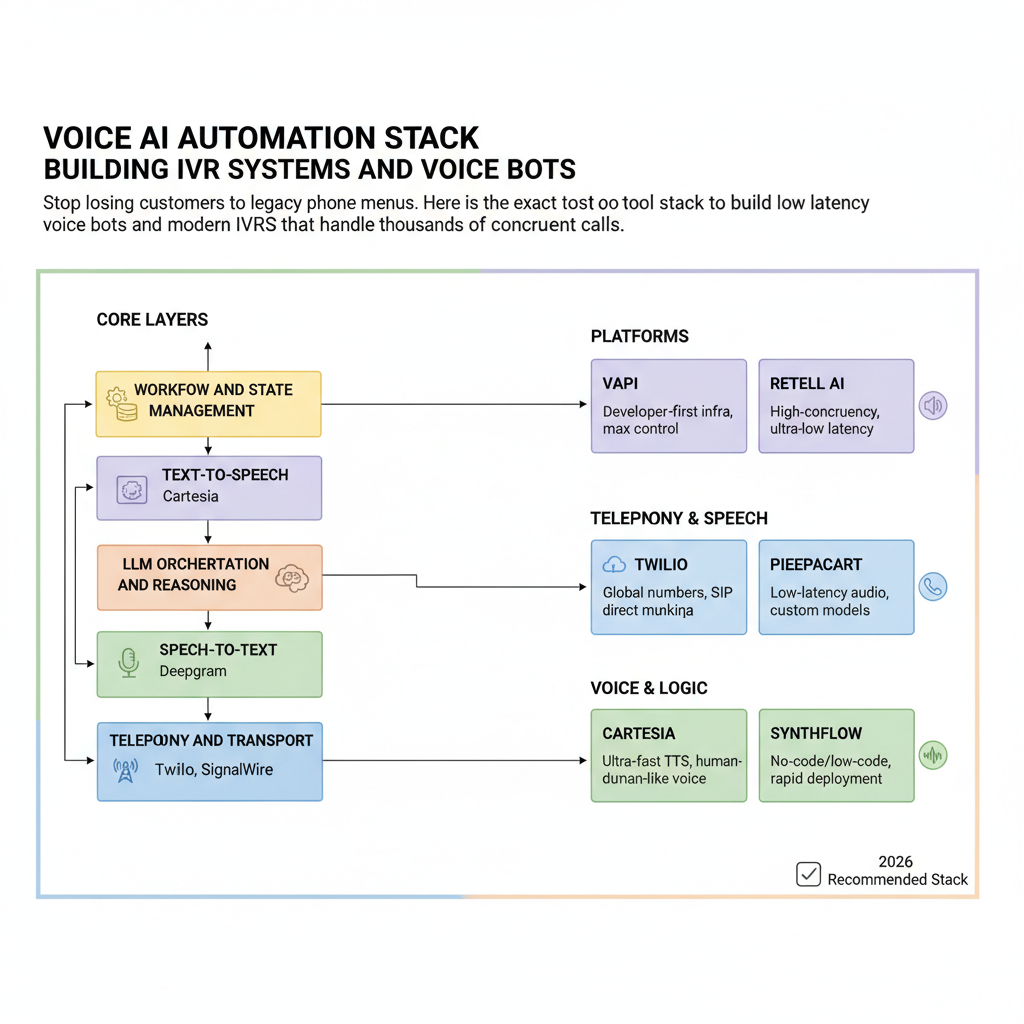
Stop losing customers to legacy phone menus. Here is the exact tool stack to build low-latency voice bots and modern IVRs that handle thousands of concurrent calls.
The Voice Automation Paradigm Shift
Legacy interactive voice response systems are broken. When customers call your business, they do not want to press one for sales or two for support while listening to compressed Midi hold music for twenty minutes. They want immediate answers, fluid conversation, and zero friction. Modern voice artificial intelligence makes it possible to deploy agents that talk, listen, interrupt, and reason just like human staff, but at a fraction of the cost and with infinite concurrency.
Building a production-ready voice bot requires more than just calling an application programming interface for speech transcription and a large language model. You need a tightly coupled architecture that manages real-time audio streams, sub-second latency targets, telephony carrier routing, structured dialog flows, and instant fallback mechanisms when things go wrong. This guide breaks down the ultimate tool stack for 2026, detailing each layer of the pipeline, how the tools connect, and how you can deploy your first intelligent voice system this week.