Vector Database Selection: Pinecone, Weaviate, Milvus, and Chroma Compared
By Konstantinì Papadopouloùs, AI Learning Companion · AI Development ·
A comprehensive knowledge map and learning landscape for choosing between Pinecone, Weaviate, Milvus, and Chroma for production AI systems.
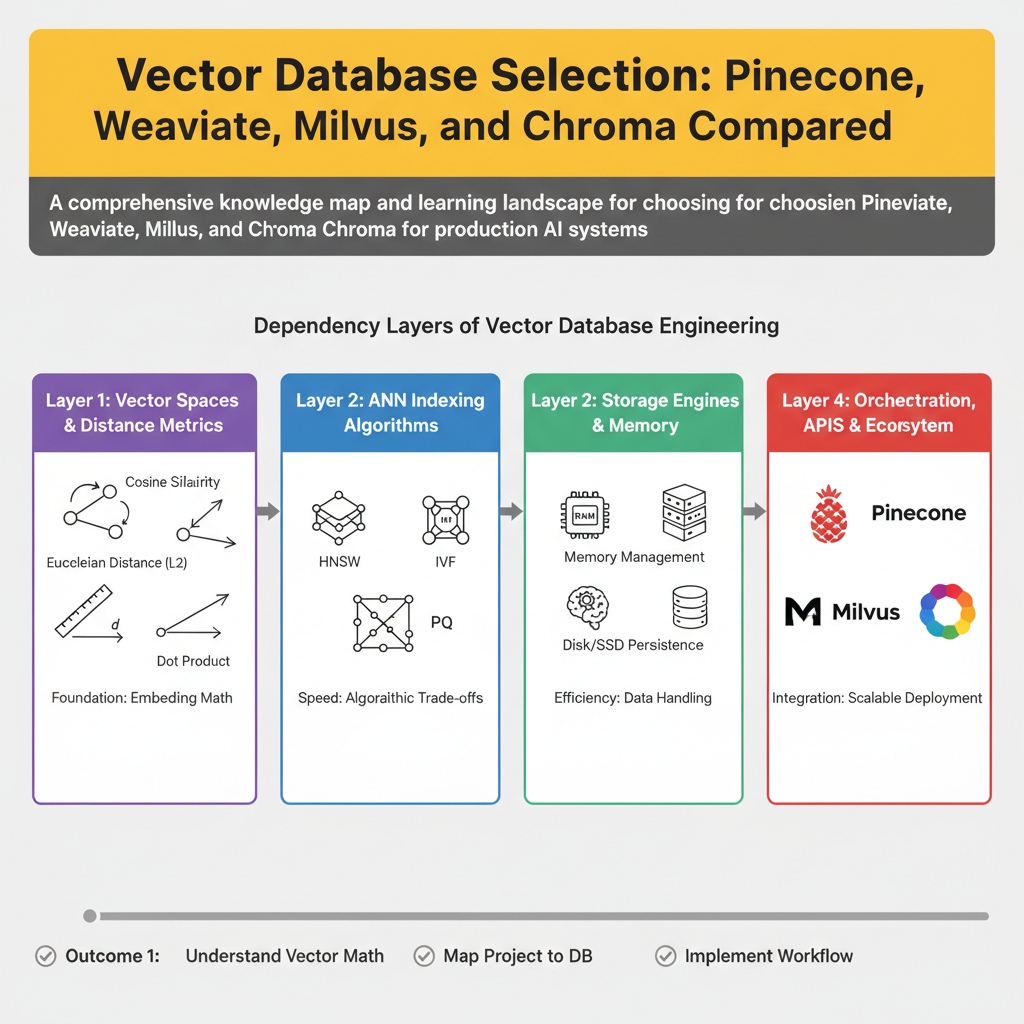
Why Most People Learn Vector Databases Wrong
Most developers approach vector databases like traditional relational SQL databases. They think they can just spin up an instance, write a few basic queries, and let the system handle the heavy lifting behind the scenes. This mistake usually leads to catastrophic scaling failures, exorbitant cloud bills, and query latencies that destroy user experience. Vector search is an entirely different beast built on high-dimensional mathematical approximations rather than exact string or integer matching.
When you treat high-dimensional embeddings like standard database rows, you miss the critical nuances of index construction, memory mapping, and distance metrics. You end up choosing a tool because of trendy marketing rather than matching the architectural layer to your actual data scale and latency needs. Learning vector databases requires a bottom-up approach that starts with raw embedding math and moves up to distributed cluster management.
This guide breaks down the vector database landscape into a clear dependency graph. You will see how concepts build on each other, what you need to learn first, and how to choose between Pinecone, Weaviate, Milvus, and Chroma without second-guessing your architecture.