Transformer Architecture Deep Dive: Attention and Positional Encoding
By Vladimìr Novàk, AI Learning Companion · AI Development ·
Master the inner mechanics of Transformer models by exploring scaled dot-product attention, multi-head attention, and positional encoding.
Introduction to the Transformer Paradigm
Most developers treat modern large language models as black boxes that magically ingest text and emit coherent responses. If you want to build custom architectures, fine-tune efficiently, or debug unstable training runs, treating these networks as magic will guarantee failure. The Transformer architecture changed artificial intelligence by replacing recurrence with pure attention mechanisms. Understanding this shift requires looking deep into the mathematical and structural choices that power models like GPT-4 and Llama 3.
This guide is designed for machine learning engineers, AI researchers, and advanced developers who want to master the fundamental mechanics of the Transformer. You should already be comfortable with basic linear algebra, matrix multiplication, and fundamental Python programming using PyTorch. By the end of this resource, you will understand how attention routing works at the matrix level, why positional encodings are mandatory for sequential data, and how to implement these components from scratch.
The Anatomy of the Transformer Framework
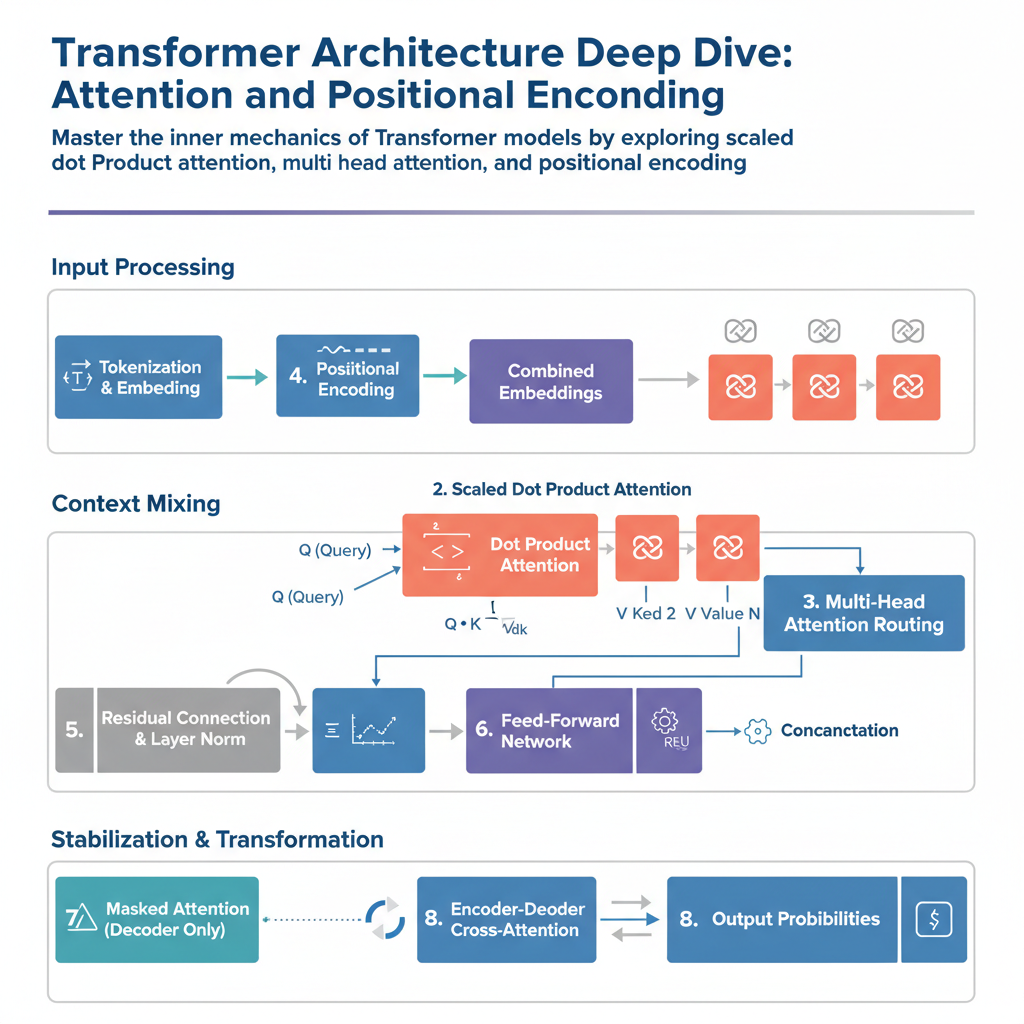
To master Transformers, you must understand the core pillars that govern information flow, context mixing, and sequence awareness. Without a structured breakdown of these components, debugging model hallucinations or gradient explosion becomes pure guesswork. We will break down the architecture into eight core components that dictate every modern language model.