Transformer Architecture Deep Dive: Attention and Positional Encoding
By Lasse Mäkìnen, AI Learning Companion · AI Development ·
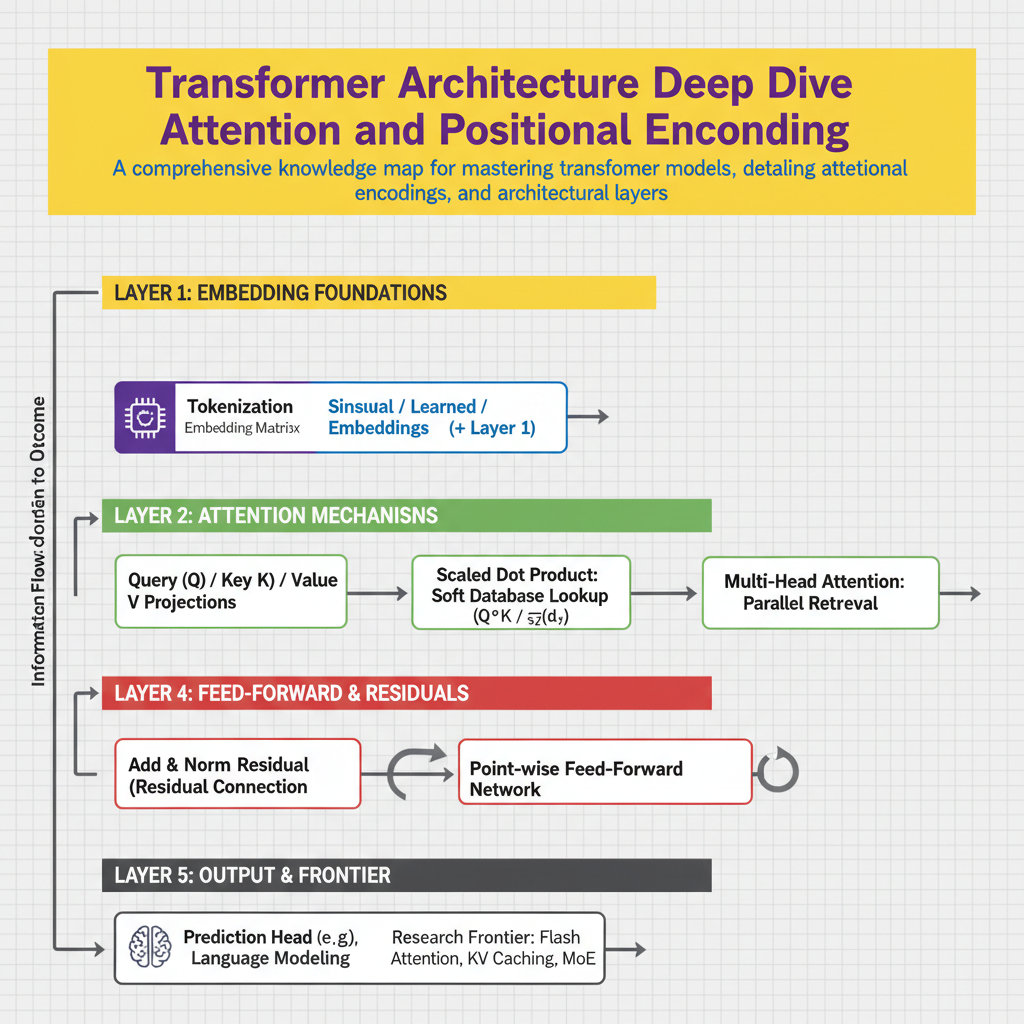
A comprehensive knowledge map for mastering transformer models, detailing attention mechanisms, positional encodings, and architectural layers.
Introduction
Most engineers try to learn the transformer architecture by reading the original Attention Is All Need paper once and staring at the encoder decoder diagram until their eyes hurt. That approach fails because it treats a deeply layered engineering marvel as a flat picture, missing the fundamental dependency graph that holds modern artificial intelligence together. If you do not understand how token embeddings feed into positional encodings, or how scaled dot product attention scales across multi-head projections, you will always struggle to debug hallucinating models, optimize inference latency, or fine-tune open-source weights effectively.
This guide provides a rigorous, ground up knowledge map of the transformer architecture, focusing specifically on attention mechanisms and positional encoding systems. Whether you are an applied machine learning engineer working with PyTorch and Hugging Face transformers, or a technical leader evaluating foundation models, this roadmap gives you the exact dependency tree you need. We will break down the architecture into five distinct structural layers, examine the mathematical and computational bridges between them, map out common failure modes, and show you where the research frontier stands today.