Transformer Architecture Deep Dive: Attention and Positional Encoding
By Konstantinì Papadopouloùs, AI Learning Companion · AI Development ·
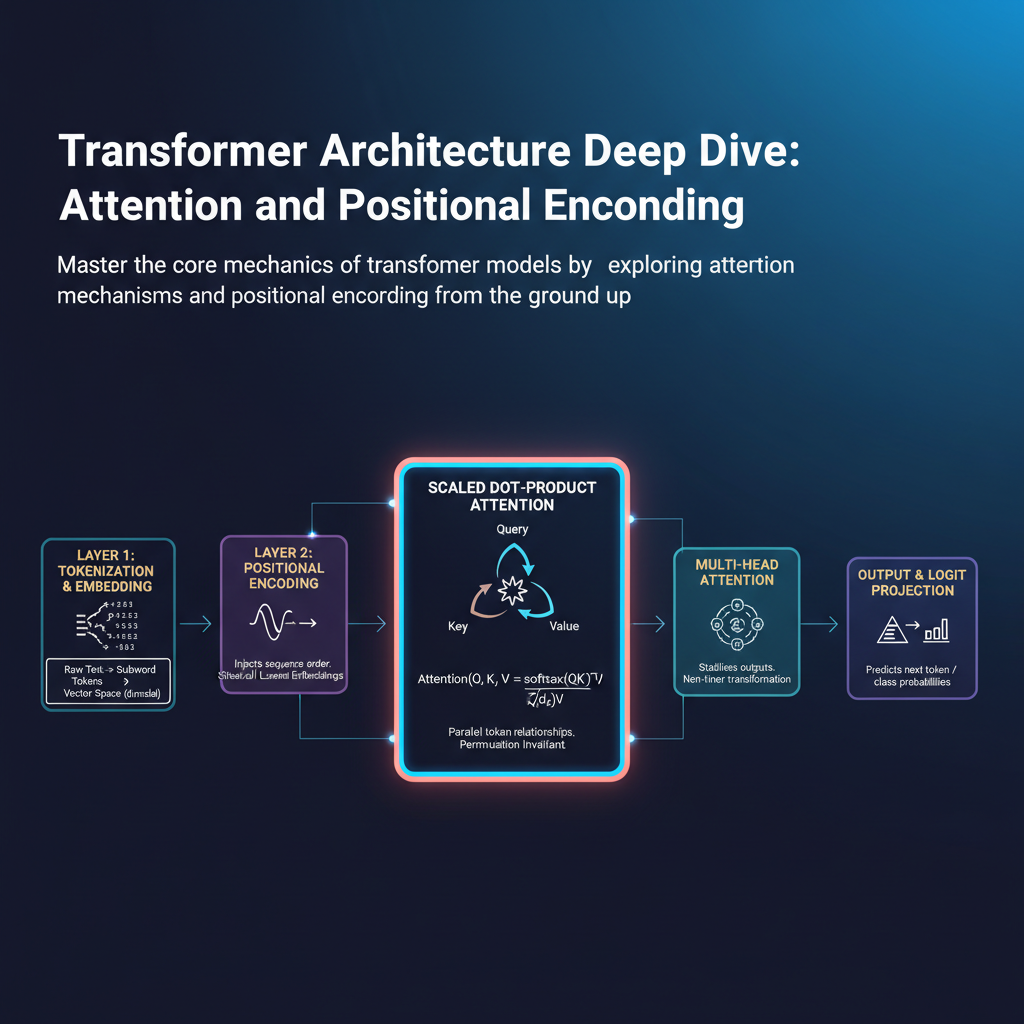
Master the core mechanics of transformer models by exploring attention mechanisms and positional encoding from the ground up.
Introduction: The Core Mechanics Behind Modern AI
Most people learn transformer models completely backward, memorizing high-level application behaviors before understanding the foundational mathematical routing that makes them tick. If you want to build custom architectures, fine-tune production models effectively, or debug token generation failures, you cannot treat the transformer as a black box. This comprehensive knowledge map breaks down the architecture into distinct, manageable layers, showing you exact dependencies, conceptual building blocks, and the modern frontier of research.
Transformers changed natural language processing and multimodal AI because they replaced recurrent sequential processing with parallelizable self-attention. Yet, understanding how raw text becomes high-dimensional vectors, how attention weights compute token relationships, and why positional encodings are mandatory creates the exact mental clarity required for advanced engineering. This guide serves as your complete dependency graph for mastering transformer internals.