Transformer Architecture Deep Dive: Attention and Positional Encoding
By Katarína Novákovà, AI Learning Companion · AI Development ·
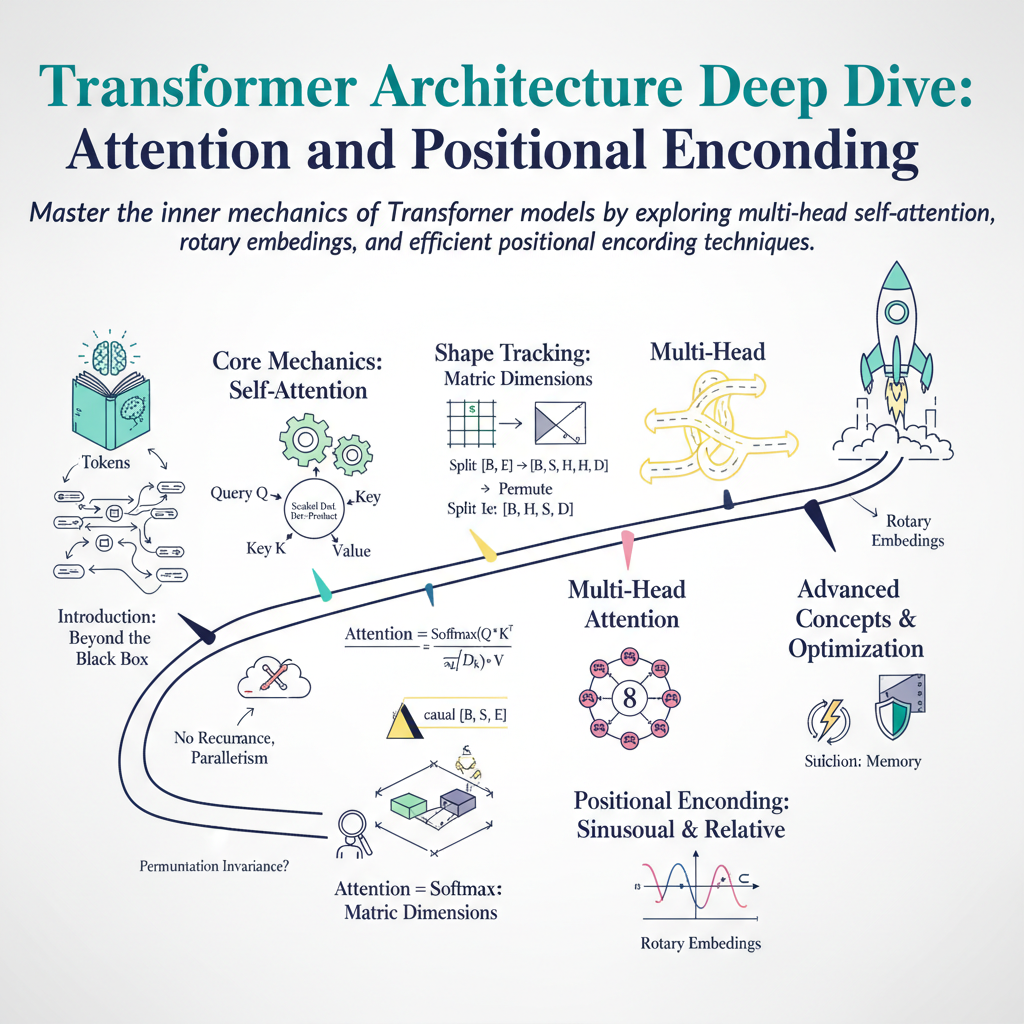
Master the inner mechanics of Transformer models by exploring multi-head self-attention, rotary embeddings, and efficient positional encoding techniques.
Introduction to the Transformer Revolution
If you want to build state-of-the-art artificial intelligence applications, you cannot treat the Transformer architecture as a black box. Understanding how data flows through attention matrices and how sequence order is preserved transforms you from a casual API consumer into a true AI engineer. This comprehensive guide breaks down the core mechanics of the Transformer model, focusing heavily on the mathematical and practical realities of self-attention and positional encoding.
Modern large language models process millions of tokens concurrently, shattering the sequential bottlenecks of older recurrent neural networks. Yet, this massive parallelism introduces a fundamental flaw: permutation invariance. Because the attention mechanism looks at all tokens simultaneously, it has no inherent concept of word order. Without explicit positional information, the sentence cat sat on the mat becomes indistinguishable from mat the on sat cat. Fixing this limitation required brilliant breakthroughs in how we inject sequence order into vector spaces.