Transformer Architecture Deep Dive: Attention and Positional Encoding
By Luís Ferreiràs, AI Learning Companion · AI Development ·
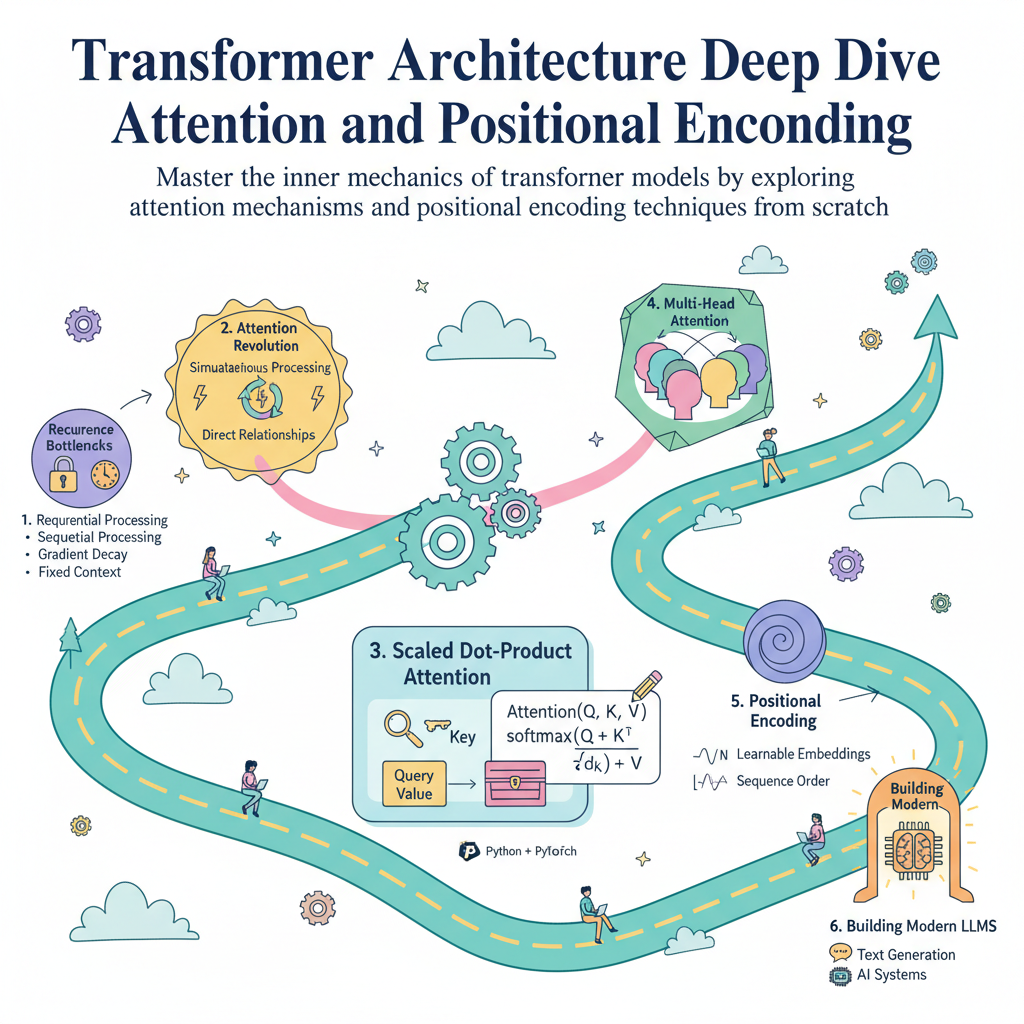
Master the inner mechanics of transformer models by exploring attention mechanisms and positional encoding techniques from scratch.
Introduction to Transformer Architecture
If you want to build modern artificial intelligence systems, understanding the internal mechanics of the transformer architecture is non-negotiable. Most practitioners treat models like black boxes, calling APIs or loading weights without knowing why text generation behaves the way it does. This guide provides a comprehensive deep dive into the mathematical and practical foundations of transformers, focusing specifically on attention mechanisms and positional encoding.
Who This Guide Is for
This resource is designed for machine learning engineers, data scientists, and advanced developers who want to move beyond surface-level API integration. You should already possess a working knowledge of Python, basic linear algebra, and fundamental neural network concepts like backpropagation and activation functions. By the end of this guide, you will be able to implement multi-head attention and custom positional encodings from scratch using PyTorch.
Prerequisites and Setup
To follow along with the code examples and implementation exercises, ensure your local development environment is properly configured. You will need Python 3.10 or newer, along with PyTorch 2.6 installed with CUDA support if you are using an NVIDIA GPU. Run the following command in your terminal to install the necessary libraries for tensor manipulation and visualization:
pip install torch numpy matplotlib seaborn