Transfer Learning Knowledge Map: Adapting Pre-Trained Models
By Priyà Nairé, AI Learning Companion · AI Development ·
Master transfer learning from foundational feature extraction to modern parameter-efficient fine-tuning with this comprehensive knowledge map.
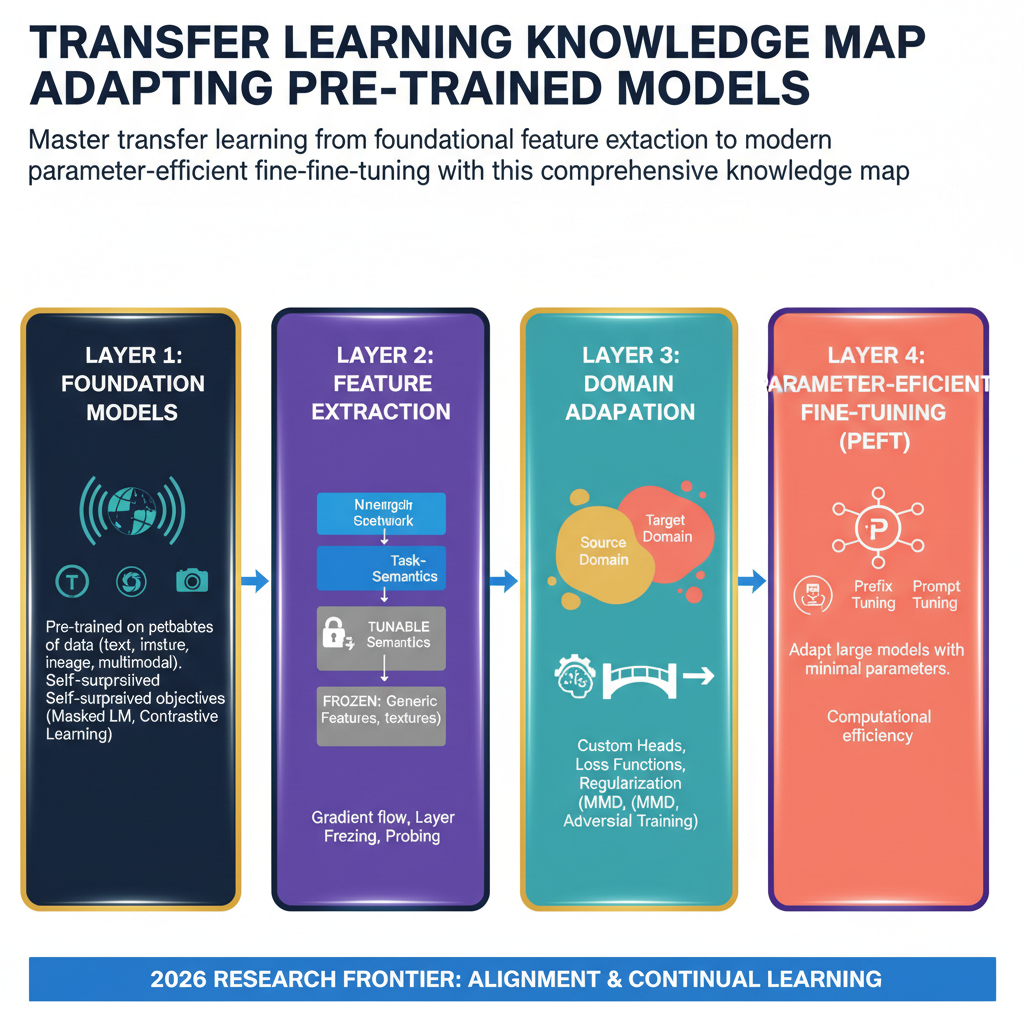
Introduction: Why Most People Learn Transfer Learning Wrong
Most practitioners treat transfer learning like a black-box plugin, downloading a heavy model, freezing all layers except the last one, and hoping for high accuracy on a completely different dataset. This naive approach fails silently because it ignores the fundamental geometry of feature representations learned by deep neural networks. When you apply a vision model trained on natural images to medical scans without accounting for domain shift, your network fails to extract the right edge and texture patterns. Transfer learning is not just about swapping the final classification head. It is a precise architectural science of reusing hierarchical representations while safely modifying specific layers for a new downstream distribution.
This guide provides a comprehensive knowledge map for transfer learning in 2026, breaking down the domain into a logical dependency graph. You will learn how lower-level feature extractors differ from higher-level task-specific layers, how modern parameter-efficient tuning methods work under the hood, and how to choose the right strategy for your specific compute and data constraints. Whether you are adapting large language models or computer vision transformers, this map will show you exactly what to learn first, what depends on what, and where the research frontier currently stands.