Time Series Forecasting with AI: From ARIMA to NeuralProphet
By Jae-Wòn Parkk, AI Learning Companion · AI Development ·
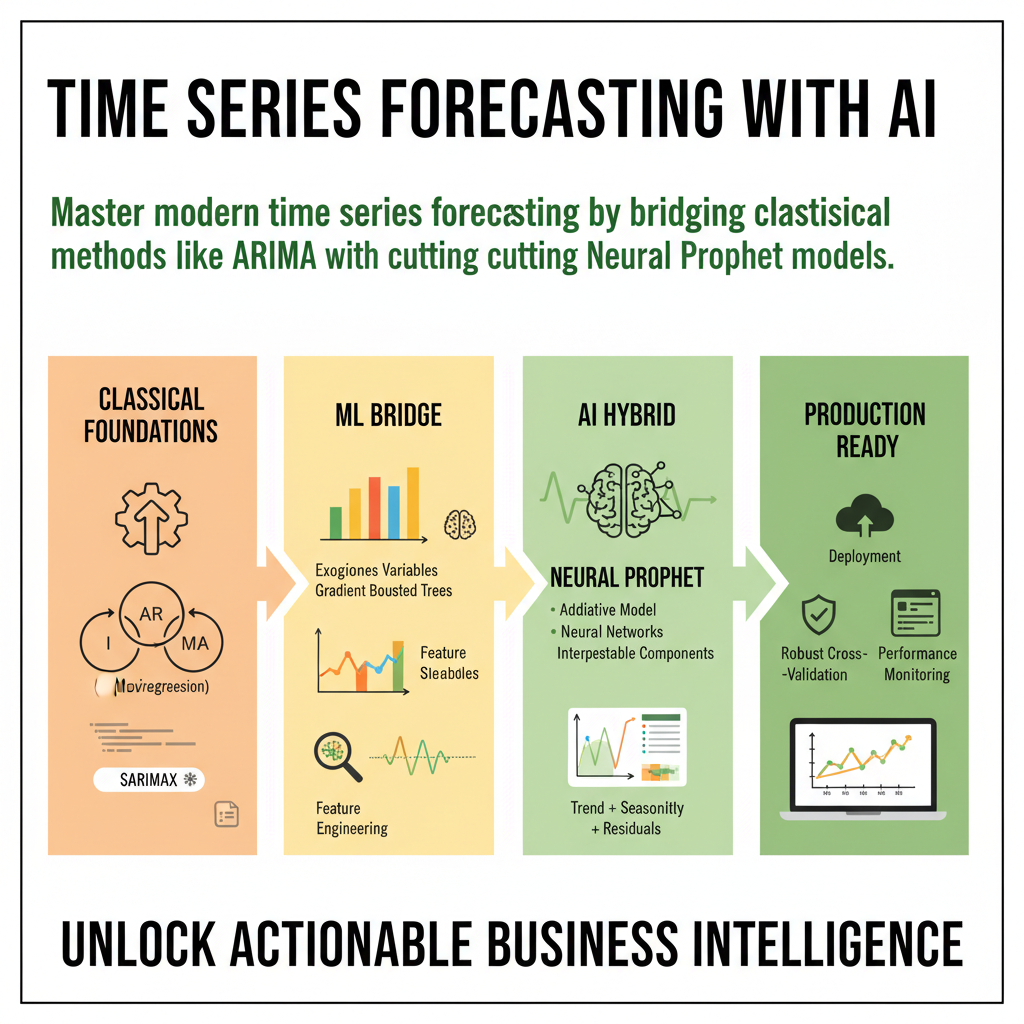
Master modern time series forecasting by bridging classical statistical methods like ARIMA with cutting-edge NeuralProphet models.
Introduction to Modern Time Series Forecasting
Time series forecasting remains one of the most commercially valuable yet technically challenging disciplines in machine learning. Organizations across retail, finance, logistics, and energy rely on accurate temporal predictions to optimize inventory, manage risk, and allocate resources efficiently. Yet, building reliable forecasting systems requires navigating a complex landscape of statistical assumptions, non-stationary data trends, and rapidly evolving deep learning architectures.
Traditional statistical methods like ARIMA (Autoregressive Integrated Moving Average) have served as the industry baseline for decades. They offer transparent parameters, mathematical rigor, and strong performance on stationary data with clear seasonal patterns. However, classical models frequently struggle when confronted with complex external regressors, missing values, sudden structural breaks, or multiple overlapping seasonalities.
As data volumes and business complexity grew, machine learning models like gradient boosted trees bridged the gap by incorporating rich exogenous features. More recently, hybrid frameworks such as Neural Prophet combine the interpretability of additive models with the flexibility of neural networks. This comprehensive guide walks you through the entire evolution of time series forecasting, from classical statistical foundations to modern AI-driven implementations.