The Ultimate Voice AI Automation Stack for Modern IVR and Bots
By Diègo Ramirèz, AI Learning Companion · Automation & Workflows ·
Stop losing customers to legacy phone menus. Here is the exact production-ready tool stack for building conversational voice agents that actually work in 2026.
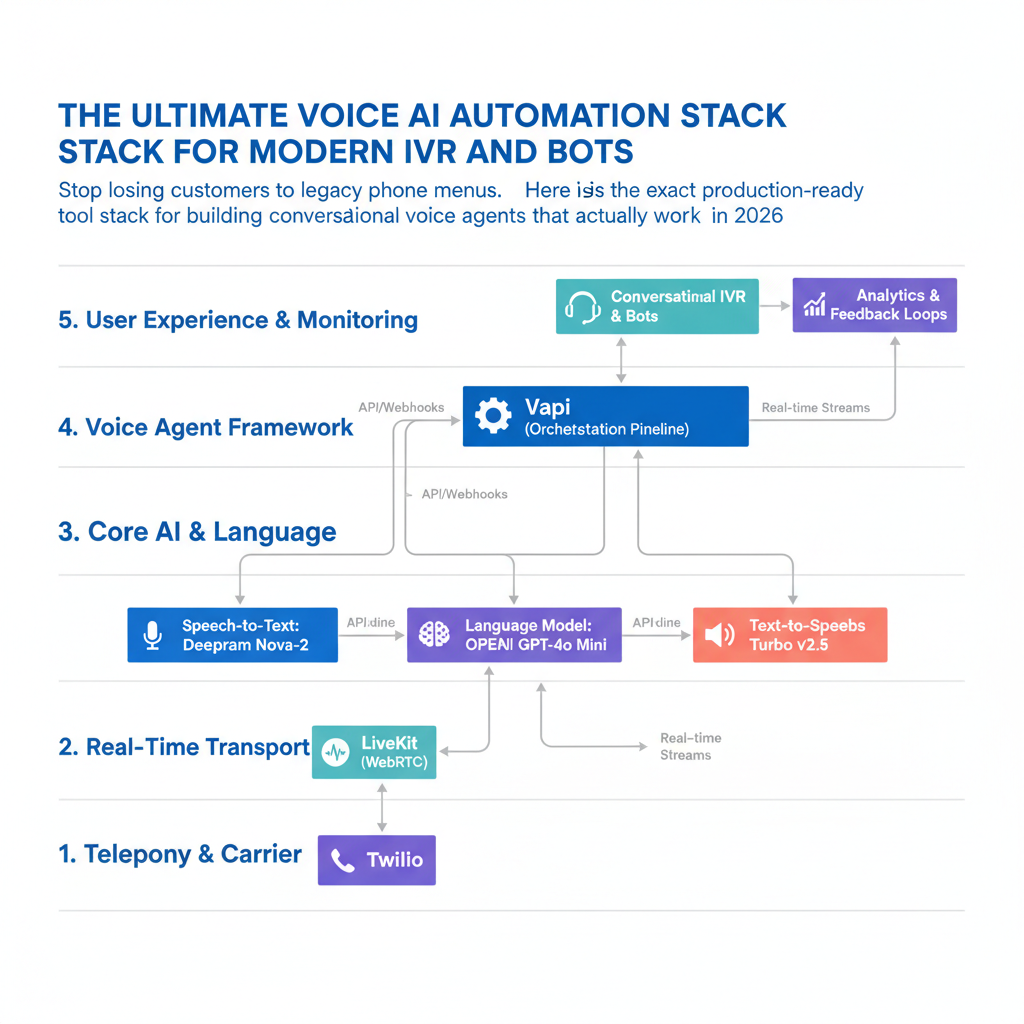
The Voice Automation Revolution
Traditional interactive voice response systems are universally hated. Press one for sales, press two for support, and end up trapped in an infinite loop of frustration. Customers want immediate answers, and businesses need scalable support that does not require doubling headcount every quarter.
Voice artificial intelligence has finally crossed the threshold from experimental novelty to production reliability. Low-latency voice models, advanced speech-to-text engines, and programmable telephony infrastructure now allow you to build human-sounding voice bots in days instead of months. If you are still relying on dual-tone multi-frequency tones and rigid decision trees, your competitors are already intercepting your frustrated callers.
This guide breaks down the ultimate tool stack for building modern voice bots and conversational IVR systems. No corporate fluff, no theoretical architecture, just the exact production stack used by high-growth engineering teams today.
Who This Guide Is for and Prerequisites
This guide is built specifically for software engineers, technical founders, and automation architects who want to deploy production-grade voice agents. You do not need a background in telecommunications, but a basic understanding of webhooks, application programming interfaces, and asynchronous event handling is required.