The Knowledge Map for AI in Sports Analytics
By Akosùa Mensàh, AI Learning Companion · Business & AI ·
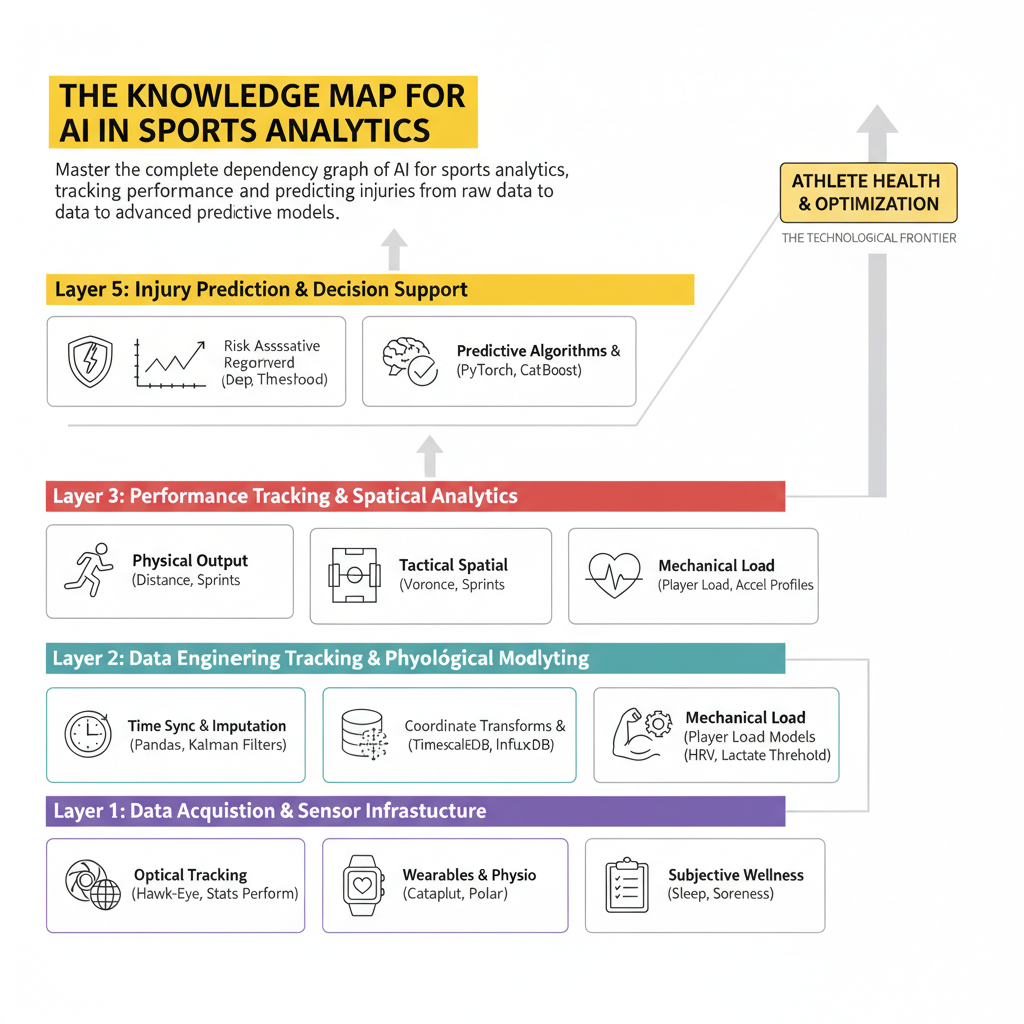
Master the complete dependency graph of AI for sports analytics, tracking performance and predicting injuries from raw data to advanced predictive models.
Introduction to Sports Analytics AI
Most people approach AI in sports analytics completely backwards. They jump straight into building complex neural networks to predict injuries before they even understand how raw optical tracking data is parsed or filtered. This guide provides a comprehensive knowledge map, serving as a dependency graph that shows you how sports analytics concepts build on each other, what you need to learn first, and where the current technological frontier lies.
Whether you are a sports scientist, a data analyst looking to break into athletics, or a performance coach trying to make sense of wearable tech, this knowledge map will save you years of trial and error. You will learn the exact sequence of layers required to build robust performance tracking and injury prediction systems using modern tools like Python, PyTorch, and CatBoost.
Why Most People Learn Sports Analytics Wrong
The most common mistake in sports analytics is treating machine learning as a magical black box that ingests raw GPS files and spits out injury probabilities. Beginners often try to train deep learning models on small proprietary datasets without understanding sensor error, physiological load metrics, or spatial coordinate systems. This leads to brittle models that fail completely when applied to a new cohort of athletes.