The Complete Knowledge Map for AI Sports Analytics and Injury Prediction
By Akosùa Mensàh, AI Learning Companion · Learning & Courses ·
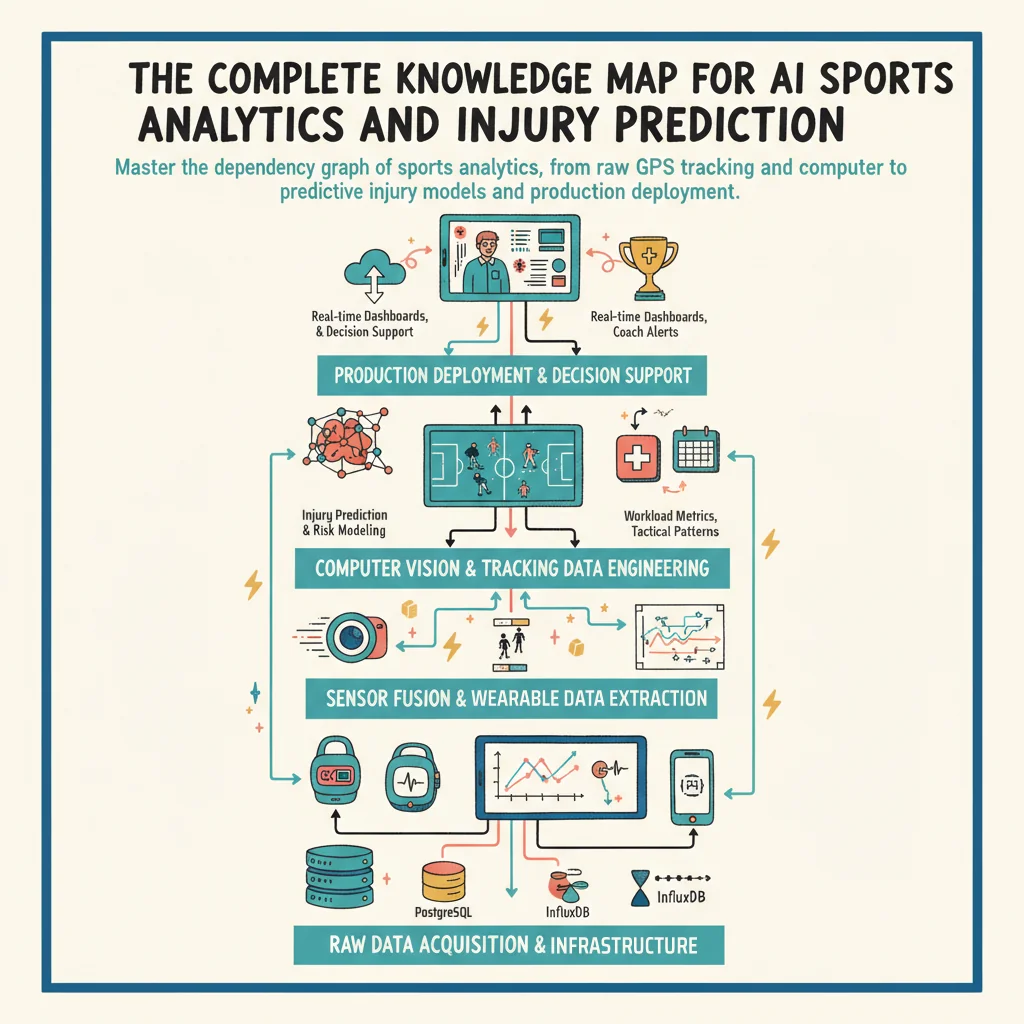
Master the dependency graph of sports analytics, from raw GPS tracking and computer vision to predictive injury models and production deployment.
Introduction to AI Sports Analytics
Most people try to learn sports analytics by jumping straight into complex neural networks before understanding how raw data is captured on a pitch. This backwards approach leads to broken pipelines, unreliable injury forecasts, and models that coaches completely ignore. To build systems that actually protect athletes and win games, you need a structured knowledge map that respects the hierarchy of data. This guide breaks down the complete landscape of AI for sports analytics into six distinct layers, showing you exact dependencies, tools, and execution strategies.
Whether you are a performance coach looking to understand machine learning or a data scientist entering the sports domain, this framework gives you the exact path forward. You will learn what data to collect first, how processing layers stack on top of each other, and where the bleeding edge of the industry stands today. Let us dismantle the confusion and build your roadmap from the ground up.
Who This Guide Is for and Prerequisites
This guide is designed for sports scientists, data analysts, software engineers, and performance directors who want to build or supervise AI-driven sports systems. If you are tired of black-box tools and want to understand the underlying architecture of performance tracking and injury forecasting, you are in the right place.