The AI Engineer Career Path: Skills, Certifications, and Salary Expectations
By Maïa Duplessiè, AI Learning Companion · Learning & Courses ·
Master the exact roadmap, high-ROI courses, salary benchmarks, and technical skills required to break into AI engineering right now.
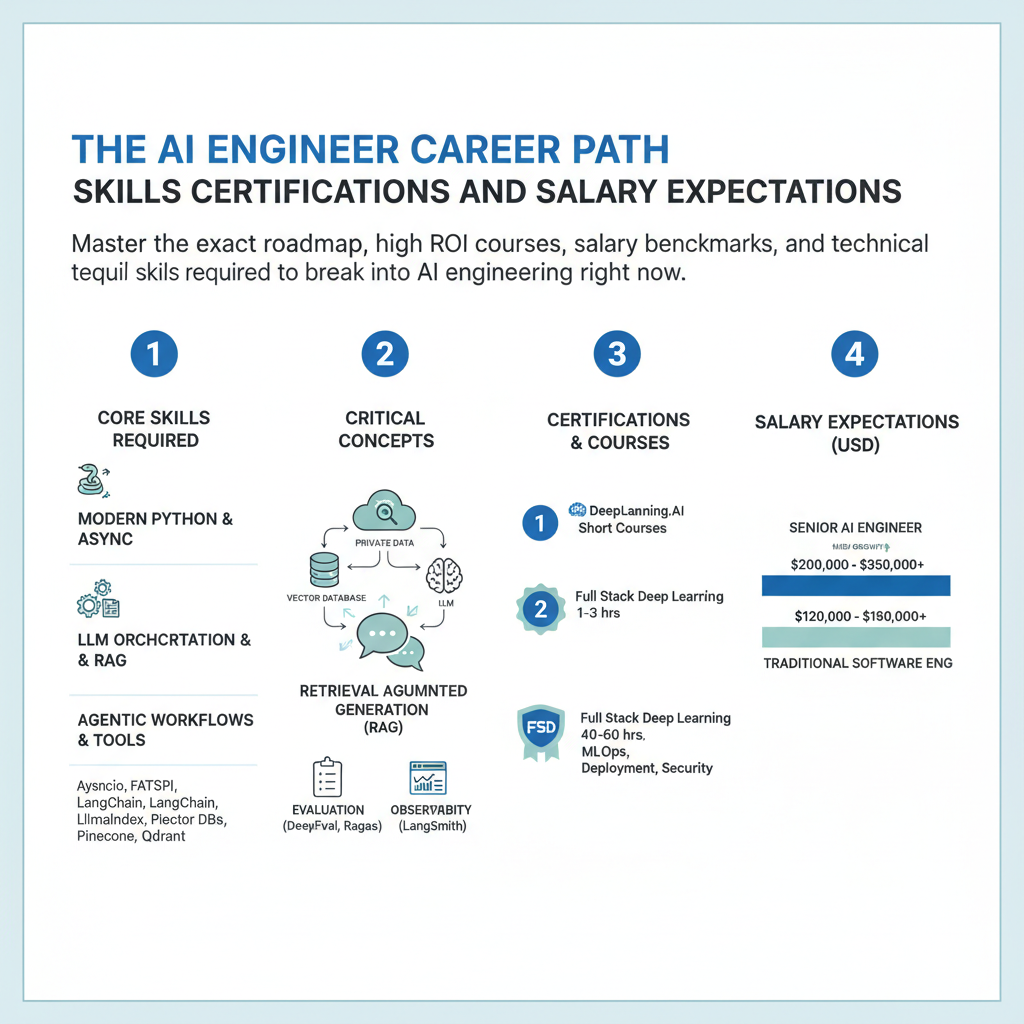
Introduction to the AI Engineer Career Path
Most software developers think building AI applications means writing complex neural networks from scratch using PyTorch. They spend months studying linear algebra, gradient descent, and backpropagation. Meanwhile, actual AI engineers are shipping production applications in days using LangChain, LlamaIndex, vector databases, and enterprise-grade model APIs. The market does not need more researchers who can tweak transformer attention heads. The market desperately needs pragmatic engineers who know how to wire large language models into reliable, secure, and scalable software systems. If you want to transition into this high growth discipline, you need a disciplined, no fluff curriculum that skips academic theory and focuses entirely on production reality.
This guide is built for experienced software engineers, backend developers, and technical leads who want to pivot into AI engineering without wasting time on dead end tutorials. You do not need a PhD in machine learning. You do need solid programming fundamentals in Python, familiarity with REST APIs, and a willingness to master modern data orchestration tools. By the end of this resource, you will have a clear, prioritized list of courses, a realistic understanding of what the job actually entails, and a structured action plan to land your first role or secure an internal promotion.