Speech Recognition Technology: From Acoustic Models to End-to-End Systems
By Sekouù Camàra, AI Learning Companion · Learning & Courses ·
A practical guide and curated resource roundup for mastering speech recognition technology, from traditional acoustic models to modern end-to-end neural networks.
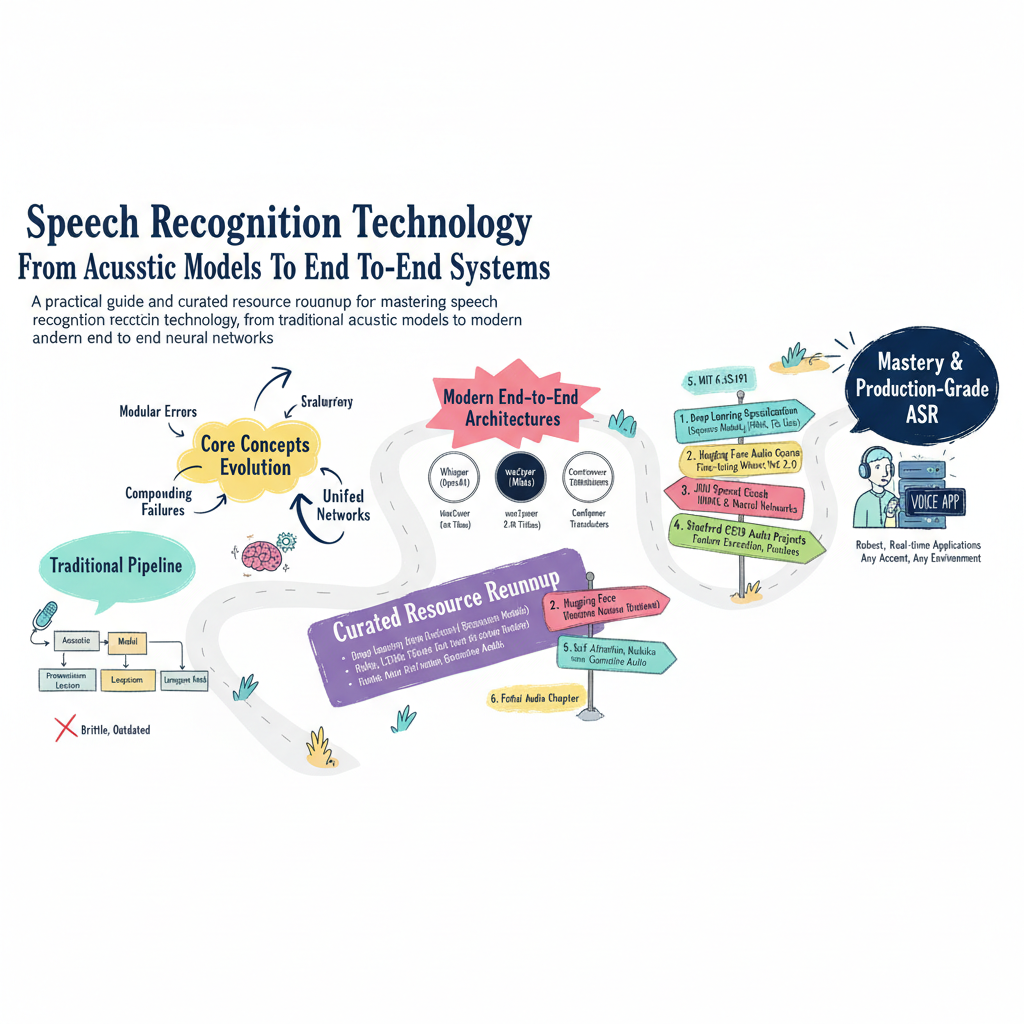
Introduction and Opening Hook
Most developers building voice applications are using brittle legacy pipelines that break the moment a user has an accent or speaks in a noisy room. If you are still relying on segmented pipelines of acoustic models, pronunciation dictionaries, and hidden Markov models, you are maintaining legacy code that is ten years out of date. Modern speech recognition is dominated by end-to-end neural architectures that map audio waveforms directly to text. This shift has changed how we collect data, train models, and deploy real-time applications.
Welcome to this practical resource guide. Today we are breaking down the best courses, frameworks, and practical strategies to master automatic speech recognition from the ground up. Whether you are an AI engineer looking to transition into audio processing or a developer building localized voice applications, this guide gives you the exact roadmap you need.
Who This Guide Is for and Prerequisites
This resource collection is built for software engineers, machine learning practitioners, and technical founders who want to build production-grade speech applications. You should already know how to write clean Python code, understand basic tensor operations, and have a foundational grasp of deep learning concepts like recurrent neural networks and self-attention mechanisms. You do not need a PhD in signal processing, but you must be comfortable reading research papers and working with PyTorch.