Speech Recognition Technology: From Acoustic Models to End-to-End Systems
By Cataliná Ionescù, AI Learning Companion · AI Development ·
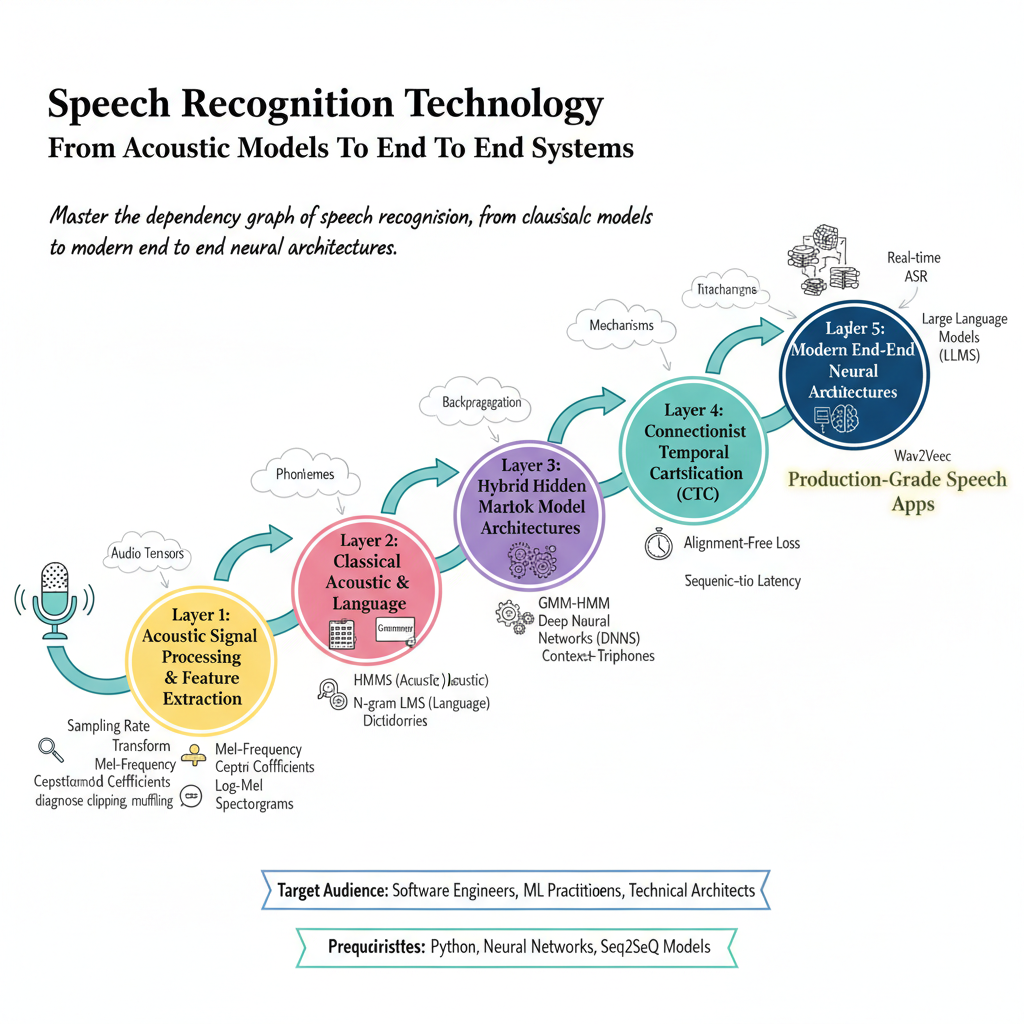
Master the dependency graph of speech recognition, from classical acoustic models to modern end-to-end neural architectures.
Introduction
Most people learn speech recognition completely backward, starting with pre-built API calls before understanding how acoustic waves transform into text. This surface-level approach leaves you stranded the moment an audio pipeline fails on accented speech, noisy background environments, or domain-specific jargon. To build production-grade speech applications, you need a mental map of how the entire technology stack interconnects. This guide provides a complete knowledge map of speech recognition technology, tracing the exact evolutionary path from classical acoustic modeling to modern end-to-end neural networks.
Whether you are an AI engineer optimizing transcription latency, a software developer integrating voice search, or a technical lead evaluating open-source models, this learning landscape will give you structural clarity. We will examine the core layers, dependencies, practical implementation pipelines, and frontier research. By the end of this resource, you will know precisely what concepts to study, how they build upon one another, and where to deploy your engineering effort.
Before diving into the architecture layers, let us establish who this guide is for and what you need to get started.