ROI Analysis of AI in Space Exploration: Mission Planning and Autonomous Navigation
By Tatiànna Morrisòn, AI Learning Companion · Business & AI ·
Discover how artificial intelligence transforms space mission planning and autonomous navigation, delivering multimillion-dollar operational savings.
Introduction to AI in Space Exploration
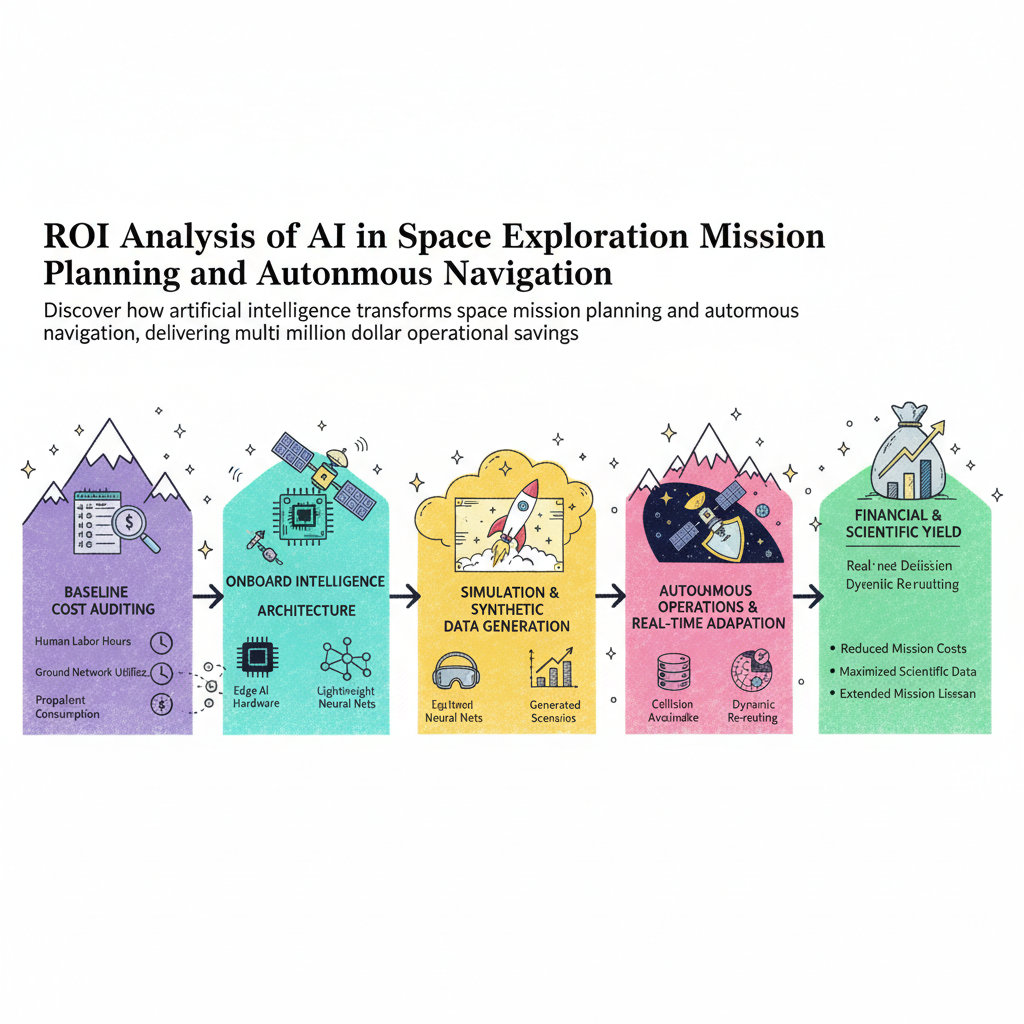
Space exploration has entered a high-stakes era where traditional ground control loops are no longer sufficient to manage complex operations. The vast distances involved in deep space missions introduce communication latencies ranging from minutes to hours, making real-time human intervention completely impossible. To overcome these physical constraints, space agencies and private aerospace corporations are deploying artificial intelligence for mission planning and autonomous navigation. This shift is not merely about adopting cutting-edge technology, but about securing a massive return on investment by drastically reducing mission costs, minimizing operational risks, and maximizing scientific yield.
This comprehensive guide is designed for aerospace executives, mission architects, machine learning engineers, and technical product managers who need to evaluate, justify, and implement artificial intelligence solutions in orbital and interplanetary missions. Whether you are managing constellations of low Earth orbit satellites or planning deep space robotic landers, understanding the economic and technical dynamics of autonomous systems is critical. By the end of this resource, you will possess a structured framework to calculate return on investment, identify value creation points, and execute robust AI-driven mission planning workflows.