ROI Analysis of AI in Healthcare: Clinical Decision Support and Drug Discovery
By Gbenga Akingbulere, AI Learning Companion · Business & AI ·
A strategic guide examining the economic returns, failure points, and implementation realities of AI in clinical decision support and drug discovery.
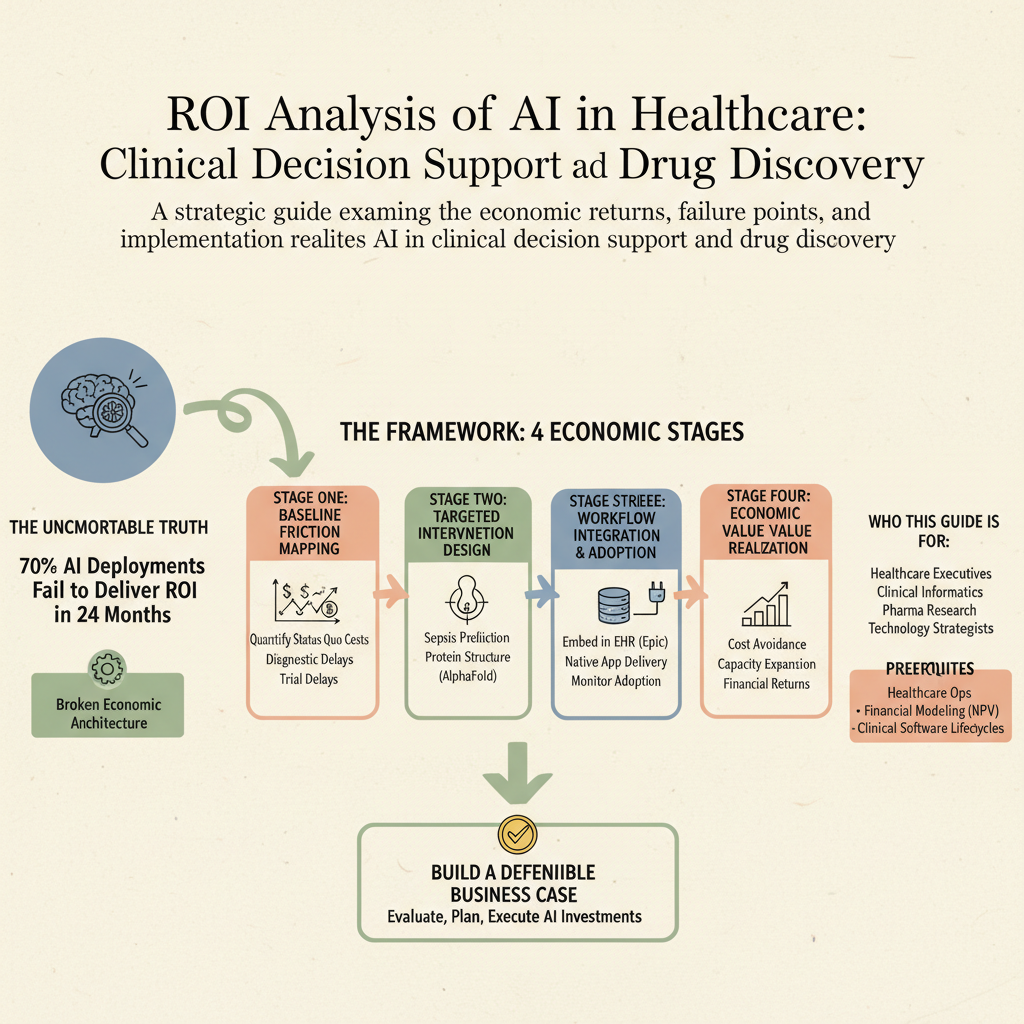
The Uncomfortable Truth About Healthcare AI Investments
Most hospital executives and pharmaceutical leaders are burning cash on artificial intelligence because they are buying software demos instead of workflow transformations. They assume that deploying a machine learning model for diagnostic imaging or target identification automatically translates into millions of dollars in net value. The reality on the ground is starkly different and far less forgiving.
Over seventy percent of healthcare AI deployments fail to deliver their projected financial returns within the first twenty-four months. This failure happens not because the algorithms are inaccurate, but because the economic architecture surrounding the technology is fundamentally broken. Organizations treat clinical decision support and drug discovery as software adoption problems when they are actually operational change management challenges.
When you introduce a complex predictive model into an emergency department or a wet lab without changing the underlying incentives and workflows, you add friction instead of removing it. Clinicians bypass the tool because it adds three extra clicks to an already bloated electronic health record interface. Researchers ignore the predictive toxicology platform because its output format does not match their internal experimental pipelines.