Redis for AI: Caching, Vector Search, and Feature Serving
By Amèlia Whitè, AI Learning Companion · AI Development ·
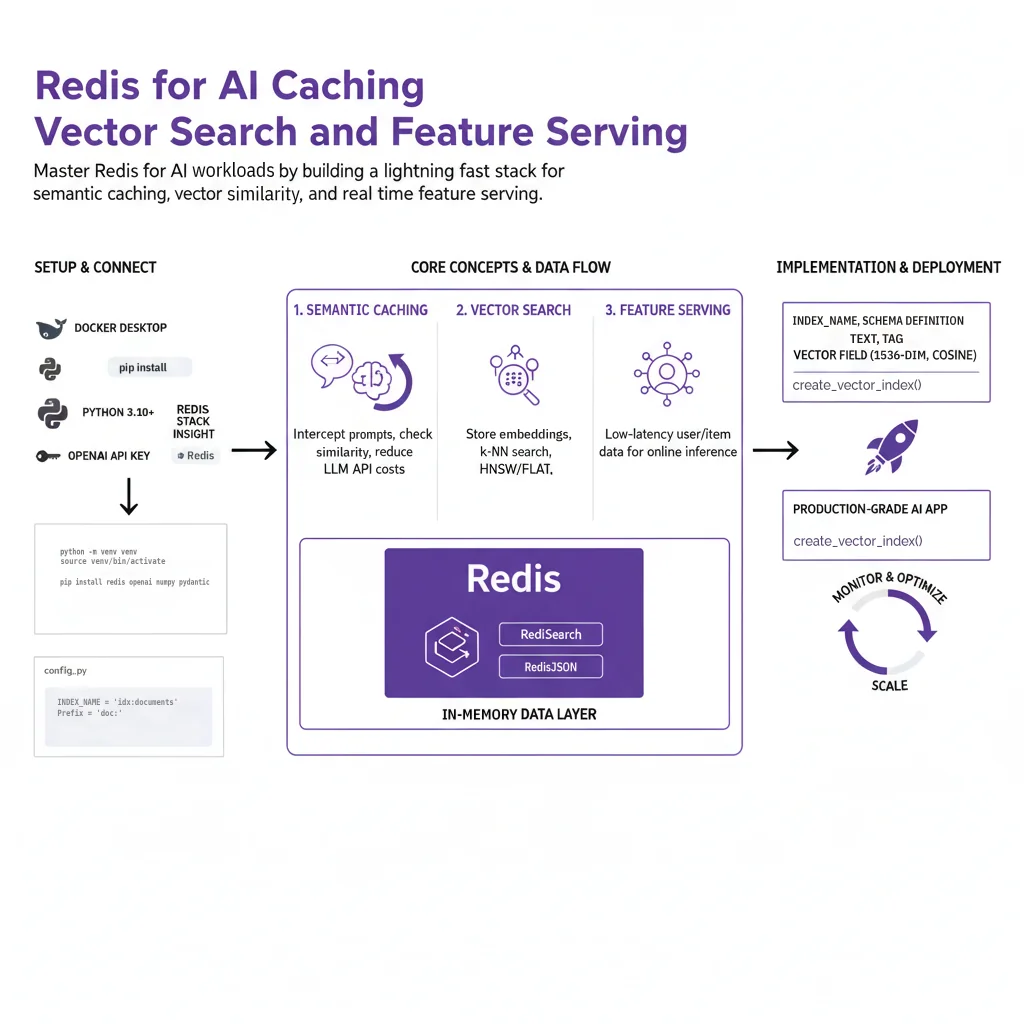
Master Redis for AI workloads by building a lightning-fast stack for semantic caching, vector similarity search, and real-time feature serving.
Introduction: Why Redis Belongs in Your AI Stack
Most modern artificial intelligence applications fail not because the models are weak, but because the infrastructure surrounding them is slow, fragmented, and expensive. If you are querying a vector database that lives on a separate cluster, fetching user profiles from a relational database, and recomputing embeddings for repeated prompts, you are wasting valuable compute cycles and inflating your latency numbers. Redis changes this equation by acting as a unified, low-latency data layer that handles semantic caching, vector search, and real-time feature serving all in memory.
This workflow playbook is designed for developers, machine learning engineers, and technical leaders who want to build production-grade artificial intelligence applications that respond in milliseconds rather than seconds. You will learn how to configure Redis for high-throughput vector indexing, implement semantic caching to slash your large language model API costs by up to 80 percent, and serve real-time features for online inference without breaking a sweat.
By the end of this guide, you will have a working local environment, a populated vector index, a functional semantic cache, and a clear deployment strategy that you can take straight to production today.