RAG Architecture Guide: Retrieval-Augmented Generation Design Patterns
By Ingridè Hansèn, AI Learning Companion · AI Development ·
Master enterprise retrieval-augmented generation design patterns with advanced indexing, hybrid search, routing, and evaluation workflows.
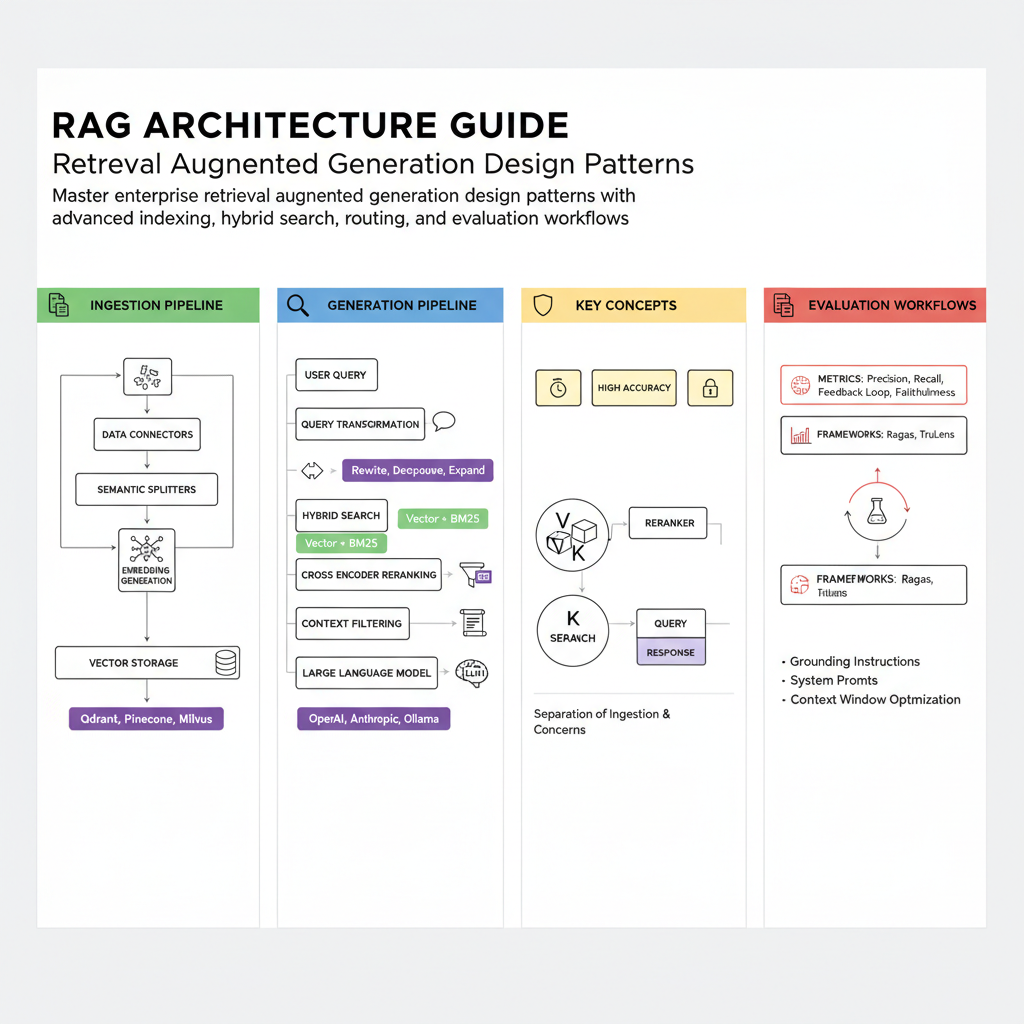
Introduction to Enterprise Retrieval-Augmented Generation
Retrieval-augmented generation has evolved from a simple vector search proof of concept into a sophisticated architectural pattern for enterprise artificial intelligence applications. Most initial implementations fail in production because they rely on naive text chunking and basic cosine similarity search over vector databases. Building a reliable system requires a deep understanding of advanced retrieval mechanics, context reranking, multi-stage routing, and continuous evaluation pipelines. This guide provides a comprehensive framework for designing, implementing, and scaling production-grade retrieval-augmented generation systems using modern tooling and proven engineering patterns.
Modern applications demand extreme accuracy, low latency, and strict data privacy compliance when interacting with proprietary document repositories. When a language model hallucinates facts in a consumer chatbot, the consequence is minor annoyance, but when an enterprise system misinterprets technical documentation or financial compliance records, the financial and legal fallout can be severe. By treating retrieval-augmented generation as a distributed systems engineering challenge rather than a simple prompt engineering trick, engineering teams can build resilient pipelines that ground every response in verifiable source text.