RAG Architecture Guide: Retrieval-Augmented Generation Design Patterns
By Fatimàh Rahimì, AI Learning Companion · AI Development ·
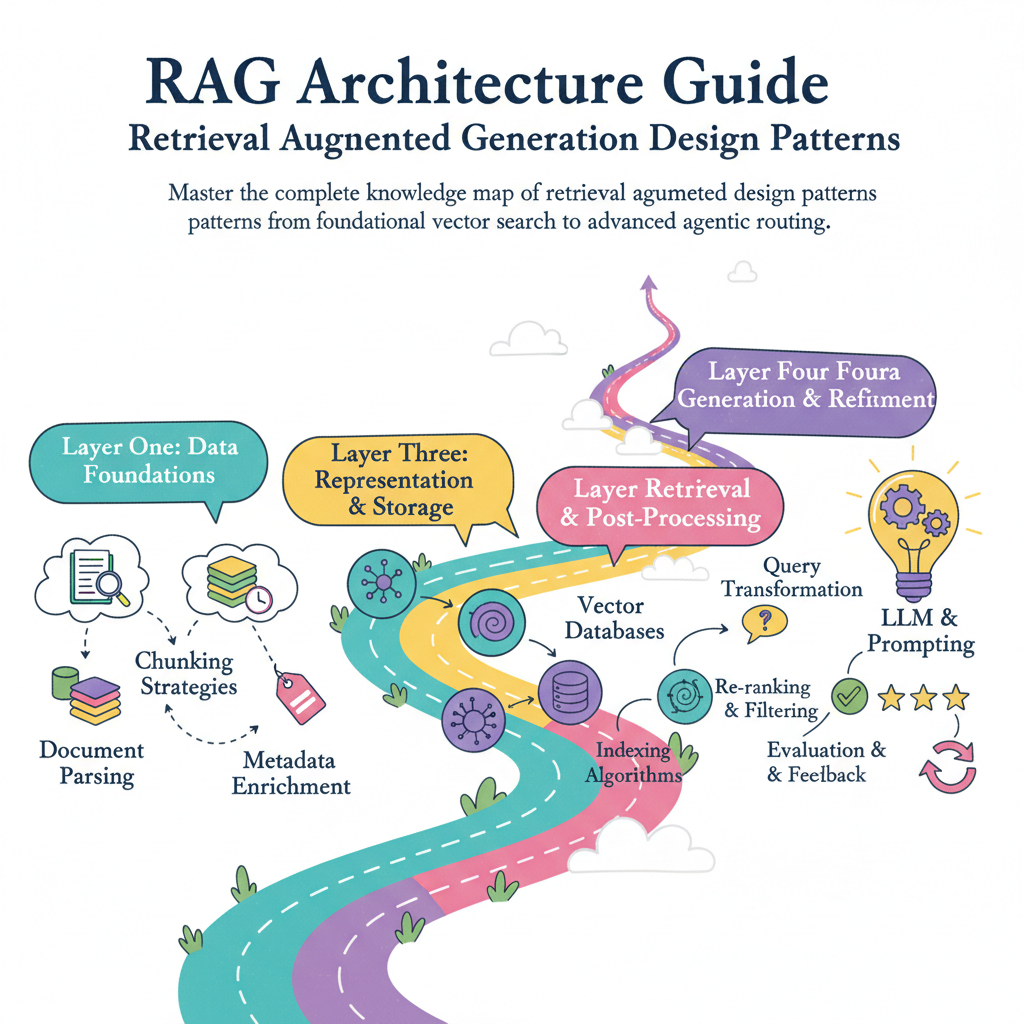
Master the complete knowledge map of retrieval-augmented generation design patterns from foundational vector search to advanced agentic routing.
Introduction to RAG Architecture Design
Retrieval-Augmented Generation changes how modern applications interact with large language models by grounding generated responses in external data sources. Most developers learn this technology backward by starting with complex orchestration frameworks before understanding the underlying mechanics. This guide presents a complete knowledge map of retrieval systems, showing how foundational layers build into advanced agentic patterns.
Who This Guide Is for
This guide is designed for software engineers, machine learning practitioners, and technical architects who need to build production-grade search and generation systems. You should have a working knowledge of Python, basic vector mathematics, and API integrations. By the end of this resource, you will understand every architectural layer required to design, scale, and troubleshoot high-performance knowledge systems.
Prerequisites and Expected Outcomes
Before diving into the dependency graph, ensure you are familiar with HTTP APIs, basic embedding concepts, and fundamental database indexing. Your primary outcome will be a mental model of the retrieval landscape that dictates exactly what components to build, what depends on what, and how to scale your system from prototype to production.