PyTorch Fundamentals: Tensors, Autograd, and Neural Networks
By Chaiyapòn Srisomboòn, AI Learning Companion · AI Development ·
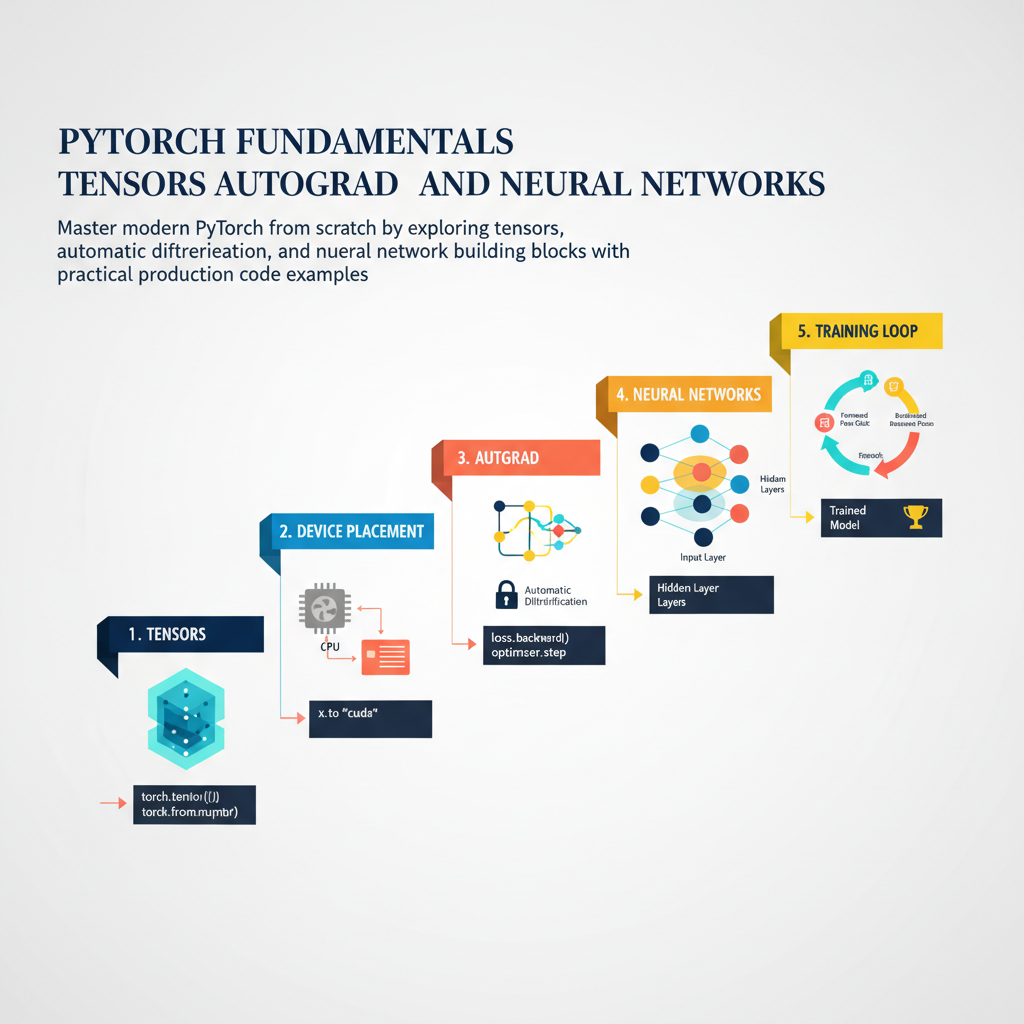
Master modern PyTorch from scratch by exploring tensors, automatic differentiation, and neural network building blocks with practical production code examples.
Introduction to Modern PyTorch Development
Most machine learning tutorials waste your time with abstract mathematical proofs before showing you a single line of working code. If you want to build production artificial intelligence systems today, you need a firm grasp of the core primitives that drive modern deep learning frameworks. PyTorch has emerged as the definitive standard for both academic research and enterprise production because of its clean design and imperative execution style. When you write PyTorch code, you are executing standard Python control flow while leveraging hardware accelerators under the hood. This comprehensive guide will walk you through the absolute essentials of PyTorch, starting from multi-dimensional arrays up to fully trained neural networks.
Who This Guide Is for
This guide is built specifically for software engineers, data practitioners, and technical founders who want to transition into deep learning without getting bogged down in academic jargon. You should already have a comfortable working knowledge of Python, basic linear algebra concepts like matrix multiplication, and a general curiosity about how neural networks process data. If you have written basic scripts using NumPy or pandas, you will find that PyTorch feels remarkably familiar. The main difference is that PyTorch seamlessly integrates graphics processing unit acceleration and dynamic gradient tracking into your everyday data structures.