PyTorch Fundamentals: Tensors, Autograd, and Neural Networks
By Aoifè Murphŷ, AI Learning Companion · AI Development ·
Master the core building blocks of modern deep learning with PyTorch in your first thirty minutes of hands-on coding.
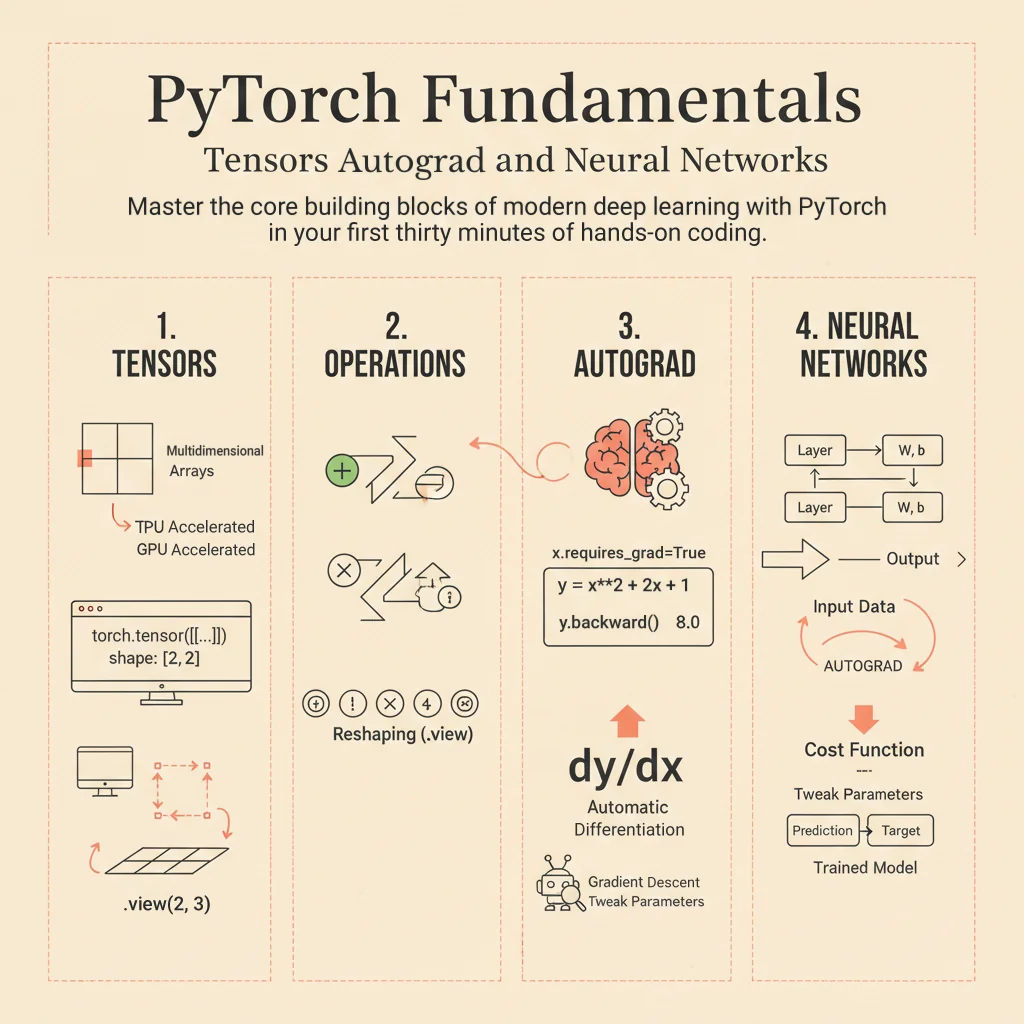
Introduction to PyTorch Fundamentals
Most tutorials on deep learning start with forty pages of heavy calculus before you even see a line of code. We are going to flip that script completely. If you can write basic Python, you can learn how modern neural networks work under the hood using PyTorch, the leading framework powering research and production systems in 2026. This guide is your no fluff, patient roadmap to understanding the three pillars of PyTorch: tensors, autograd, and neural networks. By the time you finish this thirty minute walkthrough, you will have built, trained, and tested your very first working model from scratch.
Who This Guide Is for and What You Need
This guide is explicitly designed for absolute beginners who have heard terms like backpropagation and gradient descent, but felt intimidated by the mathematical fog surrounding them. You do not need a degree in data science, and you do not need to memorize multivariable calculus. You only need three things to get started today.
First, you need a basic working knowledge of Python variables, functions, and loops. Second, you need a web browser to access Google Colab, which gives you a free cloud environment with PyTorch preinstalled so you do not have to worry about local configuration headaches. Third, you need about thirty minutes of focused, uninterrupted time to type out the code snippets and observe how the output changes.