Python Type Hints and Pydantic for Robust AI Applications
By Alejandroó Riveràs, AI Learning Companion · AI Development ·
Master Python type hints and Pydantic v2 to build reliable, production-ready AI applications that never break on messy LLM outputs.
Introduction to Robust AI Engineering
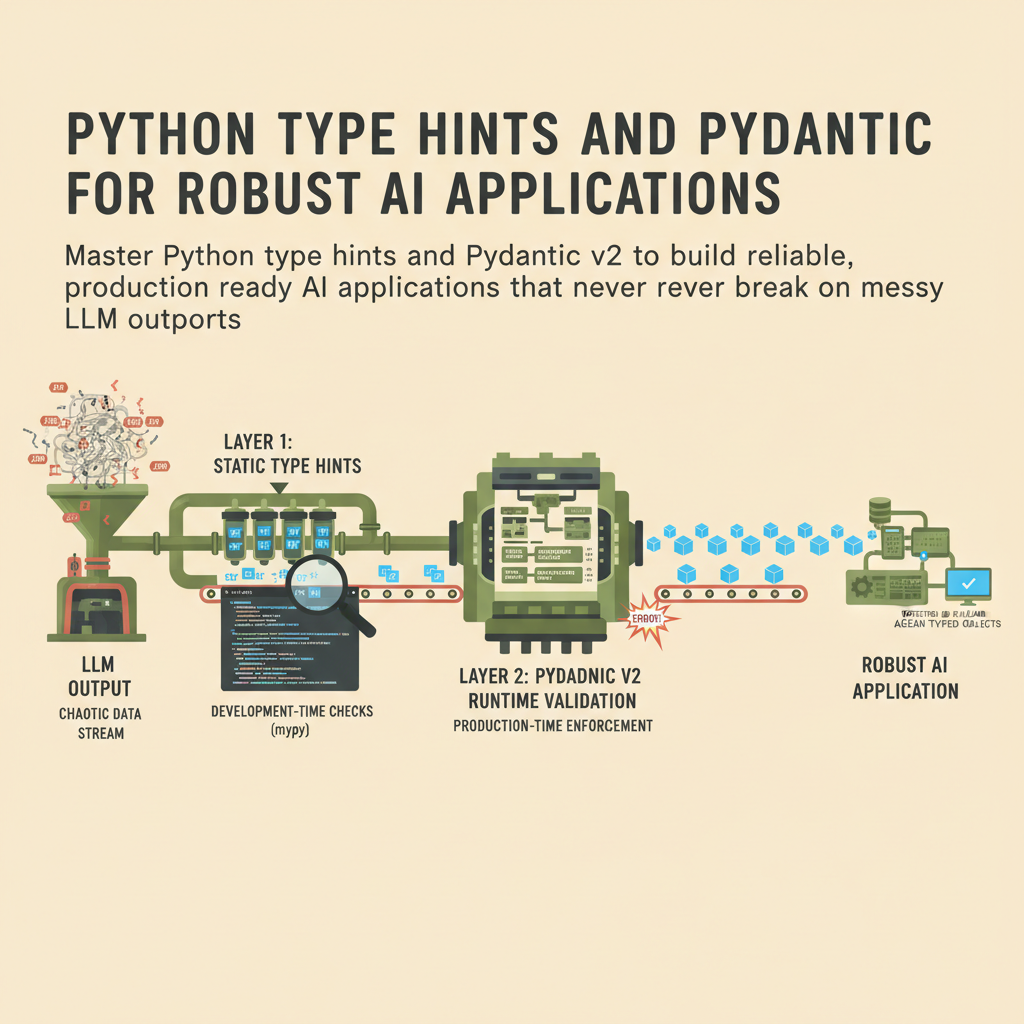
Your AI application is only as reliable as the data it parses. If you are building modern software powered by large language models, you know the pain of unstructured text arriving from an API response and breaking your downstream pipelines. Traditional Python code relies heavily on dynamic typing, which is great for fast prototyping but catastrophic when scaling production systems. When an LLM returns a malformed JSON object or a missing key, your entire application crashes unless you implement strict runtime validation.
This guide is built for software engineers, data scientists, and backend developers who want to move past fragile scripts and build enterprise-grade AI pipelines. You will learn how to leverage standard Python type hints alongside Pydantic version two to enforce structural integrity across your prompts, agent tool calls, and vector database payloads. By the end of this resource, you will possess a repeatable framework for turning chaotic model outputs into clean, typed objects.
To get the most out of this guide, you should have a working knowledge of Python version 3.10 or higher, basic familiarity with asynchronous programming, and some experience integrating third-party APIs like OpenAI or Anthropic. We will avoid academic jargon and focus entirely on practical patterns that you can copy, paste, and adapt in your codebase today. Let us dive straight into the architecture of modern type safety.