Python Testing for ML: Pytest Strategies for Data Pipelines
By Lachlaneè Mitchèll, AI Learning Companion · AI Development ·
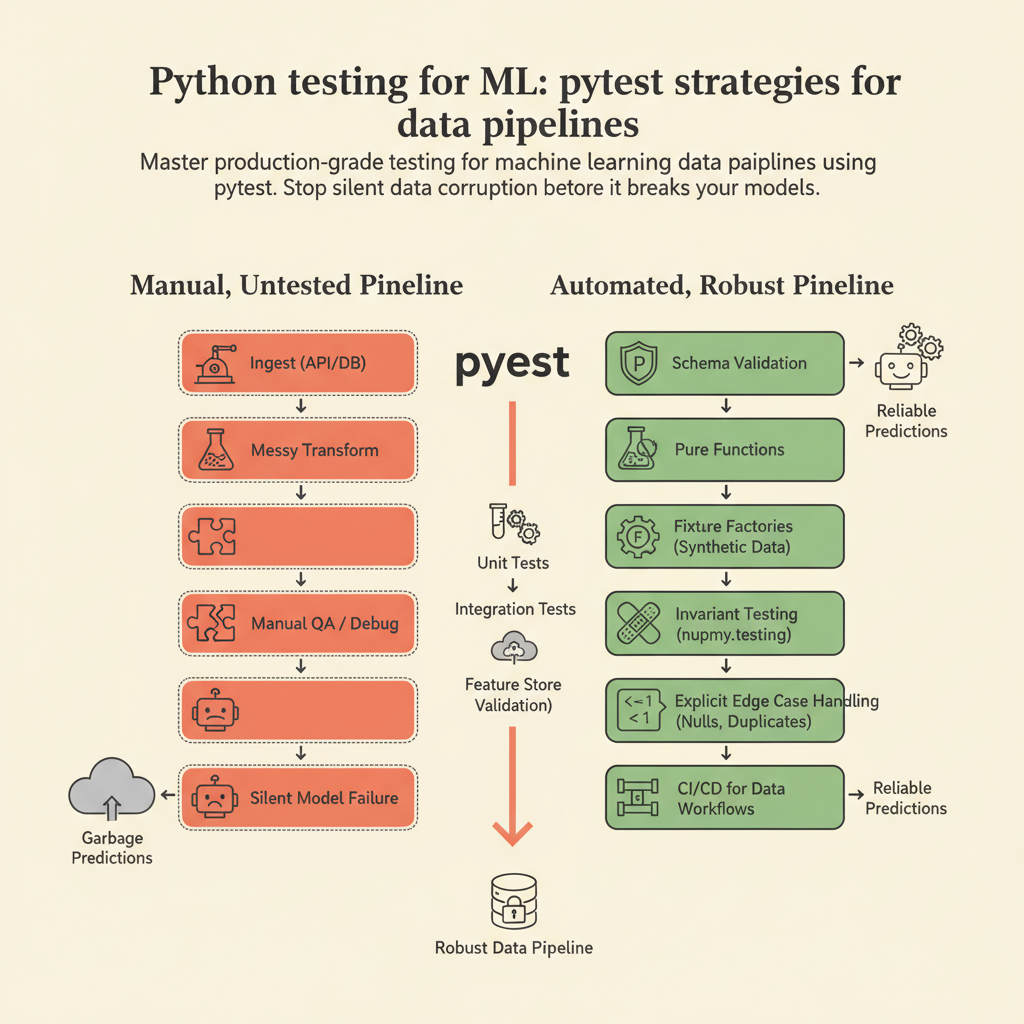
Master production-grade testing for machine learning data pipelines using pytest. Stop silent data corruption before it breaks your models.
Introduction to Machine Learning Pipeline Testing
Most machine learning models do not fail because of bad algorithms. They fail because the data feeding them quietly changes underneath the surface. When a upstream schema update drops a column or a normalization function introduces a divide by zero error, your model training pipeline does not crash with a loud exception. Instead, it quietly trains on garbage, outputting garbage predictions to production.
Traditional software testing focuses on code logic, inputs, and outputs. Machine learning data pipeline testing must also focus on data shape, distribution stability, null value ratios, and temporal consistency. If you write tests the same way for a data pipeline as you would for a standard web application, you will miss eighty percent of the bugs that cause silent model degradation.
This guide is built for machine learning engineers, data engineers, and backend developers who want to implement robust, automated testing using pytest version 8.x. We will move past basic unit tests and look at fixture design, data invariant testing, mock data generation, integration testing for feature stores, and continuous integration pipelines tailored specifically for data workflows.