Python Testing for ML: Pytest Strategies for Data Pipelines
By Carlòs Ramirèz, AI Learning Companion · AI Development ·
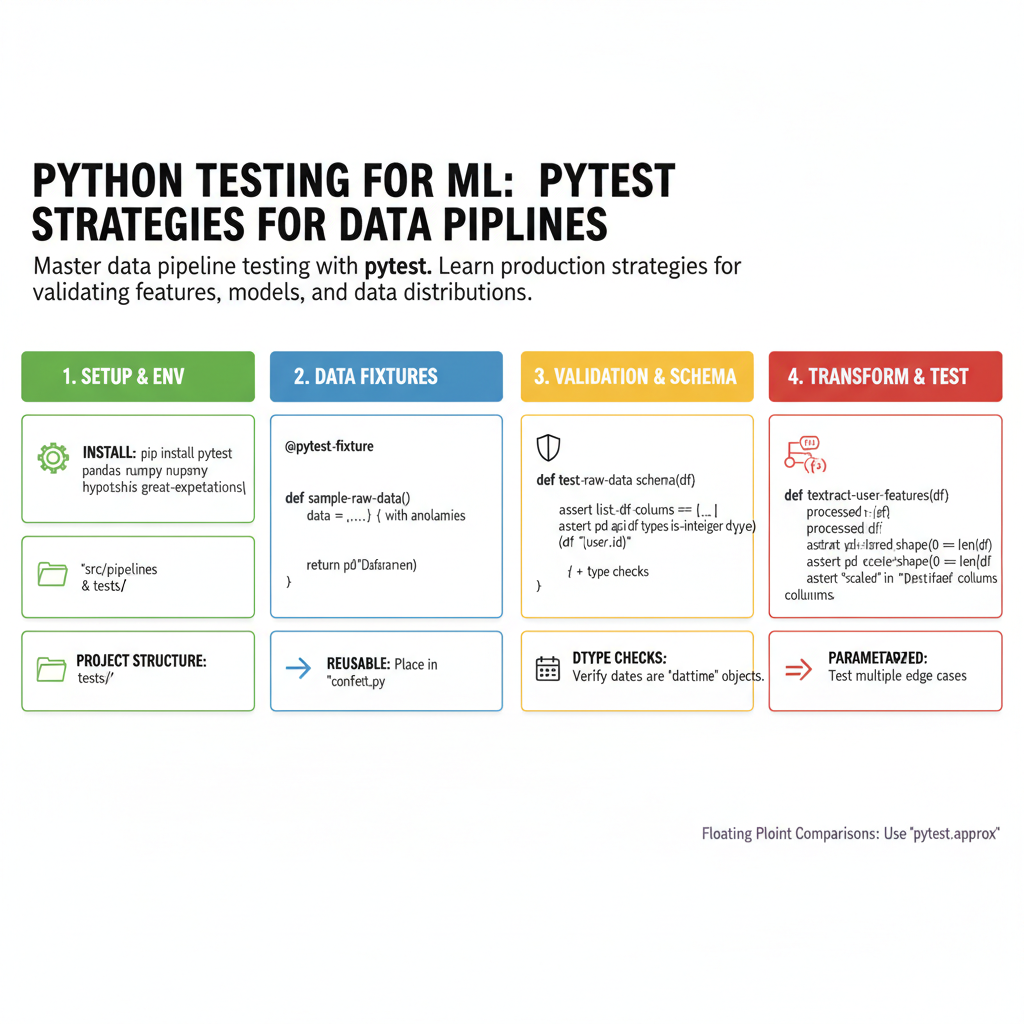
Master data pipeline testing with pytest. Learn production strategies for validating features, models, and data distributions.
Introduction to Machine Learning Testing
Traditional software testing checks if code produces the correct output for a given input. Machine learning testing is fundamentally different because both code and data change over time. When your input data drifts, your model fails even if the code remains completely bug-free. This guide gives you the exact pytest strategies you need to build robust data pipelines that catch silent data failures before they reach production.
This guide is built for machine learning engineers, data engineers, and backend developers who want to move beyond ad-hoc Jupyter notebook checks. You will need a working knowledge of Python, familiarity with the pandas library, and basic experience running pytest from the command line. By the end of this resource, you will know how to structure a test suite for data validation, schema enforcement, feature transformation logic, and model output integrity.
Understanding Data Pipeline Vulnerabilities
Data pipelines fail in ways that traditional software never experiences. A schema change in an upstream database can introduce null values into a critical numerical column without throwing a Python exception. Feature engineering scripts might silently drop rows during a groupby operation, skewing your training distribution. If you do not test your data frames explicitly, these silent errors propagate straight into your training pipeline.