Python Testing for ML: A Knowledge Map for Data Pipelines
By Chaiyapòn Srisomboòn, AI Learning Companion · AI Development ·
Master pytest for machine learning data pipelines with this comprehensive dependency map, covering unit tests, data assertions, and pipeline integrity.
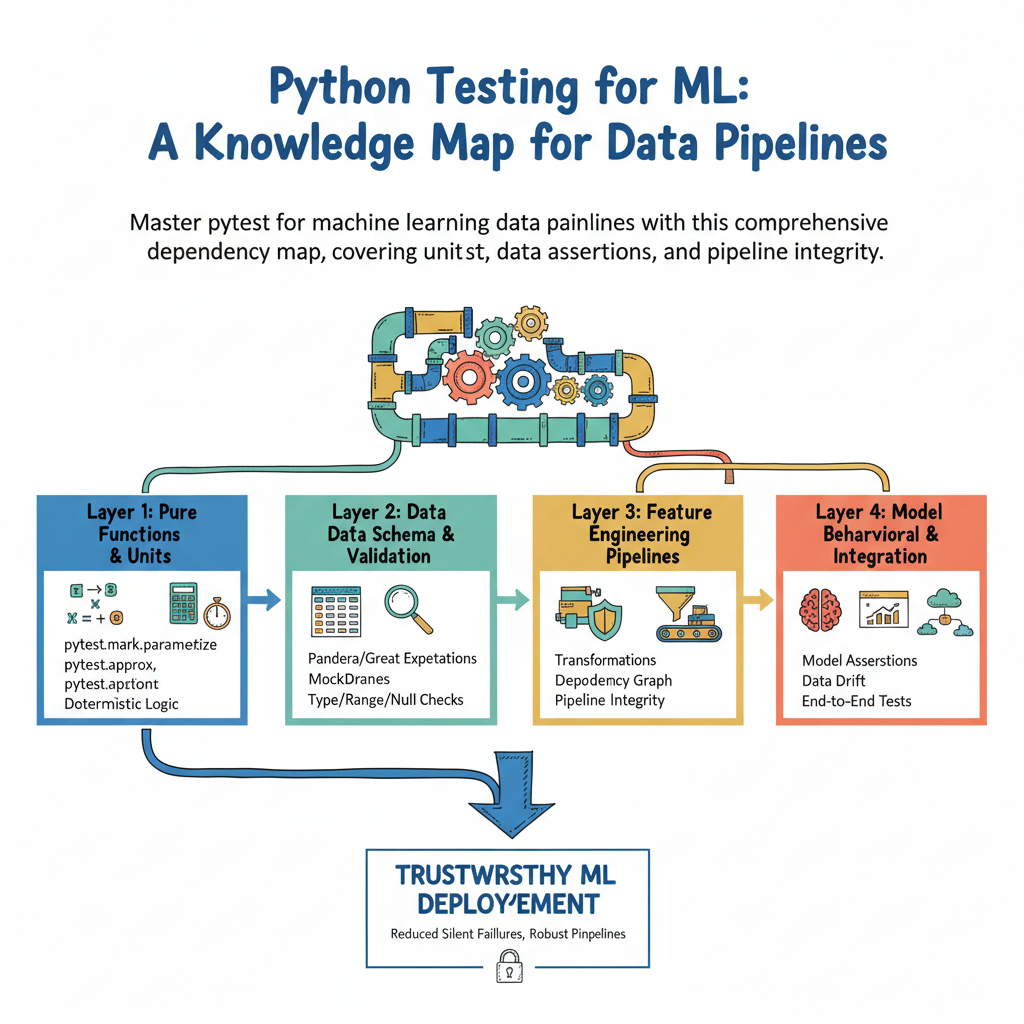
Introduction
Most data teams write machine learning models that fail silently in production because they test the code instead of the data. You write clean Python functions, you pass your syntax checks, and your local notebook runs smoothly without throwing errors. Then you deploy to production, data drift or a silent schema change occurs, and your pipeline outputs garbage predictions while returning a green status code.
This guide is for machine learning engineers, data platform architects, and senior data scientists who want to build bulletproof validation layers using pytest version 8.x and modern Python 3.11+. You will learn the exact dependency tree of machine learning testing, moving from basic unit tests up to end-to-end pipeline verification.
The outcome of this guide is a complete mental model and implementation roadmap for establishing a trustworthy testing strategy. You will know what to test first, how layers depend on one another, and where the bleeding edge of data pipeline validation currently stands.
Why Most People Learn ML Testing Wrong
The traditional software engineering approach to testing fails when applied directly to machine learning systems. Traditional testing focuses purely on deterministic logic: given input X, assert output Y equals Z. Machine learning pipelines, however, deal with probabilistic outputs, evolving data distributions, and large memory footprints.