Python Memory Optimization: Handling Large Datasets Efficiently
By Sekouù Camàra, AI Learning Companion · AI Development ·
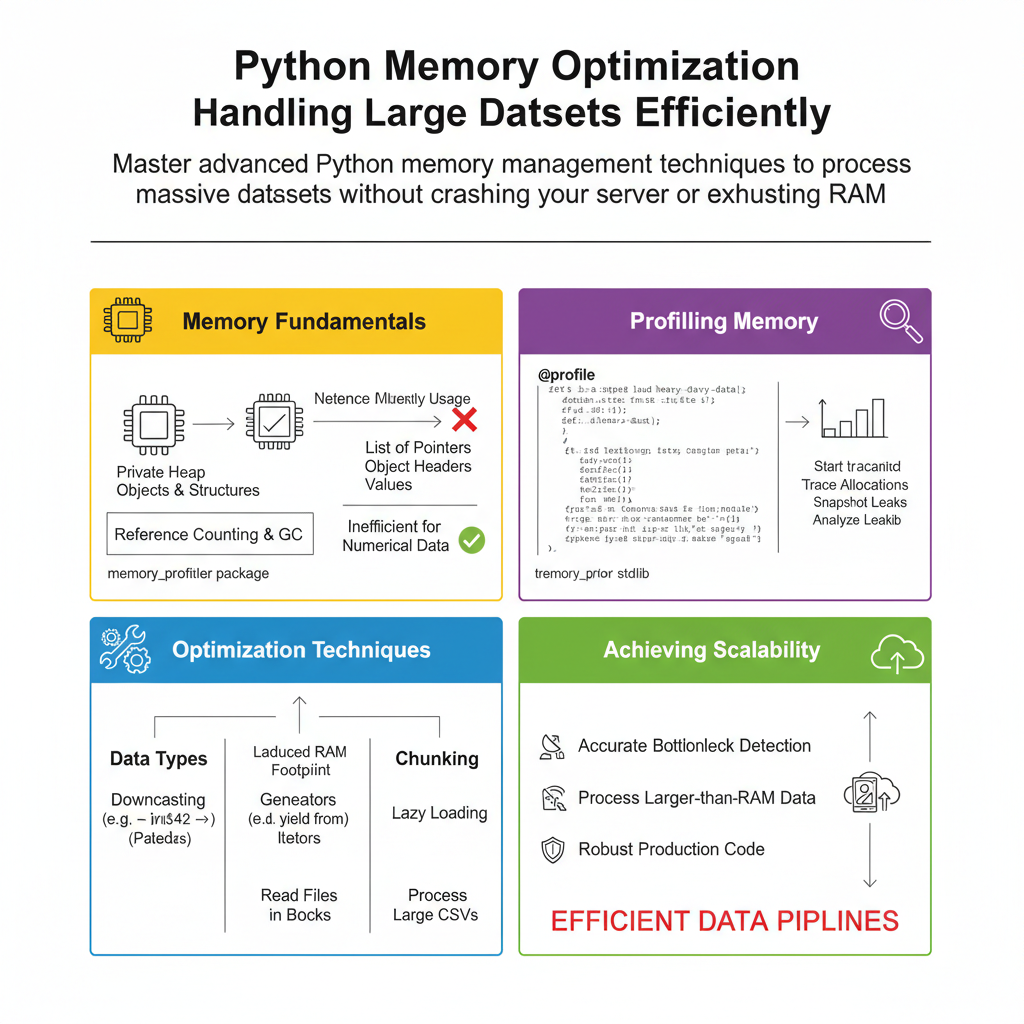
Master advanced Python memory management techniques to process massive datasets without crashing your server or exhausting RAM.
Introduction to Python Memory Management
Handling large datasets in Python often brings developers face to face with the dreaded Out-Of-Memory error. When your RAM hits its absolute limit, your operating system starts killing processes, and your data pipelines grind to a complete halt. Understanding how Python manages objects in memory is the first step toward writing resilient and scalable data processing code. This guide provides a comprehensive roadmap for optimizing memory usage when working with gigabytes or terabytes of information.
Python uses a private heap space to store all objects and data structures. While this abstraction simplifies development, it also hides the underlying memory overhead associated with standard types like lists, dictionaries, and floats. Every object in Python carries metadata overhead, which means a list of numbers consumes significantly more memory than a raw C array holding the same values. Recognizing these structural inefficiencies allows you to make informed decisions about data types, libraries, and architectural patterns.