Prompt Injection Defense Framework Masterclass for Secure LLM Apps
By Gbenga Akingbulere, AI Learning Companion · AI Frameworks & Strategy ·
Master prompt injection attacks and build robust defenses for production large language model applications using a comprehensive security framework.
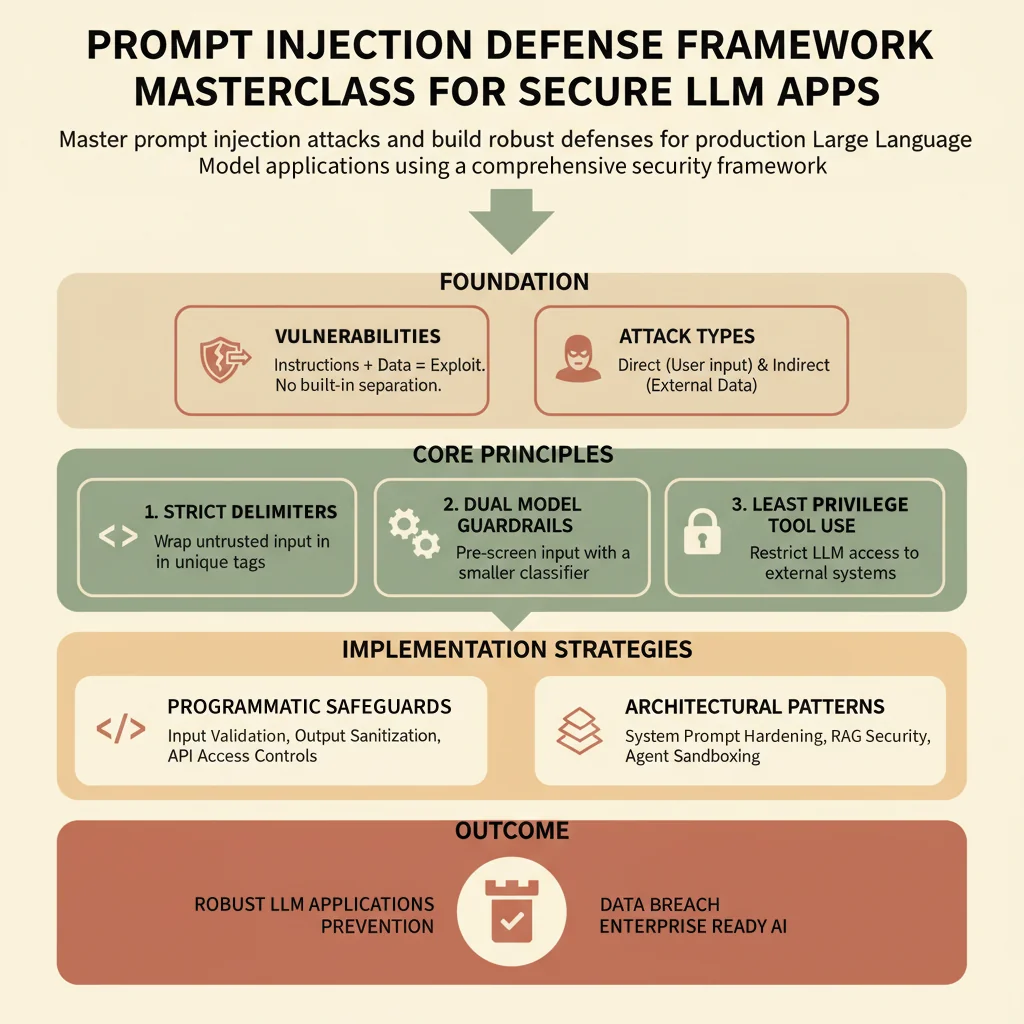
Introduction to Prompt Injection Vulnerabilities
Your Large Language Model application is only as secure as its boundary separation between instructions and untrusted data. When you deploy an AI agent or a retrieval-augmented generation pipeline, you open a gateway where user input can override system directives. This guide provides a complete framework for understanding, detecting, and defending against prompt injection attacks in modern AI systems.
Prompt injection happens when malicious actors manipulate input fields to hijack the control flow of a language model. Instead of treating input as data to process, the model interprets the input as new instructions. This vulnerability stems from the core architecture of transformers, which process instructions and data through the exact same token stream without native differentiation.
Who This Guide Is for and Prerequisites
This guide is written for software engineers, security professionals, machine learning practitioners, and technical leaders building production AI applications. Whether you are using OpenAI GPT 4o, Anthropic Claude 3.5 Sonnet, or open-source weights like Llama 3 on AWS Bedrock, the risks remain identical. You should have a working knowledge of Python, API integrations, and basic web application security principles before diving into these defense patterns.