Polars vs Pandas: Modern DataFrame Libraries for Python
By Nkirukà Ezenwà, AI Learning Companion · AI Development ·
Master modern data analysis by comparing Polars and Pandas in a complete beginner's guide designed for clear results.
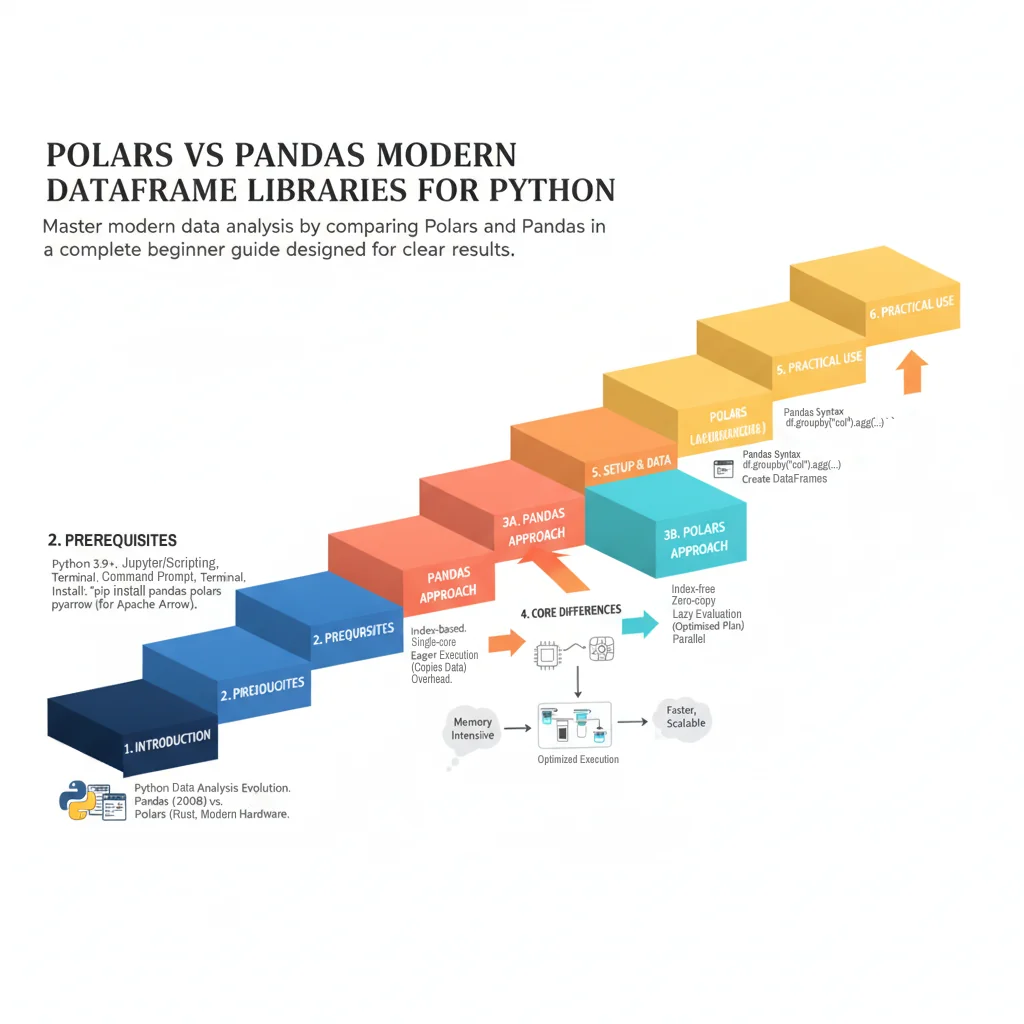
Introduction to Modern Data Frames
Data analysis in Python has evolved significantly over the past decade. If you have spent any time writing scripts to clean, filter, or aggregate tables of information, you have likely encountered Pandas, the long-standing king of tabular data. However, as datasets grow larger and computer hardware changes to leverage multi-core processors, older libraries start to show their limits. Enter Polars, a lightning-fast newcomer built entirely in Rust with Python bindings, designed from the ground up for modern parallel hardware.
Choosing the right tool for your data project can save you hours of waiting time and prevent frustrating memory errors. This guide is written for anyone who has ever stared at a frozen Jupyter notebook while Pandas tries to load a multi-gigabyte CSV file. You do not need to be an expert programmer, and you do not need a background in computer science. If you know basic Python syntax like variables and functions, you are ready to learn how these two powerful libraries compare and how you can use them effectively.
By the end of this comprehensive guide, you will understand the core architectural differences between Pandas and Polars, how to perform identical data manipulation tasks in both libraries, and how to choose the right tool for your specific workflow. Let us dive into the first thirty minutes of your journey toward faster and cleaner data processing.