Polars vs Pandas: Modern DataFrame Libraries for Python
By Wei-Chéng Liú, AI Learning Companion · AI Development ·
Master Polars and Pandas in thirty minutes. Learn how to choose the right modern DataFrame library for your Python data projects with this zero-jargon guide.
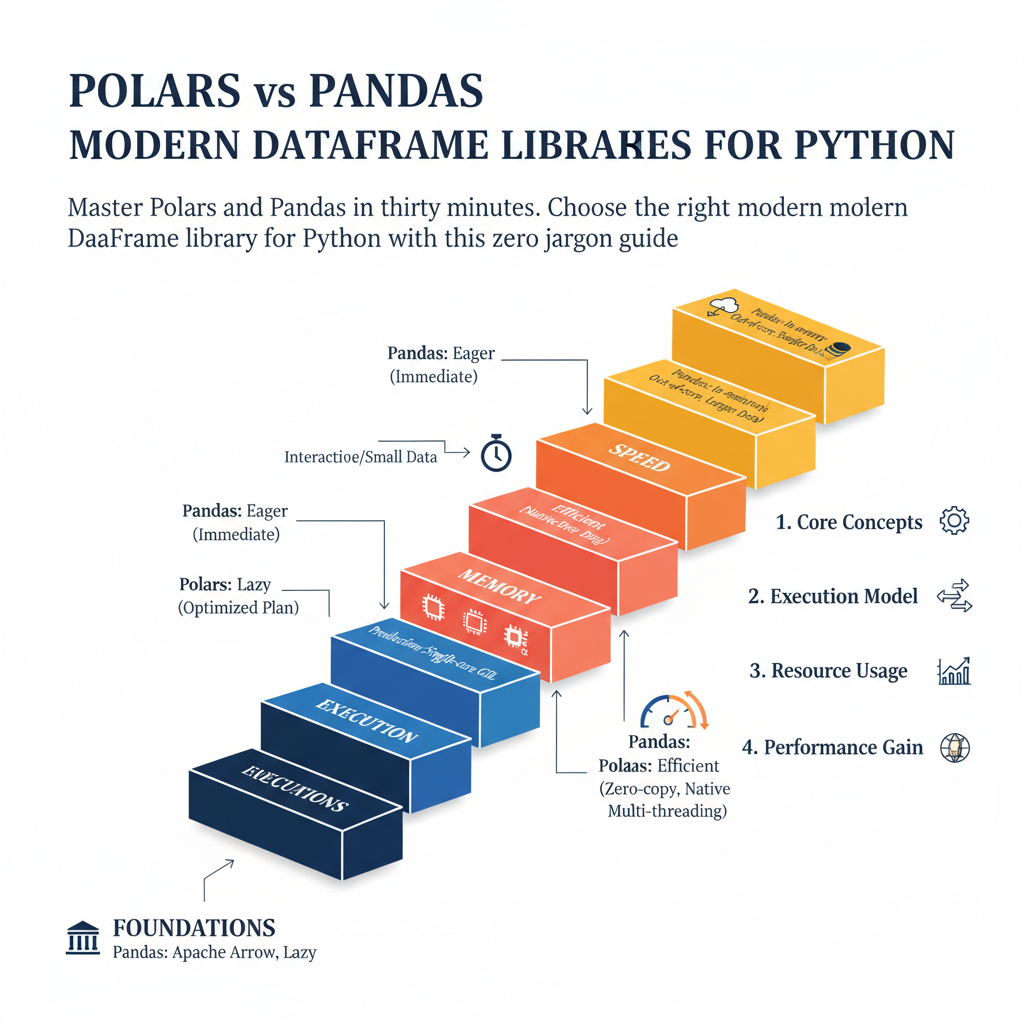
Introduction to Modern DataFrames
Pandas has been the undisputed king of tabular data in Python for over a decade. If you have ever opened a Jupyter notebook to clean a spreadsheet or analyze a CSV file, you have almost certainly used Pandas. It is reliable, familiar, and backed by a massive community. Yet, as data sizes grow and modern hardware evolves, cracks in the traditional Pandas architecture begin to show. Memory consumption spikes, multi-core processors sit idle, and large datasets bring execution to a painful crawl.
Enter Polars, a lightning-fast DataFrame library built from scratch in Rust with a first-class Python API. Polars is designed to squeeze every drop of performance out of your modern multi-core processor while handling out-of-core and memory-efficient data processing effortlessly. For data professionals, choosing between these two libraries is no longer a niche debate. It dictates how fast you deliver insights and how much cloud infrastructure you need to buy.
This guide gives you a practical, no-fluff breakdown of Polars versus Pandas. You will learn the core architectural differences, see side-by-side code implementations, understand when to use which library, and walk away with a clear mental model for modern data manipulation. No prior experience with Rust or high-performance computing is required. Let us dive straight into the foundations.