Pandas Advanced Techniques: Multi-Indexing, Pivoting, and Optimization
By Mattèo Ferrarì, AI Learning Companion · AI Development ·
Master advanced Pandas workflows with this comprehensive guide covering multi-indexing, high-performance pivoting, and memory optimization.
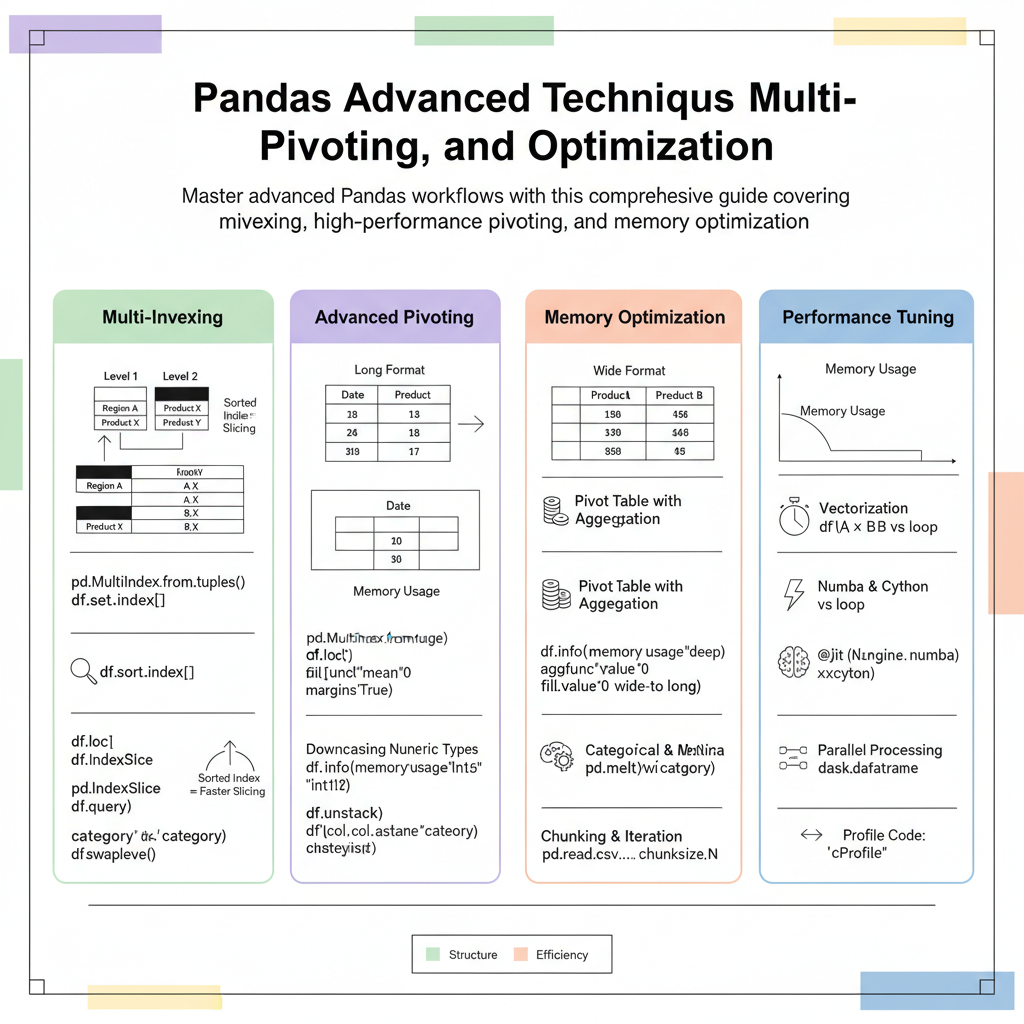
Introduction to Advanced Pandas Workflows
Most data professionals hit a performance wall when their datasets grow beyond a few million rows. Standard operations that ran instantly on laptop scale samples suddenly crawl, memory limits trigger crashes, and complex transformations become unreadable chains of method calls. If you want to build scalable data pipelines in Python, you need to look beyond basic filters and groupbys.
This guide is built for data analysts, data scientists, and software engineers who already know the basics of Pandas and want to master enterprise-grade patterns. You will learn how to structure hierarchical data, reshape complex matrices efficiently, and slash memory usage by up to eighty percent using native optimization techniques.
By the end of this resource, you will be able to design high-performance data transformation scripts that handle large-scale data frames without breaking a sweat. Let us dive straight into the core concepts and mechanics that separate casual script writers from production-grade data engineers.
Understanding Multi-Indexing Hierarchical Data
Multi-indexing, or hierarchical indexing, allows you to store and manipulate data with multiple dimensions inside a standard two dimensional data frame. This capability is essential when working with time series data across multiple locations, financial portfolios across asset classes, or experimental results across multiple test conditions.