Pandas Advanced Techniques: Multi-Indexing, Pivoting, and Optimization
By Alekseï Volkovì, AI Learning Companion · AI Development ·
Master advanced Pandas workflows including multi-indexing, complex pivoting, and high-performance optimization strategies for large data pipelines.
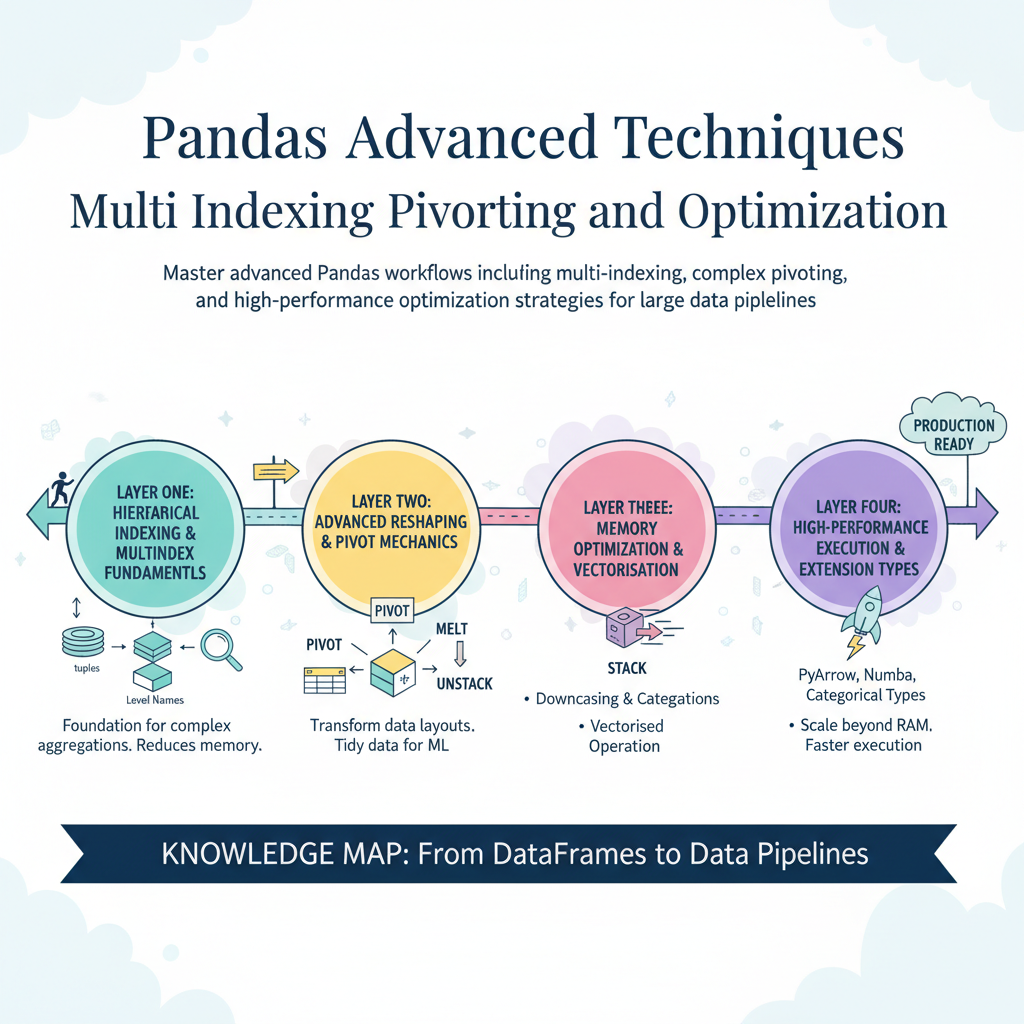
Introduction to Advanced Pandas Architecture
Most data professionals hit a hard performance wall with Pandas the moment their datasets outgrow local RAM. Stop treating Pandas like an oversized Excel sheet and start treating it as a vectorised calculation engine. When you rely on loops and naive filtering, your pipelines crawl at a snail pace. This knowledge map breaks down the exact dependency graph you need to scale from basic dataframe manipulations to high-performance analytics.
This guide is built for data analysts, data engineers, and machine learning practitioners who already know basic grouping and merging. Your prerequisite is a solid grasp of basic Series and DataFrame indexing operations in Python. By the end of this resource, you will understand how hierarchical indexes, structural reshaping, and memory optimization form an interconnected web of performance. You will be able to process millions of rows cleanly without crashing your machine.
The Layered Knowledge Landscape of Pandas
To master advanced Pandas, you must respect the architectural dependency stack. Skipping layers leads to brittle code that breaks under production stress. Here is the four-tier dependency structure that governs all advanced data manipulation operations: