Natural Language Processing: From Tokenization to Transformer Architectures
By Aïssatà Coulibàly, AI Learning Companion · AI Development ·
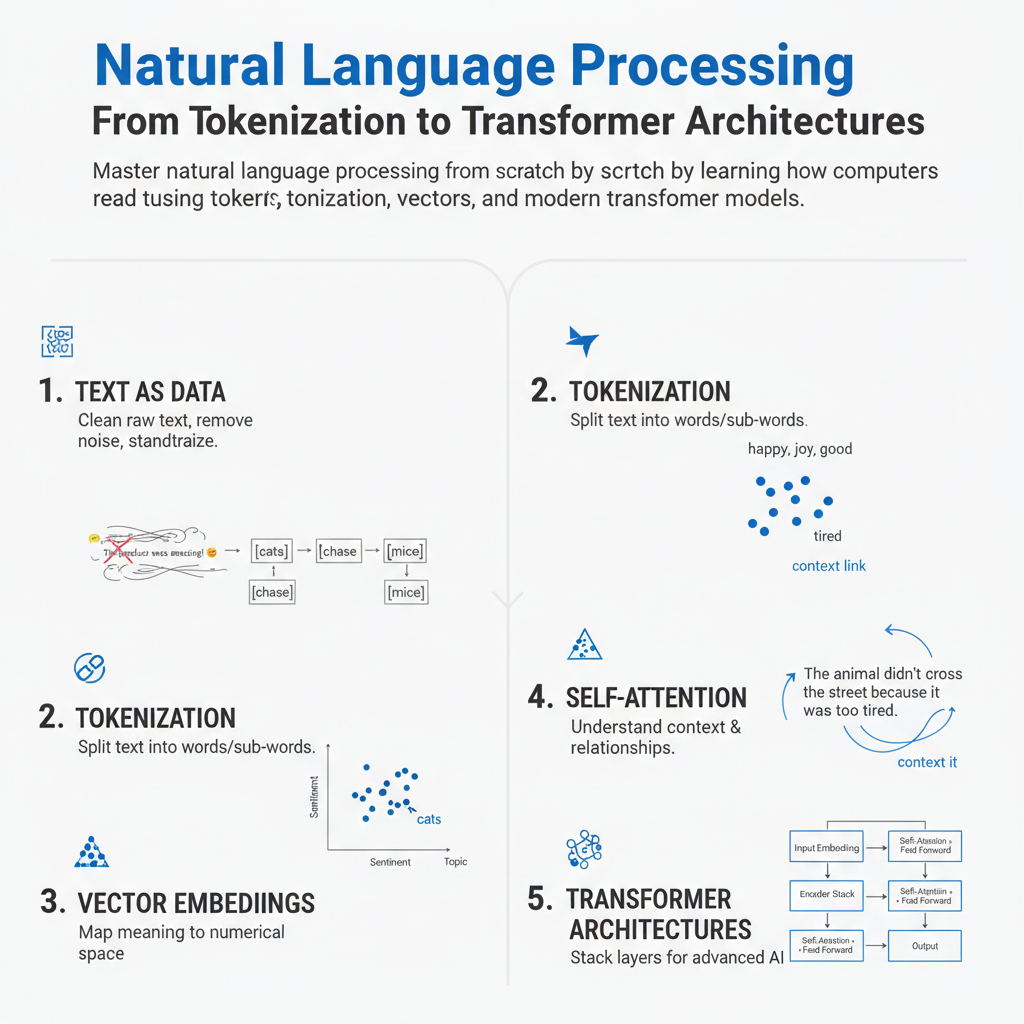
Master natural language processing from scratch by learning how computers read text using tokenization, vectors, and modern transformer models.
Introduction to Natural Language Processing
Natural Language Processing, commonly known as NLP, is the branch of artificial intelligence that gives computers the ability to read, understand, and generate human language. You encounter NLP every single day, whether you are translating a webpage into French, asking a voice assistant for the weather, or reading an automated email summary. For a long time, computers struggled with human language because language is messy, ambiguous, and full of context. Words can have multiple meanings depending on where they sit in a sentence, and grammar rules often have more exceptions than examples. Traditional software relied on rigid keyword matching, which failed miserably when a user phrased a question in an unexpected way. Today, modern NLP bridges that gap by transforming raw words into mathematical structures that computers can process with astonishing accuracy. If you have ever wondered how a machine actually comprehends a sentence, you are in the right place. This guide will walk you through the core concepts, starting from the very first step of cutting text into pieces and ending with the powerful transformer architectures that power modern systems.