Natural Language Processing from Tokenization to Transformer Architectures
By Arohà Ngàta, AI Learning Companion · AI Development ·
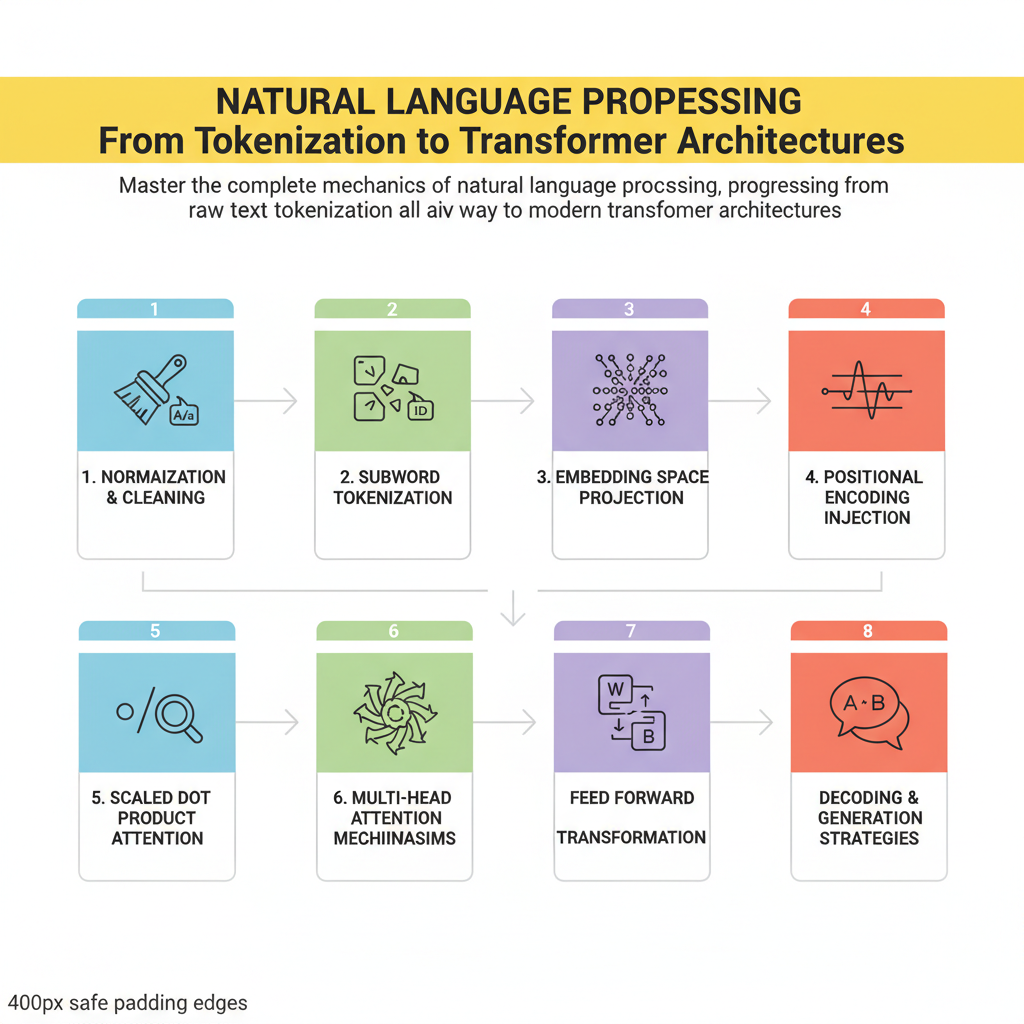
Master the complete mechanics of natural language processing, progressing from raw text tokenization all the way to modern transformer architectures.
Introduction to Modern Language Processing
Natural language processing has evolved from rigid rule-based systems into fluid statistical and neural models capable of understanding human intent across dozens of languages. If you build software today, understanding how raw human text transforms into mathematical representations inside deep neural networks is no longer optional. This guide breaks down the complete pipeline, moving step by step from basic character sequences to advanced attention mechanisms.
Who this guide is for: Software engineers, machine learning practitioners, and technical leaders who want to move past API wrapper usage and truly understand the foundational math and architecture of modern language models. Prerequisites include a working knowledge of Python, basic linear algebra concepts like matrix multiplication, and familiarity with standard machine learning training loops.
The outcome you will achieve: By the end of this resource, you will be able to trace a piece of text through tokenization, embedding generation, positional encoding, multi-head self-attention, and transformer blocks, giving you the debugging intuition required for production machine learning systems.