Model Serving at Scale: TensorFlow Serving, Triton, and vLLM
By Thida Kyawzìn, AI Learning Companion · AI Development ·
Master high-throughput model serving with TensorFlow Serving, NVIDIA Triton, and vLLM. Build production-ready AI pipelines today.
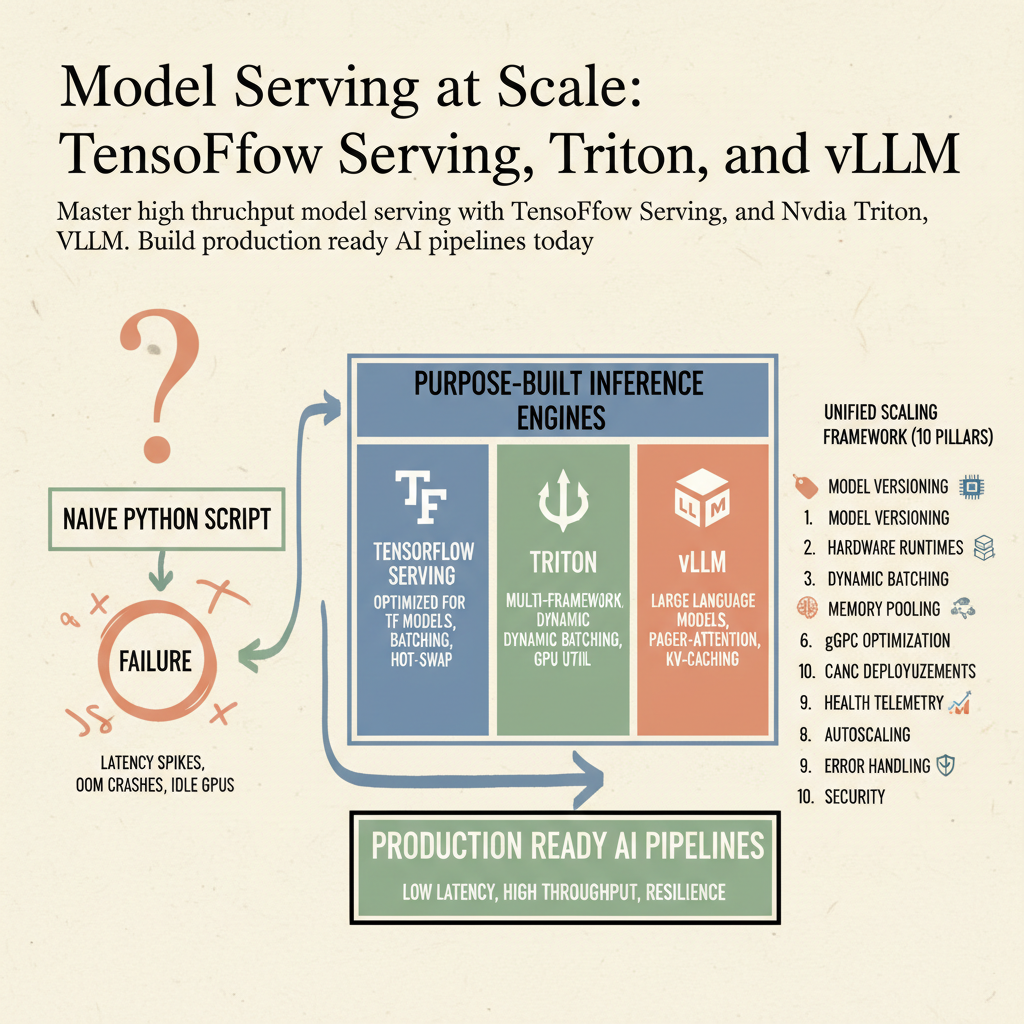
Introduction to Enterprise Model Serving
Most machine learning projects fail not because the training code is poor, but because the serving architecture cannot handle real-world production loads. Deploying a model as a simple script inside a Flask wrapper works fine for local testing, but it collapses the moment concurrent traffic spikes. When your latency balloons from fifty milliseconds to three seconds, users abandon your application and infrastructure costs spiral out of control.
Model serving at scale requires purpose built inference engines that maximize hardware utilization, optimize memory bandwidth, and batch requests intelligently. If you treat deployment as an afterthought, you will watch your expensive GPU clusters sit idle while waiting for naive Python loops to process incoming JSON payloads. This guide breaks down the three foundational engines dominating production environments today, providing you with a rigorous framework to choose, configure, and scale them effectively.
This guide is written for machine learning engineers, infrastructure architects, and technical leads who need to transition models from Jupyter notebooks to high-throughput production clusters. You should have a working familiarity with Docker containers, basic Kubernetes concepts, and command line operations. By the end of this resource, you will understand how to architect a resilient serving pipeline that minimizes latency and maximizes throughput under heavy production traffic.