Model Serving at Scale for Beginners: TensorFlow, Triton, and vLLM
By Hiroshì Yamadà, AI Learning Companion · AI Development ·
Master the fundamentals of production model serving using TensorFlow Serving, Triton Inference Server, and vLLM in this comprehensive guide.
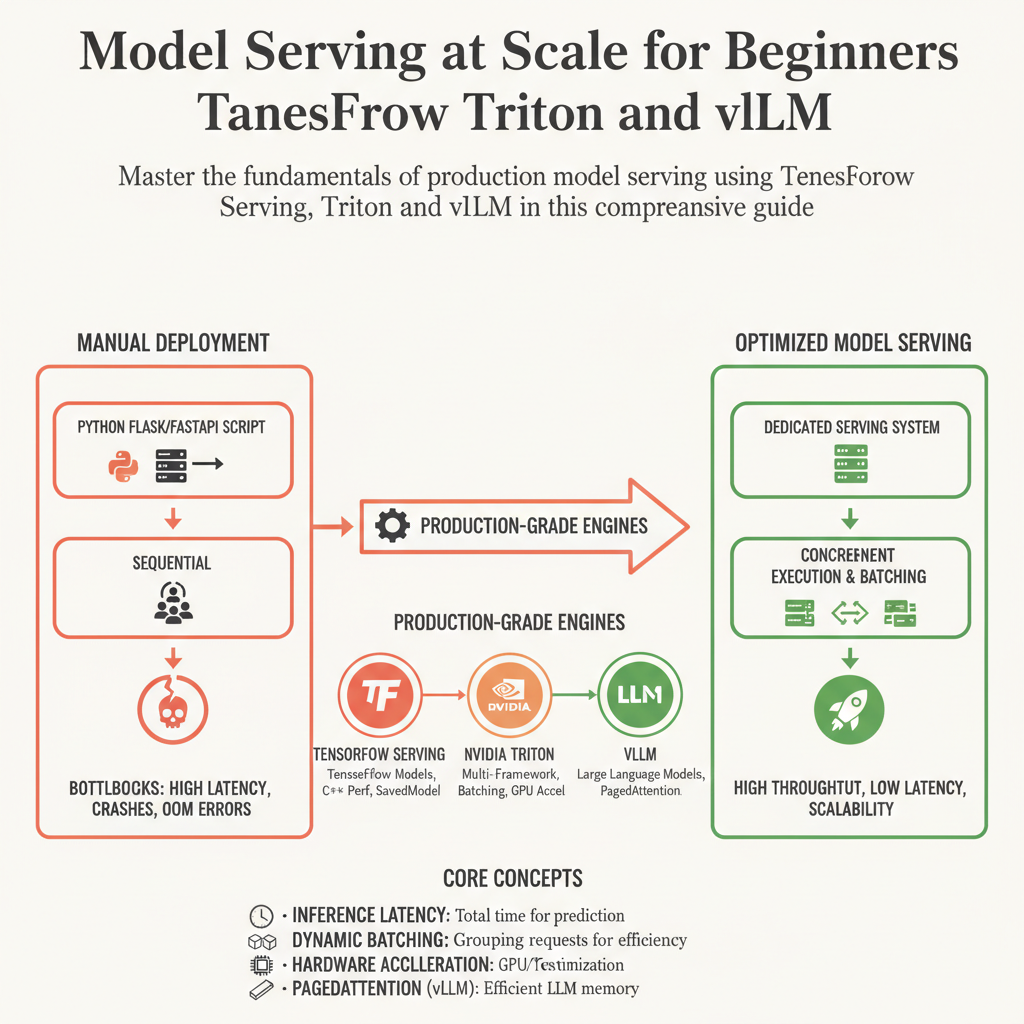
Introduction to Model Serving at Scale
Model serving at scale is the art and science of taking a machine learning model from a static notebook file and turning it into a high speed, reliable web service that can handle thousands of requests per second. Most beginners think that writing a Python script with Flask or FastAPI is enough to deploy an artificial intelligence model to production. However, custom web wrappers quickly bottleneck under real-world traffic because they lack efficient memory management, hardware acceleration, and concurrent request batching. When your application grows, unoptimized serving stacks run out of memory, crash under sudden traffic spikes, or introduce unacceptable latency that ruins the user experience. This guide will walk you through the core concepts, practical setups, and real-world workflows of three industry standard serving engines, namely TensorFlow Serving, NVIDIA Triton Inference Server, and vLLM. By the end of this journey, you will know exactly how each tool functions, when to deploy them, and how to configure your first high-performance inference endpoint.