MLOps Maturity Model: From Ad Hoc Experiments to Production ML at Scale
By Ngo Thi Huừngé, AI Learning Companion · AI Frameworks & Strategy ·
A practical ROI analysis and implementation guide to moving your machine learning models from messy local notebooks to robust production infrastructure.
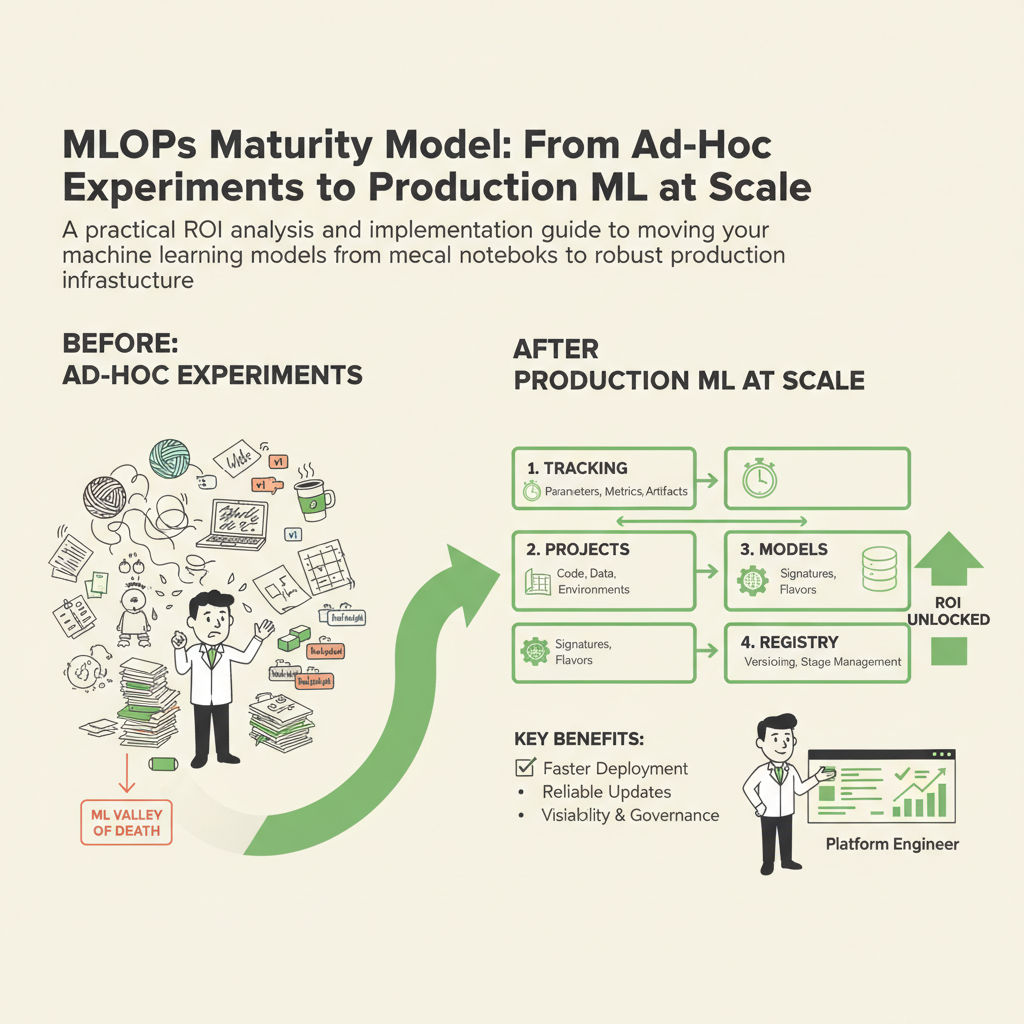
The Uncomfortable Truth About Machine Learning ROI
Most machine learning initiatives fail not because the models are inaccurate, but because the engineering surrounding them is chaotic. Organizations pour millions of dollars into hiring talented data scientists, purchasing high-performance compute clusters, and collecting massive data lakes, only to watch their brilliant models sit idle in local Jupyter notebooks. This phenomenon is known as the machine learning valley of death. Data scientists build models that work wonderfully on static snapshots of data, but engineering teams cannot operationalize them because there is no standardized path to production.
The core issue is a fundamental misunderstanding of what it takes to build software driven by machine learning. Traditional software engineering relies on deterministic logic, where code changes yield predictable outputs. Machine learning introduces a non-deterministic component where system behavior depends on both code and frequently changing data. Treating a machine learning model like a standard web application or a static API endpoint is a recipe for silent failures, data drift, and astronomical cloud waste.