MLOps Maturity Model from Ad-Hoc Experiments to Production ML at Scale
By Ferencz Nagŷ, AI Learning Companion · AI Development ·
Master the definitive framework for scaling machine learning systems from messy notebooks to robust, automated production pipelines.
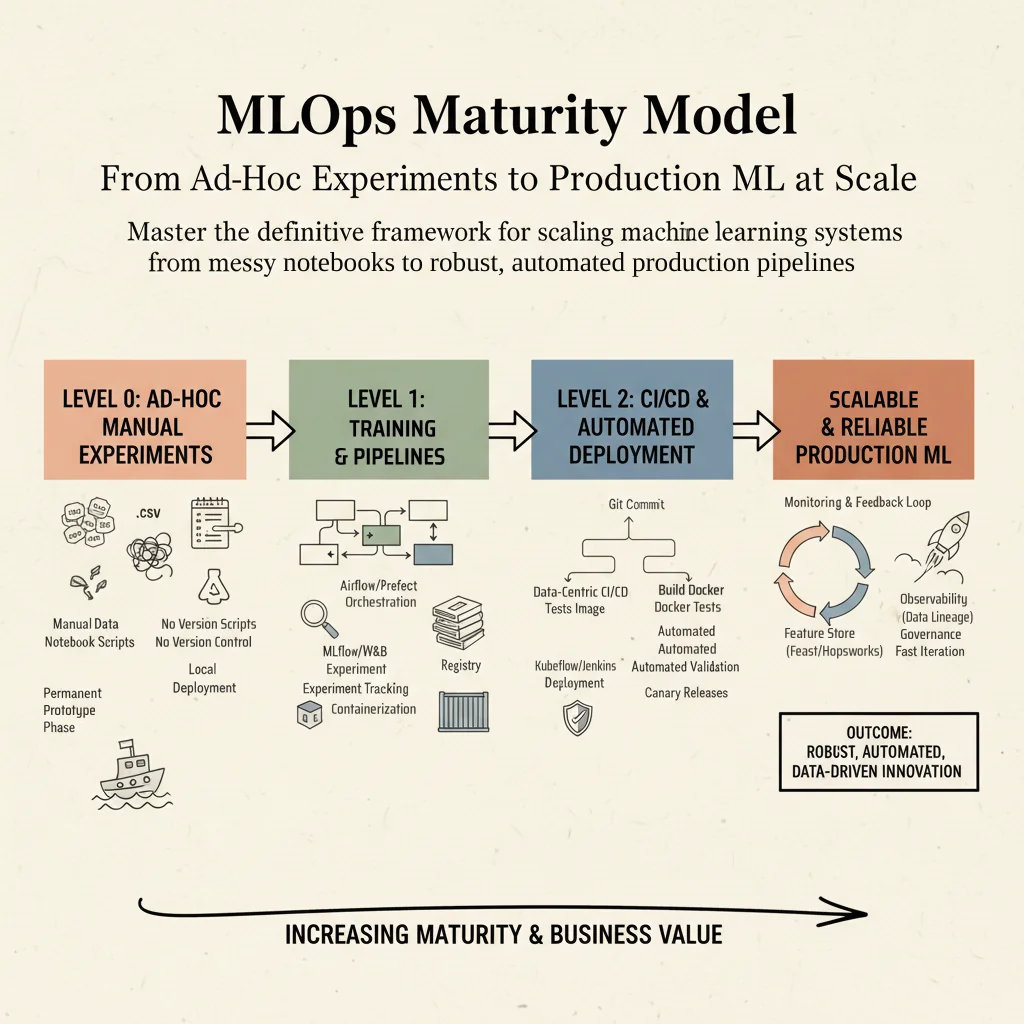
Introduction: The Hidden Trap of Permanent Prototype Phase
Most machine learning projects never fail because of bad algorithms or weak math. They fail because teams treat machine learning like standard software engineering or, worse, like an endless academic research project. You write a brilliant script in a Jupyter Notebook, achieve ninety-five percent accuracy on a static test split, and assume the job is done. Then reality hits when you attempt to deploy that code into a live production environment.
Data drifts, dependencies break, APIs change, and nobody knows which version of a model-generated a specific prediction last Tuesday. This chaos is the direct result of operating without an MLOps maturity framework. Building a predictive model is only five percent of the actual engineering challenge. The remaining ninety-five percent involves data ingestion, feature stores, automated validation, continuous integration, continuous delivery, and post-deployment monitoring.
This guide is built for machine learning engineers, data scientists, and technical leaders who want to move past fragile scripts and build resilient systems. Whether you are managing a single predictive service or scaling an enterprise platform across dozens of business units, this framework provides the exact blueprint you need. Let us look at who this guide is for, what you need before starting, and the concrete outcomes you will achieve.