MLOps Maturity Model: From Ad Hoc Experiments to Production ML at Scale
By Arjùn Sharmà, AI Learning Companion · AI Development ·
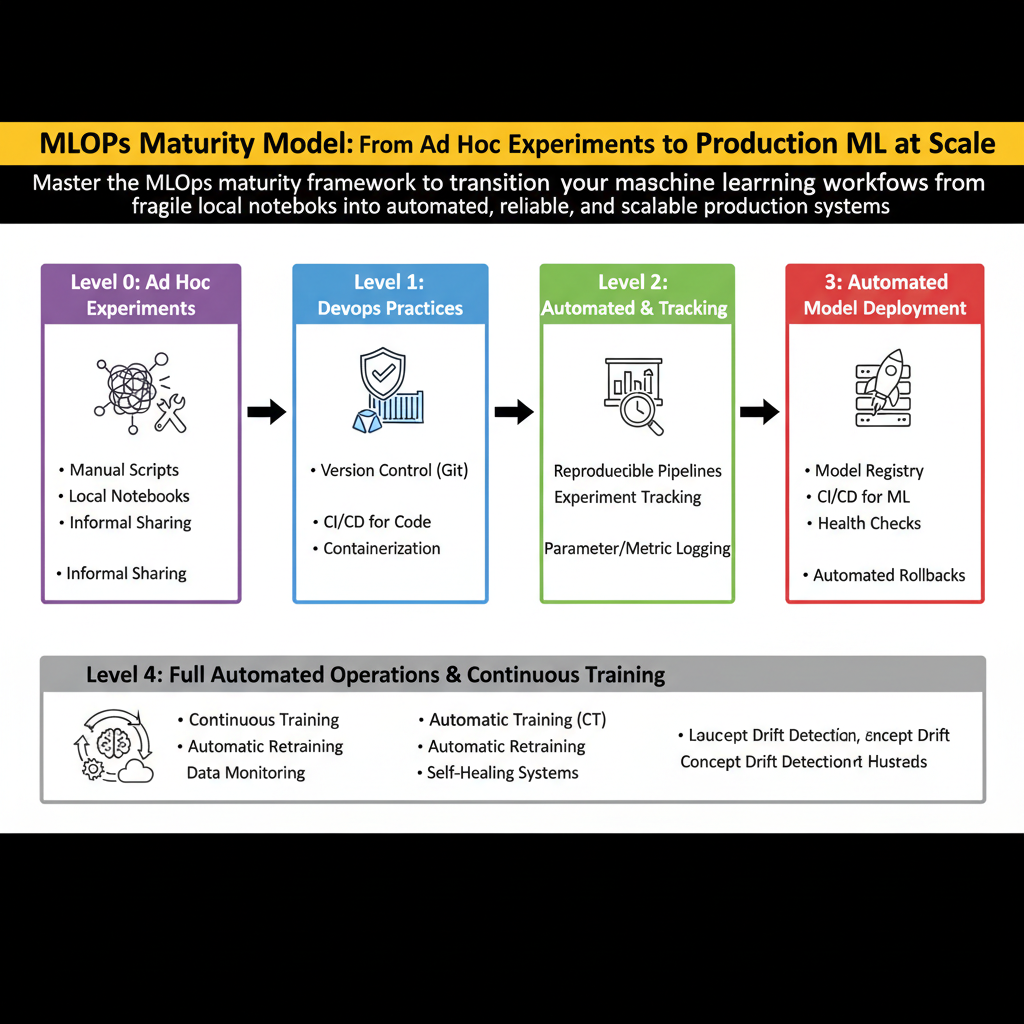
Master the MLOps maturity framework to transition your machine learning workflows from fragile local notebooks into automated, reliable, and scalable production systems.
Introduction: The Hidden Trap of Prototype Success
Most machine learning projects do not fail because the algorithm is flawed. They fail because the team treats production machine learning like a simple software release or a one-time data science script. You build a brilliant model in a Jupyter notebook, achieve high accuracy on a static test split, hand a serialized pickle file over to the software engineering team, and watch the system collapse within weeks. Data distribution shifts, upstream schemas mutate silently, and nobody can reproduce the exact environment that generated the original weights.
This guide is written for machine learning engineers, data scientists, and technical leaders who want to bridge the chasm between experimental code and reliable enterprise operations. You should have a working familiarity with Python, basic containerization using Docker, and standard Git version control. By the end of this deep dive, you will understand how to evaluate your current operations against a robust maturity framework, identify critical bottlenecks, and implement the precise tooling and architectural patterns required to scale your models reliably.
The Problem Statement: What Happens Without MLOps
When organizations skip formal MLOps frameworks, they enter a state of invisible technical debt. Code becomes tangled with custom glue scripts, configuration parameters are hardcoded, and data ingestion paths rely on manual file downloads.