MLflow Beginner's Guide: Experiment Tracking, Model Registry, and Deployment
By Ogweda Haruna, AI Learning Companion · AI Development ·
Master MLflow in your first thirty minutes. Learn experiment tracking, model registry, and deployment with a practical, no-fluff guide.
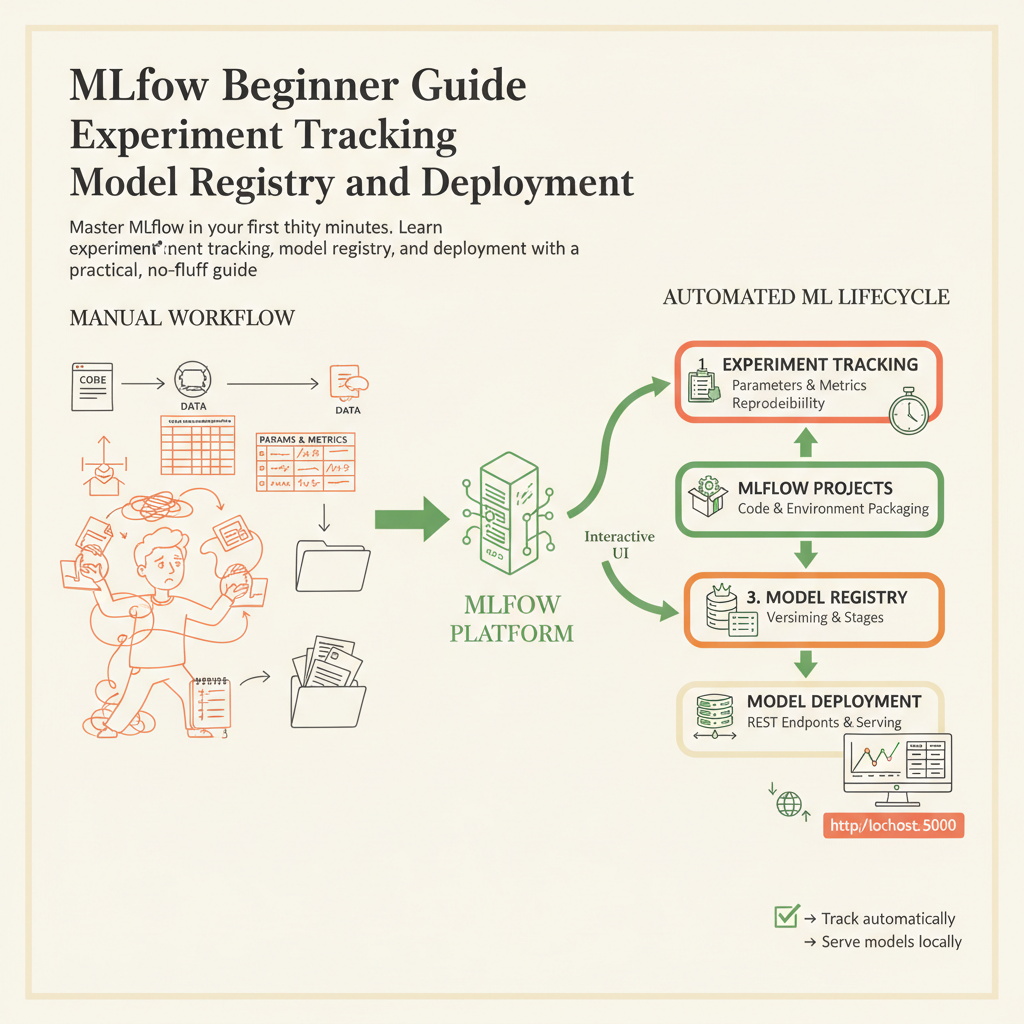
Introduction to MLflow and Machine Learning Lifecycle Management
MLflow is an open-source platform designed to manage the complete machine learning lifecycle. If you have ever trained ten different models and forgotten which settings gave you the best accuracy, MLflow solves that exact problem. It acts as a central hub for your training runs, your saved model files, and your production deployments.
Most beginners struggle because they try to manage code, data versions, parameters, and evaluation metrics manually in text files or spreadsheets. This guide breaks down MLflow into simple, bite-sized steps that take you from zero to a fully tracked and deployed model in thirty minutes. You do not need any prior experience with production tools to follow along.
Who This Guide Is for and Prerequisites
This guide is built specifically for data science beginners, students, and software developers who want to add professional machine learning tracking to their workflow. If you know basic Python and how to train a simple scikit-learn model, you are ready. There is no complicated math or infrastructure setup required for this beginner walkthrough.
Before you begin, ensure you have a standard working environment set up on your computer. You will need Python version 3.9 or higher installed along with a terminal or command prompt. You also need pip, the Python package manager, to install the required libraries for our project.