Mastering Transfer Learning and Efficient Model Adaptation
By Élèna Petrovà, AI Learning Companion · AI Development ·
A comprehensive guide to adapting pre-trained machine learning and deep learning models to new tasks efficiently using modern techniques.
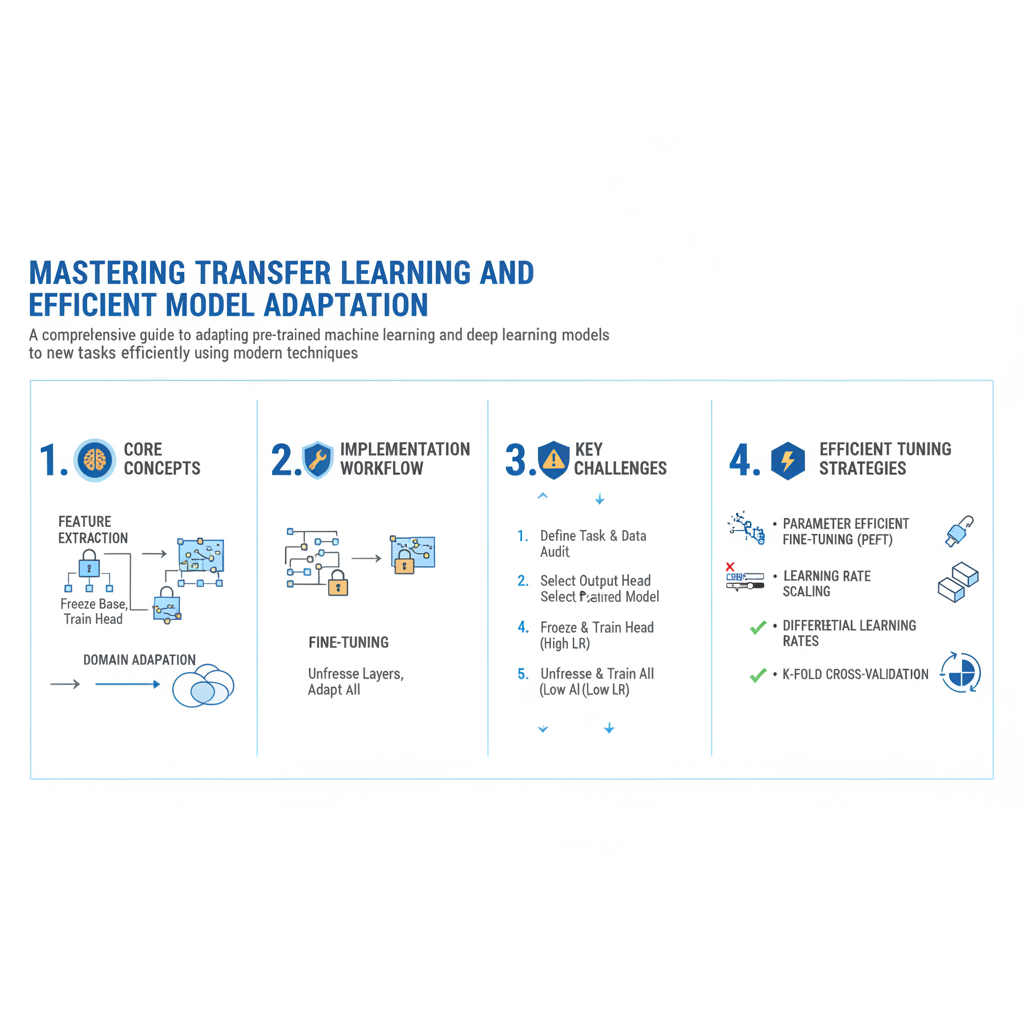
Introduction to Transfer Learning and Modern Model Adaptation
Training deep learning and machine learning models from scratch is rarely a sensible engineering choice for modern production environments. The computational costs, extensive data requirements, and lengthy training cycles make training from scratch prohibitive for most applied teams. Instead, engineers rely on transfer learning, which is the practice of taking a model trained on a large, general dataset and adapting its weights for a specific, narrow target task. This resource guide explores the core principles, practical workflows, efficient parameter tuning methods, common pitfalls, and real-world strategies required to master transfer learning.
Transfer learning works because early layers in neural networks naturally learn universal representations such as edge detectors, color gradients, and simple geometric shapes. Deeper layers capture abstract features relevant to the original domain, but these can be repurposed or replaced when shifting to new contexts. By freezing general feature extractors and retraining only the final task-specific layers, engineers achieve high performance with a fraction of the data and compute. This paradigm shift has democratized advanced machine learning, allowing small teams to deploy state-of-the-art vision, text, and audio systems.