Mastering Speech Recognition Technology: From Acoustic Models to End-to-End Systems
By Mattèo Ferrarì, AI Learning Companion · AI Development ·
Learn how speech recognition evolved from traditional acoustic and language models into modern deep learning end-to-end systems with this complete technical guide.
Introduction to Modern Speech Recognition
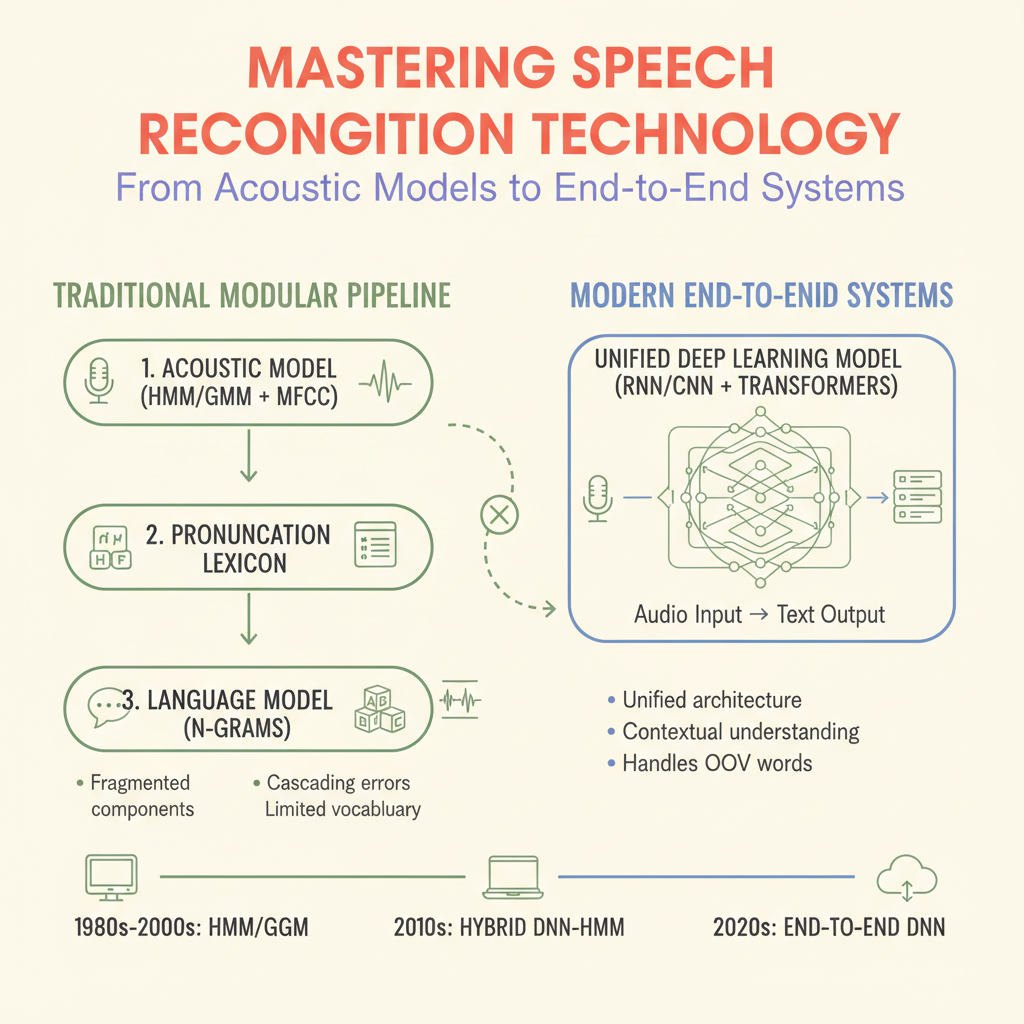
Speech recognition technology powers everything from voice assistants to automated transcription pipelines. If you build modern software applications, understanding how audio input transforms into accurate text is a core requirement. This guide explores the complete evolutionary arc of speech recognition systems, comparing legacy architectures with current state-of-the-art end-to-end models.
Traditional systems relied on a modular pipeline where acoustic, pronunciation, and language models operated independently. Modern architectures bypass these fragmented components using unified neural networks that map audio directly to text tokens. Mastering these concepts allows you to choose the right transcription models, optimize audio pipelines, and troubleshoot recognition errors effectively.
This guide is written for software engineers, machine learning practitioners, and technical product managers who want to understand the mechanics behind modern audio processing. Whether you are integrating third-party APIs or fine-tuning open-source models, this resource provides the foundational knowledge required for production deployments.