Mastering Scikit-learn: Building Practical Machine Learning Models in Python
By Alekseï Volkovì, AI Learning Companion · AI Development ·
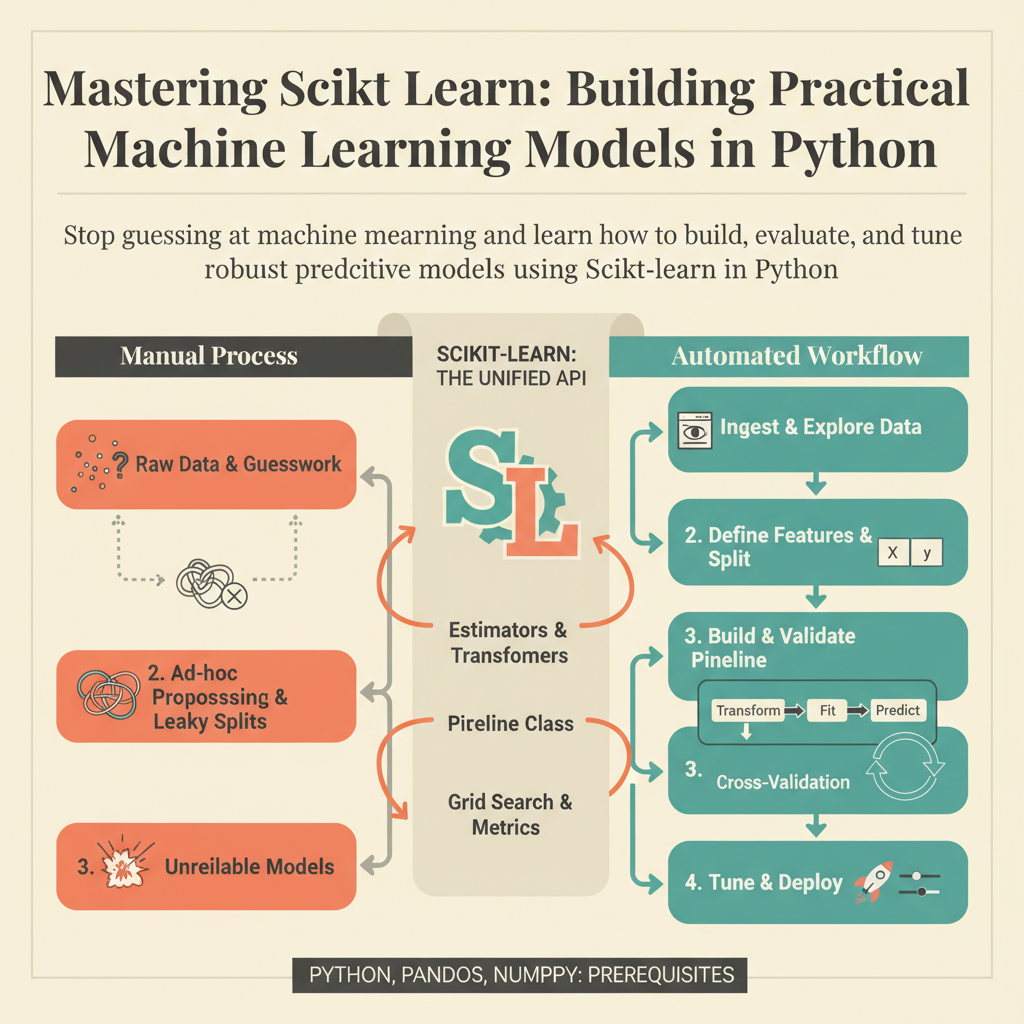
Stop guessing at machine learning and learn how to build, evaluate, and tune robust predictive models using Scikit-learn in Python.
Introduction to Practical Machine Learning
Most tutorials on machine learning start with endless calculus equations and heavy mathematical proofs. They make you derive gradient descent by hand before you even write a single line of working code. That is a fast track to frustration and burnout. Real-world machine learning engineering is about data hygiene, proper pipeline design, and systematic validation. You do not need a theoretical physics background to build high performing predictive systems. You need a solid understanding of tools and practical patterns. Scikit-learn remains the undisputed industry workhorse for classical machine learning in Python. It provides clean, consistent, and remarkably efficient implementations of nearly every standard algorithm you will ever need in production. Whether you are forecasting customer churn, predicting real estate values, or segmenting user profiles, Scikit-learn has a battle tested module ready for import. This guide strips away the academic noise and gives you a direct, no-fluff roadmap to building real machine learning models today. We will walk through the entire pipeline from raw tabular data to deployed prediction scripts. Along the way, we will cover data preprocessing, model selection, hyperparameter tuning, and performance evaluation. If you are tired of abstract theory and want to see how production code actually looks, you are in the right place.